














1. Flashy Digital Dashboards Might Just Be an "Expensive Illusion"
In many manufacturing enterprises, you will likely encounter this scene: the end of the production line is fully equipped with inspection devices. Dimensions are automatically collected, data is uploaded in real-time, large screens constantly refresh, and reports are generated with a single click. The system interface is highly modern, the trend lines are smooth, and KPIs are clear at a glance. Management stands before these screens, feeling as if everything is perfectly under control.
However, if there is no underlying logic of Statistical Process Control (SPC) supporting these systems, it might just be an expensive illusion.
Inspection, by its very nature, is the examination of a product after it has been manufactured. When the system flags an item as "non-conforming," the raw materials have already been consumed, the labor has been expended, the equipment time has been occupied, and delivery schedules may have already been disrupted. Digitalization here merely allows you to confirm—faster and more clearly—that a loss has already occurred. It accelerates the speed of feedback but does absolutely nothing to change the mechanisms that generate risk.
If an inspection system ultimately answers only one question—"pass or fail"—its core function remains merely screening. No matter how rigorous the screening is, it only controls the outcome. It cannot control the risk formation process.
Without process quality management, collecting quality data is simply a waste of server space.
2. Process Quality Management: Eliminating Risks Before Losses Materialize
What truly determines profitability is never how many defective products you manage to sort out, but rather your ability to realize a process is shifting the very moment a trend begins to emerge.
This is exactly the core value of Statistical Process Control (SPC).
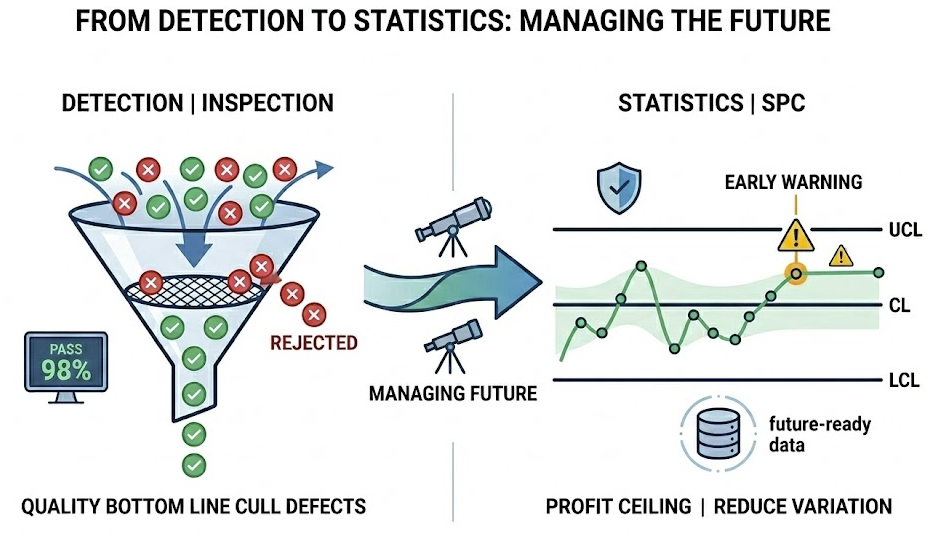
SPC does not merely focus on whether a single data point falls out of bounds; it pays far more attention to whether the structure of variation has changed, focusing heavily on trends. It distinguishes between "common cause variation" and "special cause variation," identifying patterns such as trends, shifts, cycles, and stratification. When a process is technically still within specification limits but a systemic drift has already begun, a control chart will trigger an alert long before a non-conforming product is ever produced. This early warning capability is something mere end-of-line inspection can never provide.
Under this logic, intervention happens during the risk formation stage, not after the loss has materialized. Risks are eliminated in the bud, rather than tallied up later in the scrap area.
Many enterprises invest heavily in building digital inspection systems while ignoring a fundamental truth: data itself does not create value. Only data embedded with statistical logic can be transformed into decision-making power.
Digitalization without SPC is like watching a high-definition video replay of a car crash. You can clearly see the entire process of the accident, but you still failed to prevent it. A system embedded with statistical control logic, on the other hand, acts as an early warning radar—alerting you to change course before an anomaly turns into a disaster.
3. Early Warning Radar: Statistics as a Tool for Managing the Future
The latest AIAG-VDA SPC guidelines (for example, the harmonized SPC methodology released jointly by AIAG and VDA) are not just about adding a few new formulas or rules. They strongly emphasize aligning statistical methods with the actual state of the process, deeply understanding process stability, and insisting that process capability analysis must be built upon a foundation of statistical control.
Statistics should not be a post-event evaluation tool; it is a process management tool.
When inspection data is merely recorded, it serves the past. When that same data is integrated into control chart analysis, it begins to influence the future.
Inspection guarantees product quality; statistical control governs enterprise risk. Inspection tells you what happened; statistics determine what will happen next.
4. The Bottom Line and the Ceiling: From "Quality Screening" to "Risk Governance"
From a management perspective, this represents a transformation from "quality screening" to "risk governance." The core of the former is eliminating defects; the core of the latter is reducing variation. The former focuses on pass rates; the latter focuses on process capability. The former patches things up at the result level; the latter optimizes at the mechanism level.
In an environment characterized by thinning profit margins, increasingly tight delivery schedules, and lower customer tolerance, simply possessing rapid inspection capabilities is far from enough. What enterprises truly need is to embed statistics directly into their digital systems, turning every single data collection event into a real-time risk assessment.
If digitalization only serves to make reports look prettier, it is undeniably expensive. But if it carries statistical logic, it becomes a powerful tool for managing the future.
Perhaps we can understand this from a different angle:
Inspection is the bottom line of quality; statistics are the ceiling of profit.
Only when data is upgraded from "recording history" to "managing the future" does digitalization truly begin to create value.