














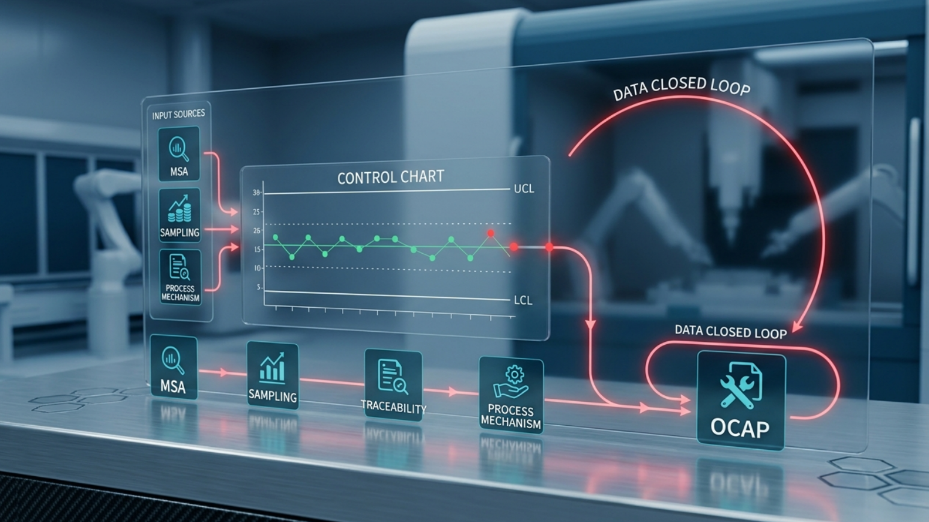
Many enterprises treat SPC merely as an outdated charting tool to survive audits. In reality, SPC is the earliest and most profound data science practice in the industrial sector. In the Industry 4.0 era, truly successful SPC implementations are those that integrate high-precision measurement, structured data traceability, and the OCAP (Out-of-Control Action Plan) closed loop—creating a "sensing-decision" operating system on the shop floor that merges underlying hardware protocols (like MQTT, OPC-UA), statistical analysis engines, and artificial intelligence.
Whether in precision automotive parts machining or nanoscale semiconductor cleanrooms, we frequently hear a similar sentiment recently: "With everyone talking about large models, AI, big data, and the Industrial Internet, isn't statistical process control outdated? Isn't SPC just about drawing control charts and calculating capability indices?"
This perception is highly superficial. If a company can fully integrate SPC into its core quality operations, its quality management level is absolutely world-class. Because in modern manufacturing, no enterprise can claim success in quality management without first mastering and respecting statistical process control.
The Exceptionally High-Threshold "Factory Lifeline"
The threshold for implementing a successful SPC system is extremely high. There are countless free and paid tools on the market capable of generating control charts, but making SPC truly operational requires a rigorously strict set of supporting systems and processes.
To implement genuine process control on the shop floor, five critical processes are essential:
- Reliable Measurement Systems: Your instruments must pass rigorous
MSA(Measurement System Analysis) to guarantee measurement accuracy and prevent process misjudgments caused by measurement system errors. - Scientific Sampling Plans: You must understand how to obtain representative subgroups to avoid falling into statistical "overfitting" or "representativeness bias."
- Complete Data Traceability: In a modern digital factory, the moment data is generated, technical means like APIs must be deployed to ensure traceability. Measurement data must be permanently bound to structured metadata such as equipment IDs, personnel, molds, and batches.
- Deep Understanding of Process Mechanisms: You must clearly distinguish Key Process Input Variables (
KPIV) from Key Process Output Variables (KPOV). - System-Deeply-Integrated OCAP: This is the "last mile" of the quality control closed loop. When a point on the control chart turns red and triggers an alarm, if the field personnel don't know whether to check for tool wear or investigate the ambient temperature, the alarm is completely worthless. A qualified system must forcibly display standardized action guidelines tightly bound to that specific anomaly characteristic the exact instant an out-of-control rule is triggered.
These processes, in essence, constitute the lifeline of a modernized factory. Without crossing these thresholds, a factory's digital transformation is baseless. Therefore, SPC is far more than just a few charts posted on a workshop dashboard; it is the ultimate weapon for testing a factory's fundamental management standards.
The "Cognitive Model" Piercing Through the Noise
SPC is absolutely not a statistical tool that exists merely to cope with third-party audits; it is a deep "process cognitive model."
In highly complex, non-linear production environments, the data generated daily resembles a vast ocean. The true power of SPC lies in its ability to accurately extract the "signals" of abnormal variation from massive data noise. It uses mathematics to reveal exactly which variables are dictating your product quality. SPC transforms cold dimensional, torque, and temperature data into actionable basis for management decision-making.
Data Closed Loop: The Evolution Blueprint from Statistics to Industrial AI
With the digital transformation of manufacturing and the advancement of Artificial Intelligence (AI) technology, data has indisputably become the most critical production factor in manufacturing systems. If you carefully review the latest SPC manuals (such as the AIAG-VDA convergence guidelines), you will be struck by how their requirements highly align with today's Big Data and AI trends.
| Technical Dimension | Traditional SPC Perception | Digital Era SPC (Industrial AI Paradigm) | |||
|---|---|---|---|---|---|
| Data Acquisition & Format | Manual entry or Excel import, chaotic formats | Automated, real-time data flow based on standard protocols (MQTT) and JSONformats |
|||
| Statistical Analysis Engine | Relies on lagging calculations from local standalone software, only checks CPK |
Real-time stream computing, supporting leading-lagging correlation analysis and intelligent fitting of non-normal distributions | |||
| Reaction Mechanism (OCAP) | Verbal notifications after out-of-tolerance is found, arbitrary actions with no records | Anomalies trigger automated OCAPwork orders, even generating natural language root cause diagnostics via Large Language Models (LLM) |
Specifications for data formats and interface exchange protocols, underlying statistical analysis engine algorithms, and the OCAP mechanism after a process goes out of control—these elements essentially form a perfect data closed loop: Sensing and Acquisition of Data ➔ Statistical Analysis by Algorithms ➔ Decision-Making Actions at the Terminal.
Understood from this dimension, quality control in the new era is not merely an ancient management method, but rather a "practical guide" for enterprises to apply AI technology and machine learning algorithms to physical manufacturing processes within the context of digital transformation.
SPC itself is exactly the earliest, most enduring, and most profoundly influential great practice of data science in the industrial field. This is precisely why re-examining and understanding SPC in today's digital age of exploding computing power appears more urgent and important than ever before.
Abandon those isolated software tools that can only be used for drawing charts after the fact. Contact the NEXSPC team immediately to obtain a perpetual license plan for enterprise-level On-Premise deployment, giving your factory a truly world-class, data-driven SPC operating system.