














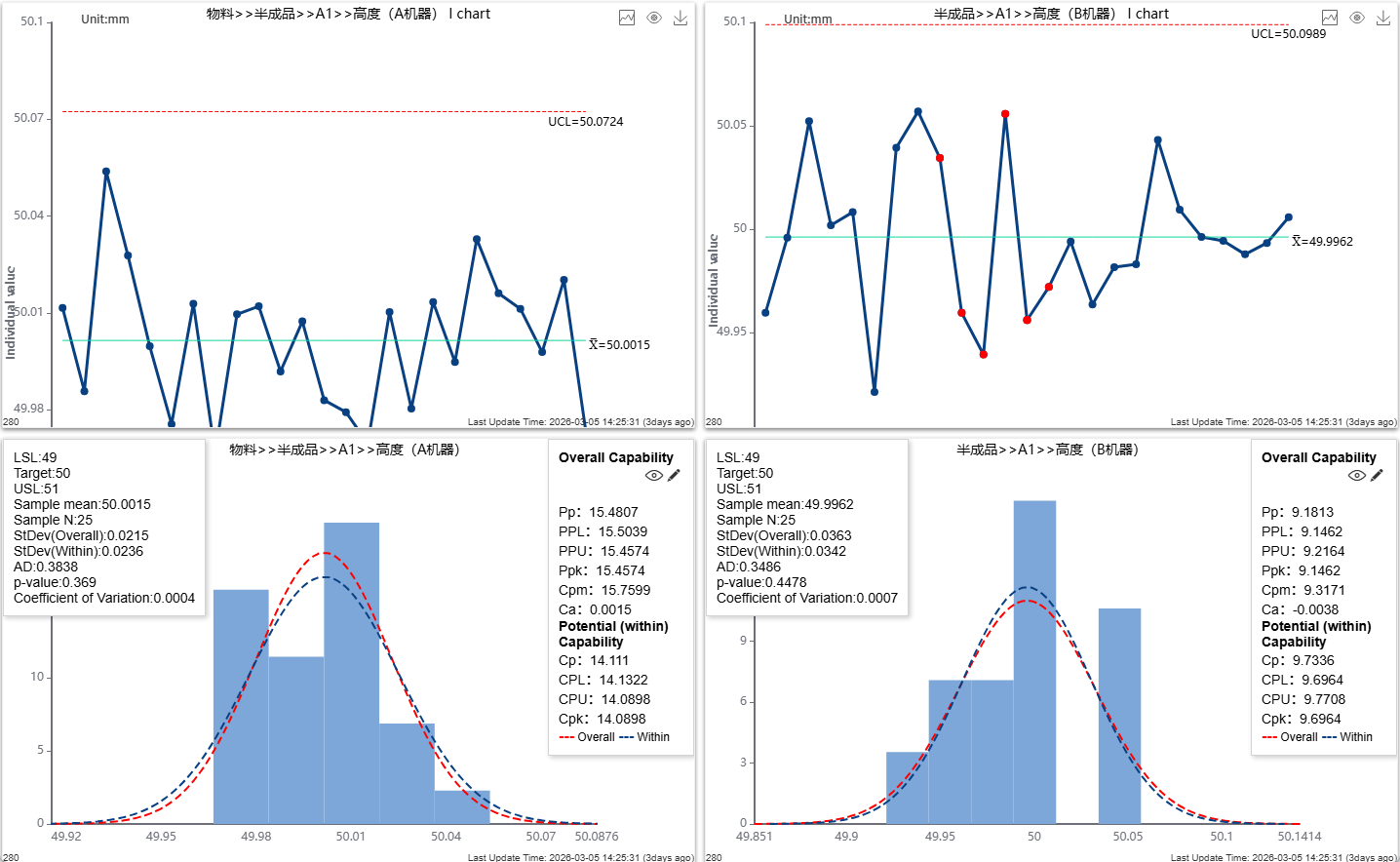
The root cause of Statistical Process Control (SPC) implementation failures in enterprises is rarely incorrect statistical methodologies; rather, it is heavily driven by underlying data structure issues. Isolated measurement values hold zero industrial value. A qualified SPC system must record part measurements, design tolerances, and manufacturing traceability information (e.g., work orders, equipment, tooling) simultaneously at the point of inspection. Only then can the SPC system achieve anomaly traceability and multidimensional analysis. Otherwise, while SPC software may render beautiful charts, statistical process control will remain entirely detached from core business operations.
The Futility of Isolated Data
Many believe that implementing SPC is merely importing CSV exports from inspection equipment or manual logs into software for calculation. In a real-world industrial environment, an isolated dimensional measurement (e.g., 12.09mm) stripped of its context has near-zero diagnostic value.
Which part batch and work order does this 12.09mm belong to? Which product characteristic in the BOM does it correspond to? Which station on which production line processed it? Which equipment and tooling were used? From which raw material supplier did it originate? Lacking this traceability metadata, SPC analysis is rendered entirely incapable of performing Root Cause Analysis (RCA) when confronted with abnormal variations.
Structured Convergence: Unifying Design, Inspection, and Manufacturing
Advanced digital quality systems enforce the creation of a structured relational model the exact moment data is generated. An engineering-meaningful quality data record must bind the following three layers of information at the database transaction level:
- Physical Inspection Layer: Records high-precision actual measurement values, inspector IDs, and precise timestamps.
- Design Standard Layer: Must associate at least the Upper/Lower Specification Limits (USL/LSL) and Target Value of the characteristic.
- Manufacturing Traceability Layer: Binds work order numbers, batch numbers, equipment IDs, and mold cavity numbers from the MES or ERP.
The encapsulation of this multidimensional data model is the absolute prerequisite for executing control chart out-of-control rules and calculating Cpk/Ppk indices.
Data Entry is Just the Beginning
Whether data is acquired via Excel imports, API synchronization, or manual input, the exact same traceable, structured data baseline must be maintained.
How to Leverage Structured Data for SPC Analysis (An Example)
If the structured data for a specific inspection item includes the equipment ID, we can differentiate control charts and Cpk/Ppk indices for the same product and inspection item produced by different machines. Assuming production costs and efficiencies are comparable across equipment, management can:
- Align with company strategy by routing VIP customer orders to the equipment demonstrating a higher Cpk.
- Investigate the two machines to identify the root cause of the Cpk discrepancy and implement targeted improvements.
To access more industry-specific examples, please contact us.
How NEXSPC Reconstructs the Underlying Data Foundation
As a highly mature, purely Web-based SPC, NEXSPC completely abandons the standalone mindset that relies on the manual splicing of traceability data at the database architecture level. Whether via manual entry, Excel import, or API synchronization, ample structured fields are reserved to log the attribute metadata of every measurement value (e.g., batch number, shift, station, operator, equipment, tooling, material supplier). All of these fields are fully customizable.
| Architectural Dimension | Traditional Standalone / Node-Licensed SPC Software | NEXSPC (Pure B/S Architecture) | |||
|---|---|---|---|---|---|
| Data Structure & Acquisition | Highly dependent on manual entry; relies on post-process Excel splicing for traceability. | Built-in engines utilize MQTT, OPC-UA, and APIs to map and fuse equipment data streams with business context in real-time. | |||
| Automation & Analysis Engine | Static post-calculation; control charts require manual refreshing. | Based on structured data, enables lead-lag correlation analysis, multi-dimensional capability comparisons, and AI natural language diagnostics. | |||
| Deployment & Total Cost of Ownership (TCO) | High hidden subscription fees; continuous charging based on user accounts or inspection points. | Enterprise on-premises private deployment; one-time perpetual license with unlimited users and points. | |||
| Transnational Factory Collaboration | Single-language local clients; severe difficulties in cross-border data interoperability. | Pure Web architecture supporting seamless, real-time UI switching among English, Chinese, Spanish, Vietnamese, Thai, etc. |
No Structure, No Automated Analysis
Today's quality statistical programs have evolved to become incredibly complex. Without standardized data structures acting as a backbone, how would the system know which historical data subsets to feed into Large Language Models (LLMs) for deep, natural language quality diagnostics?
Whether automatically generating multi-level control charts, executing real-time process capability analysis, or utilizing algorithms to identify micro-level process shift patterns, everything relies entirely on clear characteristic mapping and traceability anchors within the underlying data model. The starting point of SPC is never statistical formulas—it is a rock-solid data structure foundation.
Abandon legacy, subscription-based SPC systems that drain budgets, incur exorbitant costs, and inevitably create data silos. Contact the NEXSPC team today to request a quote for a perpetual on-premises license or to schedule a live demonstration, and equip your quality data foundation with true Industry 4.0 bearing capacity.