














Quality management has a dirty little secret. Step onto the floor of an otherwise cutting-edge manufacturing facility—one boasting multi-million-dollar CNC setups and lightning-fast SMT lines—and you will likely spot an operator standing next to a machine, holding a clipboard, and scribbling down caliper measurements.
It makes absolutely no sense. We expect Industry 4.0 efficiency from our equipment, yet we accept 1980s-era manual data entry for our most critical quality metrics. This disconnect is exactly why modern engineering teams are aggressively migrating to Web-based SPC software that treats data connectivity not as an afterthought, but as its core foundation.
If your organization is still relying on human hands to type numbers into a spreadsheet or a legacy quality module, you aren't actually practicing process control; you are simply documenting your scrap. Today, we are going to dive deep into the mechanics of Automated SPC data collection, exploring exactly how protocols like MQTT, TCP, and HTTP/JSON APIs are eliminating the clipboard, eradicating human error, and feeding real-time statistical engines like NEXSPC 4.0.
The Financial Bleed of Manual Data Entry
Before we get into the technical weeds of networking protocols, let's talk about why Plant Managers and IT Directors lose sleep over manual data collection.
First, there is the raw cost of human error. "Fat-fingering" a decimal point on a critical aerospace component measurement doesn't just skew your CPK calculations; it can trigger massive false alarms that shut down production lines, or worse, allow non-conforming parts to ship.
Second, manual entry guarantees an unacceptable time lag. When an operator measures a part, writes it down, and a quality tech types it into a desktop system hours later, the analysis is purely a post-mortem. By the time you realize your process mean has drifted out of specification, you've already produced a mountain of scrap.
Finally, auditors hate it. ISO 9001 and IATF 16949 audits heavily scrutinize data integrity. Paper records and manual transcriptions are prime targets for traceability findings.
To achieve true variance reduction and bulletproof compliance, you need to cut the human out of the data transport layer.
The IoT Data Engine: How NEXSPC 4.0 Connects the Shop Floor
The transition from manual entry to an automated data pipeline sounds intimidating, but it essentially comes down to speaking the right digital languages. NEXSPC 4.0 was engineered with a pure Web-based (B/S) architecture that natively understands the varied dialects of modern manufacturing equipment.
Let’s break down the three most powerful methods for pulling live data from your machines directly into your control charts.
1. MQTT: The Lightweight Lifeline for High-Frequency Data
If you have modern PLCs (Programmable Logic Controllers) or environmental sensors monitoring your line, you need a protocol that can handle high-frequency data without choking your factory's network.
This is where MQTT (Message Queuing Telemetry Transport) shines. It operates on a highly efficient "publish/subscribe" model. Instead of your SPC software constantly asking a sensor, "Do you have new data now? How about now?", the sensor simply publishes data to a central broker whenever a measurement occurs.
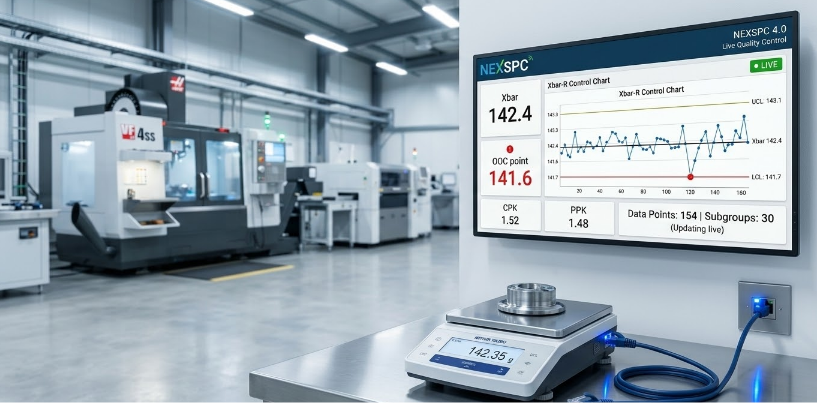
NEXSPC 4.0 acts as a subscriber to these specific data topics. When a CNC machine finishes a cycle and publishes a dimensional value, MQTT data capture instantly routes that value into the NEXSPC engine. The result? Your Xbar-R charts update dynamically on the shop floor dashboard. No page refresh required. It’s incredibly lightweight, making it perfect for environments where network bandwidth is limited or connections drop intermittently.
2. TCP Server Integration: Listening Directly to Your Instruments
Not all data comes from massive PLCs. Often, the most critical quality data comes from standalone precision instruments—like digital calipers, micrometers, and high-precision scales.
Let's look at a very specific, real-world scenario we encounter frequently: automated weighing. Imagine a manufacturing line where products pass over a Mettler Toledo weighing scale to ensure fill volumes are exact.
Historically, an operator would watch the digital display and type the weight into a terminal. With NEXSPC 4.0, we deploy a direct TCP Server integration. The Mettler scale is configured as a TCP Client. Every time a product stabilizes on the scale, the scale fires a data string over the network via a standard TCP/IP port.
NEXSPC 4.0's built-in TCP Server sits quietly, listening on that exact port. When the data packet arrives, the software parses the string, extracts the precise weight value, assigns it the correct timestamp, and drops it straight into the process capability calculator.
If that weight violates one of the 11 built-in smart rule groups (such as a sudden shift or an out-of-control point), the system immediately triggers an alert via email or enterprise messaging apps. The process is entirely touchless, instantaneous, and mathematically flawless.
3. REST APIs & JSON: Bridging the Gap to ERP and SAP
Capturing a measurement is only half the battle. A dimension of "12.05 mm" is useless if you don't know which batch, work order, or operator it belongs to. Quality data requires deep operational context.
This context lives in your enterprise systems—typically an ERP like SAP, or a Manufacturing Execution System (MES). NEXSPC 4.0 utilizes modern HTTP interfaces and REST APIs for manufacturing to actively pull this contextual data.
Using highly readable and fast-to-parse JSON payloads, NEXSPC can query your ERP the moment a work order begins. It pulls down the target specifications, upper and lower tolerance limits (USL/LSL), and the specific part routing. When the automated measurement data flows in via MQTT or TCP, NEXSPC merges it seamlessly with the ERP data.
This bidirectional communication ensures that your statistical analysis is always grounded in the absolute latest engineering revisions and production schedules.
The Invisible Risk of Automation: Software Licensing
Here is a critical warning for any IT Director planning an IoT data integration project: Automated data collection will destroy your budget if you are using legacy SPC software.
Why? Because traditional quality vendors use restrictive, subscription-based business models. They charge you a hefty annual fee per user seat, or worse, they charge you based on the number of "tags" or inspection points you monitor.
When you rely on manual entry, you might only record 50 data points a shift. But once you connect an automated Mettler scale via TCP or a high-speed sensor via MQTT, you might be capturing 5,000 data points an hour across hundreds of tags. If your software vendor charges by the data point, your subscription costs will skyrocket overnight.
This is where NEXSPC 4.0 completely disrupts the market, acting as the ultimate Minitab alternative. We operate on a 100% Perpetual Server License. It is a one-time fee. There are absolutely zero hidden subscription costs.
Because the license is tied to the server, we grant you unlimited users, unlimited inspection tags, and unlimited dashboards. You can automate data collection across your entire facility, scaling up to millions of data points, without ever paying us another dime for software access. We built a pricing model that actually encourages you to capture more data, rather than penalizing you for it.
Beyond the Connection: Turning Data into Action
Getting the data into the system automatically is a massive win, but it’s just the starting line. What does NEXSPC do with that data once it arrives?
- Continuous Validation: Before you can trust the data streaming from that automated scale, you must trust the scale itself. You can seamlessly run your automated data through our built-in MSA (Measurement System Analysis) module to conduct Gage R&R and ensure your measurement system isn't introducing its own variance.
- AI-Powered Insights: Once the data is verified and plotted, NEXSPC applies Lead-Lag Correlation analysis and integrates with cutting-edge LLM AI. Instead of just showing you a chart that says your process is failing, the AI analyzes the historical data patterns and provides plain-language insights into potential root causes.
- Uncompromising Data Security: Because this automated data pipeline is the lifeblood of your production, it must be protected. NEXSPC 4.0 is designed for 100% secure On-Premise deployment. Your proprietary production data stays behind your corporate firewall, ensuring total data sovereignty.
- Cross-Border Collaboration: Modern supply chains are global. When a TCP-connected sensor in a Mexican facility triggers a process alert, the local operator needs to see that warning instantly in Spanish. Meanwhile, the Quality Director in Chicago needs to review the CPK drop in English, and the partner facility in Southeast Asia needs the capability reports in Vietnamese or Thai. NEXSPC’s real-time UI language switching makes this multinational coordination effortless, tearing down language barriers in quality management.
Stop Typing. Start Analyzing.
The era of the clipboard is over. The technology to capture precise, real-time data directly from your equipment is no longer science fiction—it is readily available, standardized through MQTT, TCP, and REST APIs, and surprisingly easy to implement.
However, executing this digital transformation requires a software platform built to handle the volume, speed, and security demands of the modern shop floor, without trapping you in an endless cycle of SaaS subscription fees.
You need a system that marries advanced statistical rigor with unrestricted, automated connectivity.
Are you ready to abandon expensive, subscription-based legacy tools and experience true quality democratization? Stop paying per user. Stop paying per tag. Start capturing the data your machines are already generating.
Contact the NEXSPC team today for a free live demo or to request your customized perpetual license quote. Let's get your shop floor connected.