














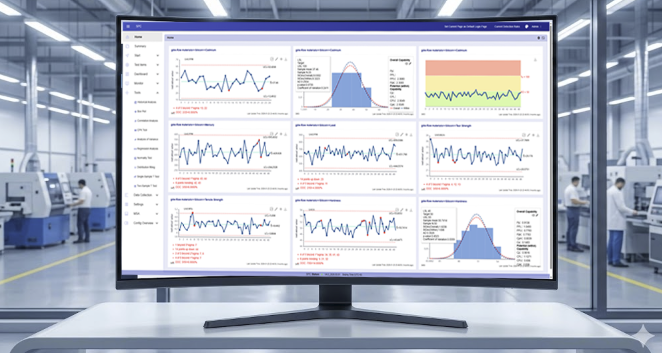
The manufacturing landscape is undergoing a massive transformation, driven by the relentless pursuit of zero-defect production and the realities of globalized supply chains. As we navigate through 2026, the traditional methods of tracking process variation and quality metrics are no longer sufficient. To truly achieve proactive quality control, organizations must move away from isolated, desktop-bound tools and embrace modern, connected ecosystems. If you are looking to future-proof your quality infrastructure, investing in an enterprise-grade Web-based SPC software is the single most critical decision your IT and Quality Management teams will make this year.
For decades, plants have relied on legacy Client/Server (C/S) architectures or standalone desktop applications to manage Statistical Process Control (SPC). While these tools paved the way for modern quality methodologies, their inherent architectural limitations have become major bottlenecks in the era of Industry 4.0. In this ultimate guide, we will explore why the industry is shifting toward pure Browser/Server (B/S) architectures, how this paradigm shift eliminates data silos, and why next-generation platforms like NEXSPC 4.0 are redefining what is possible on the shop floor.
The Pain Points of Legacy C/S Architecture in Manufacturing
Before understanding the power of a pure Web-based SPC system, we must first address the systemic pain points that legacy desktop software and C/S architectures inflict on modern manufacturing environments.
Pain Point 1: The IT Maintenance and Deployment Nightmare In a traditional C/S setup, the SPC software client must be manually installed, configured, and updated on every individual PC across the shop floor. If your facility has 50 inspection stations, that means 50 individual installations. When a new software patch or statistical rule update is released, the IT department faces a logistical nightmare, leading to version inconsistencies, downtime, and exorbitant IT labor costs.
Pain Point 2: Latency and the "Refresh to See" Limitation Legacy systems suffer from critical data latency. When an operator inputs measurement data, the system often requires manual refreshing, or worse, batch processing at the end of a shift, to render the control charts. By the time a Quality Engineer sees an Out-of-Spec (OOS) trend, the line has already produced hundreds of defective parts, resulting in massive scrap costs and rework.
Pain Point 3: The Subscription Trap and "Per-Seat" Licensing The philosophy of Total Quality Management (TQM) dictates that everyone—from frontline operators to the Plant Manager—should participate in quality monitoring. However, legacy software vendors typically charge expensive annual subscription fees based on the number of installed clients, user accounts, or inspection points. This forces companies to artificially limit who gets access to the software, directly contradicting the goals of a TQM culture.
The Solution: Pure B/S Architecture and the Power of the Browser
The ultimate solution to these systemic bottlenecks is a transition to a pure Browser/Server (B/S) architecture. Next-generation platforms like NEXSPC 4.0 completely eliminate the need for client installations.
Zero-Client Deployment With a pure Web-based architecture, the entire SPC system is accessed via a standard web browser (like Chrome or Edge). Whether an operator is using a PC, a tablet, or a massive TV dashboard on the shop floor, they simply navigate to a URL. Deployment takes a single day. You can configure the system in the morning on your central server, and by the afternoon, operators across the entire plant are inputting data and viewing live charts.
Instant Data Rendering Without Refreshing The most transformative aspect of a true Web-based SPC software is real-time synchronization. Driven by advanced web technologies, data entry results in instant rendering. The moment a measurement is recorded—either manually or automatically—the control charts (such as I-MR or Xbar-R) update dynamically on screen. There is no need to hit "refresh." The quality dashboard auto-redraws according to production fluctuations, ensuring that managerial decisions are perfectly synchronized with the reality of the shop floor.
Essential Capabilities of a Next-Gen Web-Based SPC System
When evaluating an Enterprise SPC software in 2026, a web-based interface is just the foundation. The platform must offer a comprehensive suite of tools that bridge the gap between IT infrastructure and rigorous quality standards like IATF 16949 and FDA 21 CFR Part 11.
- Automated IoT Data Capture
Manual data entry is prone to human error and inefficiency. A cutting-edge Web SPC must seamlessly connect the physical and digital worlds. NEXSPC natively supports Automated IoT data capture through a variety of protocols. Whether you are using a TCP Server to directly listen to Mettler Toledo scales, utilizing MQTT protocols to handle millisecond-level data bursts from semiconductor wire bonders, or using REST APIs and JSON to pull production orders from your ERP/SAP system, the integration should be entirely automated. (Note: For a deeper dive into how to set up these integrations, check out our upcoming guide on Automated Data Collection in SPC).
- Smart Rule Groups to Eliminate False Alarms
One of the most common reasons SPC implementations fail is "alarm fatigue." When a system alerts too frequently on minor process variations, operators begin to ignore it. A premier Web-based SPC software solves this through Smart SPC Rules. NEXSPC, for instance, features 11 built-in professional anomaly detection rules (supporting Nelson, Western Electric, and GB standards). More importantly, it allows for 'One Project, One Rule' tiering. You can apply ultra-strict thresholds (e.g., 1 point > 3 sigma) for critical automotive safety components, while relaxing the rules for standard parts, effectively eliminating false alarms.
- Advanced Analytics: Beyond Basic Control Charts
To truly act as a powerful Minitab alternative, the software must offer a deeply technical statistical toolbox accessible right from the browser. Quality engineers need instant access to:
- Process Capability Studies: Real-time calculation of CPK, PPK, and PPM with auto-generated normal probability plots and fitting curves.
- Measurement System Analysis (MSA): Full capabilities for Gauge Linearity and Bias studies, as well as Gauge R&R (both Crossed and Nested) to guarantee data integrity before analysis even begins. (We cover this extensively in our definitive guide to MSA).
- Lead-Lag Correlation Analysis: A revolutionary feature for continuous manufacturing. The system automatically scans thousands of production variables to uncover the lagging logical relationships between upstream process parameters (e.g., mixing temperature) and downstream quality results (e.g., coating thickness).
-
LLM AI-Powered Quality Insights: By integrating Large Language Models (LLM), the software acts as a 24/7 Digital Six Sigma Black Belt, automatically analyzing chart anomalies and outputting professional root-cause hypotheses in natural language.
-
The "Tour Mode" for Factory Audits
A unique reality of manufacturing is customer audits. NEXSPC introduces an innovative "Tour Mode". When activated during an audit, the system temporarily hides out-of-control points and visual anomalies on the dashboards, allowing plant managers to confidently display their sophisticated digital quality infrastructure without exposing sensitive operational hiccups to visiting clients.
Global Connectivity: Breaking Language and Data Silos
In 2026, manufacturing is inherently global. A plant in Mexico or Southeast Asia may be producing parts for a headquarters located in the United States or Germany.
A top-tier Web-based SPC software must facilitate cross-border quality collaboration. Through the browser, NEXSPC allows users to seamlessly switch between more than a dozen languages in real-time, including English, Spanish, Vietnamese, Thai, Indonesian, and Malay. A Quality Director in the US can review a CPK report in English, while the machine operator in Monterrey inputs data into an identical interface rendered entirely in Spanish. This zero-cost communication completely shatters language barriers.
Furthermore, a true open API architecture ensures that the SPC software does not become another data silo. It must offer seamless QMS and MES integration, pushing real-time quality alerts directly to omnichannel workplace platforms like Microsoft Teams, Email, DingTalk, or WeChat Work, ensuring the right person is notified the second a process begins to drift.
Securing Data Sovereignty: The On-Premise Advantage
There is a common misconception that "Web-based" automatically means "Public Cloud." For enterprise manufacturing, sending core technical parameters, proprietary recipes, and yield data to a third-party SaaS cloud is often a non-starter due to strict IP protection policies and compliance mandates.
The ultimate Web-based SPC software provides the best of both worlds: the accessibility of a browser interface with the ironclad security of an On-premise SPC deployment.
By deploying NEXSPC 100% on your enterprise's private intranet servers, you achieve absolute physical data isolation. Your data never leaves your facility. This data sovereignty is crucial for defense contractors (AS9100), medical device manufacturers (FDA 21 CFR Part 11), and high-tech semiconductor fabs, allowing them to easily pass the most stringent information security audits while retaining total ownership of their quality data assets.
Redefining ROI: The Perpetual License Business Model
Finally, the ultimate guide to SPC in 2026 would be incomplete without addressing the business model. The industrial software market has been plagued by predatory pricing for too long. Paying annual subscription fees per user, per PC, or per inspection point actively penalizes a company for growing its digital footprint.
Next-generation platforms are disrupting this space by returning to a high-ROI, highly predictable model: the Perpetual License.
NEXSPC 4.0 is designed as a highly cost-effective Minitab alternative. We offer a one-time lifetime authorization fee. There are zero hidden subscription fees. You receive unlimited online users, unlimited inspection items, and unlimited cross-platform dashboards. As your factory expands—adding new lines, new plants, and new employees—the value of your SPC system compounds automatically, transforming your software from a recurring operating expense (OPEX) into a permanent fixed asset (CAPEX).
Conclusion: Take the Leap to Next-Gen SPC
The days of installing clunky desktop software, manually refreshing charts, and paying exorbitant annual fees for basic statistical control are over. In 2026, an elite Web-based SPC software provides real-time visibility, automated IoT data collection, AI-driven root cause analysis, and impenetrable on-premise security—all accessed through the simplicity of a web browser.
It is time to empower your Quality Managers, arm your IT Directors with maintenance-free architecture, and give your Plant Managers the predictive tools they need to slash scrap costs and achieve zero-defect manufacturing.
Are you ready to abandon expensive subscription-based legacy tools? Don't let outdated architecture hold your quality initiatives back. Contact the NEXSPC team today to request a free interactive demo or to receive a custom quote for our unlimited perpetual license. Experience the future of Quality Management, completely secure and forever yours.