














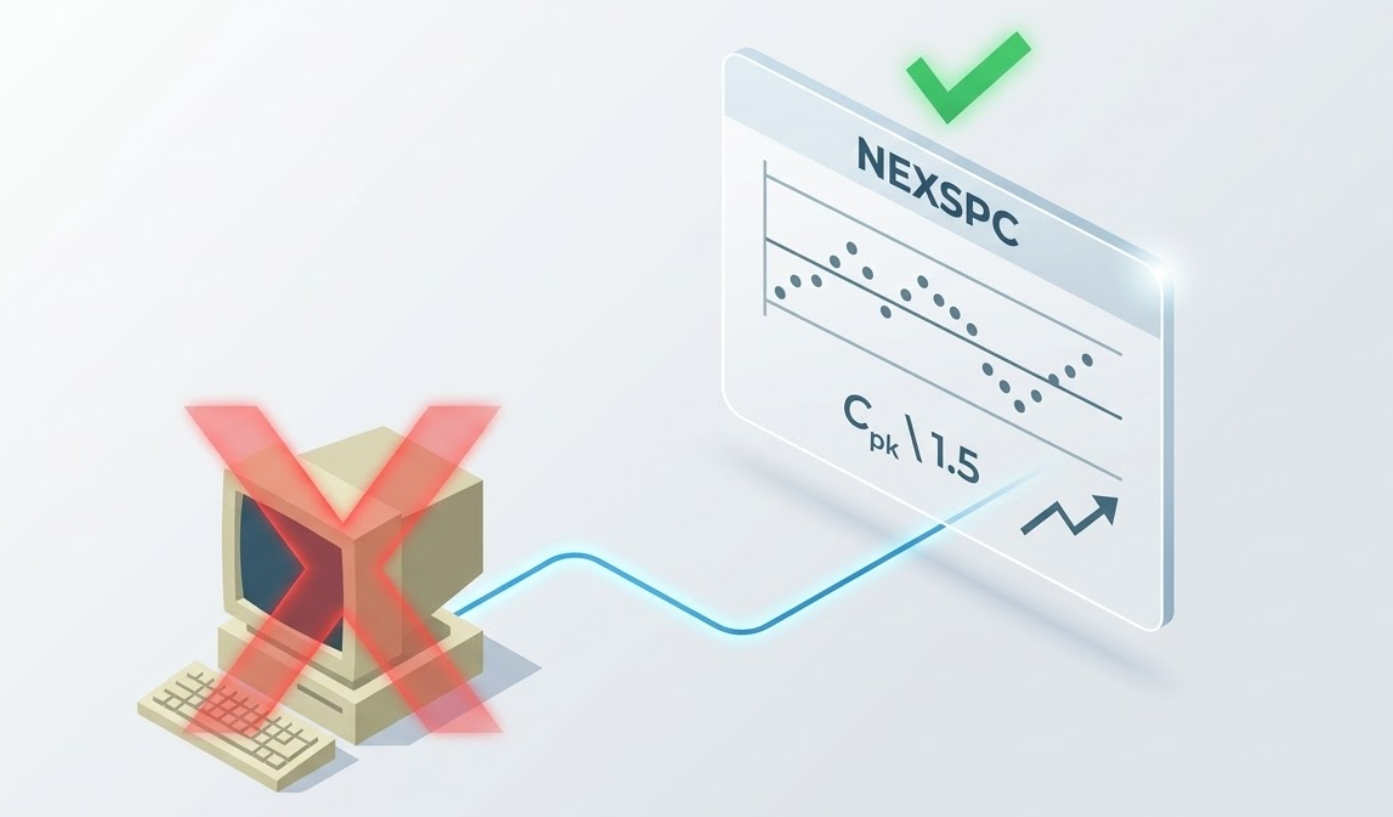
Many factory shop floors utilize expensive Mahr, Mitutoyo, or high-end semiconductor measurement equipment. These host machines often come pre-installed with dedicated "embedded" or "closed" SPC workstations.
Initially, everyone thinks that "buying equipment and getting SPC for free" is a great deal. However, when pushing for Total Quality Management (TQM), a harsh reality emerges: these closed workstations only aid their own specific machining processes. They cannot comprehensively compare similar equipment, and using different SPC software across various machines quickly leads to operational chaos.
Today, let's analyze the inherent conflict between the "vertical depth" and "horizontal breadth" of SPC workstations.
I. The Fatal Flaws of "Closed" SPC
The limitations of equipment-embedded workstations are primarily reflected in the following three critical issues:
1. Inability to Analyze Across Processes and Equipment
When you have a vision measurement machine with built-in SPC and a separate inline inspection system with its own SPC, quality engineers simply cannot see the end-to-end process capability metrics of the entire product on a single report. To create a monthly quality report, someone must walk around with a USB drive, export Excel files from two different machines, and manually perform tedious data cleaning and aggregation. This manual operation is destined to be unsustainable, turning real-time monitoring into an empty promise.
2. Inconsistent Statistical Standards
Different brands of measurement equipment often have slight variations in their built-in statistical algorithms and calculation logic (for example, sample size requirements, subgroup division handling, or even the calculation formula for the capability index Ppk). Inconsistent calculation tools easily lead to "quality misjudgments" and communication barriers between different workshops and processes.
3. Hidden Risks of Hardware Aging
Many equipment-embedded workstations still run on outdated operating systems (such as Windows XP or Windows 7). Once the host computer ages or experiences a hard drive failure, all precious historical quality data and system configurations face the risk of permanent, unrecoverable loss.
II. Depth vs. Breadth: Closed Workstations vs. Modern Centralized Web SPC
The fundamental difference between "bound" SPC workstations and modern, open Web-based quality platforms essentially boils down to a trade-off: "vertically serving a single device" versus "horizontally connecting plant-wide data."
| Comparison Dimension | Closed SPC Workstation | Centralized Web-Based SPC | |||
|---|---|---|---|---|---|
| Data Source | Single.Only serves that specific brand or model; extremely difficult to integrate other processes or manual inspection data. | Diverse.Supports manual entry,APIintegration, database synchronization, or automatic collection via IoTgateways. |
|||
| Algorithm Agility | Fixed.Algorithms are hardcoded in old software;SPCalgorithms might even differ from machine to machine. |
Dynamic Updates.A server-side upgrade globally supports the latest statistical models like Pearson and Box-Cox transformations. | |||
| Interaction Logic | Traditional client interface, sometimes reminiscent of the Windows 98era. |
Modern Web interface, operating as smoothly and intuitively as a modern OAsystem. |
|||
| Scalability | Siloed.Data exists in local proprietary formats; cross-process and cross-workshop linkage is highly difficult. | Quality Hub.Plant-wide/group-wide data is aggregated in real-time, supporting large dashboard screens and multi-dimensional complex report comparisons. | |||
| Analytical Capability | Strictly limited to analyzing the host equipment itself. | Conducts comparative SPCanalysis on products processed by similar equipment; can analyze which specific process has the greatest impact on CPK. |
III. Breaking the Deadlock
In actual factory digital transformation, we can revitalize this closed equipment and extract their true value through the following three methods:
- Silent Collection, Seamless Integration: There is no need to change the operating habits of frontline workers. We can monitor the
CSV/JSONfiles generated by local equipment to synchronize data silently and in real-time to the centralSPCserver. - Protocol Conversion, Unified Language: The varying terminologies and expressions of different
SPCsystems are mapped and unified into a single standard, achieving a truly unified quality language across the entire plant. - Layered Application, Result Transmission: Shop-floor operators can continue using the equipment's native interface to view real-time measurement results. Meanwhile, quality managers and executives sit in the office, using Web browsers to conduct deep statistical audits and drive continuous improvement based on plant-wide data.
Conclusion
The SPC that comes bundled with measurement equipment solves the problem of "whether it can be measured." A centralized Web SPC platform, on the other hand, solves the critical problems of "whether it can be managed" and "whether it can be utilized effectively."
Evolving from isolated measurement nodes to a unified "Quality Hub" is an inevitable path for manufacturing enterprises transitioning to data-driven operations. This is precisely why adopting a pure Web-based architecture like NEXSPC 4.0 is essential. By seamlessly connecting these isolated data islands and providing an enterprise-grade statistical engine—with 100% on-premise security and a highly cost-effective perpetual license model—NEXSPC transforms fragmented inspection data into a cohesive, intelligent quality defense line.