













In the manufacturing industry, many enterprises are vigorously promoting Six Sigma projects, certifying batch after batch of Black Belts and Green Belts. These teams can proficiently use various statistical tools to find root causes with data and improve quality.
On the surface, the atmosphere of data-driven management is excellent. But dig a little deeper, and you will discover a fatal flaw that very few people seriously consider: where exactly does the data for these projects come from?
The real scenario often looks like this: To execute an improvement project, the team temporarily goes to the shop floor to "pull data," manually backfill records, and even spend weeks cleaning and organizing fragmented, incomplete logs. Eventually, beautiful control charts and regression analyses are produced, the project closes successfully, and everyone gets a bonus.
And then what? The moment the project ends, this temporarily built data pipeline is completely cut off.
Therefore, you will notice a highly common phenomenon: enterprises execute countless Six Sigma projects year after year, winning "battles" one after another, yet the enterprise's overall quality control capability is never truly institutionalized.
Is Six Sigma the problem? Not at all.
The problem is that the enterprise has not established the underlying capability to "continuously generate high-quality data."
Truly valuable data cannot be temporarily pieced together in a Six Sigma project room just for a presentation. It should flow continuously and naturally from every day, every production line, and every normal manufacturing process.
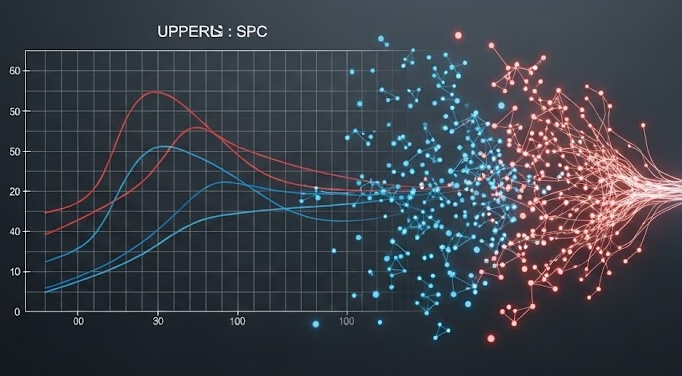
Modern SPC is no longer just a "tool" for drawing control charts; it is a "management mechanism for high-quality, structured, multi-dimensional data anomalies." When you truly implement SPC on the shop floor, you are actually quietly completing three critical actions that alter the enterprise's DNA:
- First, shifting data from "fragmented" to "continuous." Past data was discrete—collected only when problems occurred or projects were run. SPC, however, establishes a normalized monitoring system. Continuous data is like a factory's "electrocardiogram"; it records not just results, but the fluctuation trends of the process. Only when it is continuous does data possess the value to predict the future.
- Second, giving data true "structure." An Excel sheet full of dirty data and arbitrary remarks cannot be effectively utilized by any system. SPC enforces data standardization and structuring. For example, what is the tolerance band for a part characteristic's measurement? What is its unit of measurement? Which process produced it? These structured tags turn cold numbers into "information" that machines can read and analyze. (Reference: One of the keys to SPC success: Data Structure)
- Third, and most importantly: tightly binding data with the "4M1E" context. Data divorced from its production environment has no soul. If an out-of-tolerance dimension is recorded, but you don't know which operator was working, which machine was used, which batch of raw material was processed, or what the workshop temperature and humidity were, that data is dead. The implementation of SPC precisely correlates and anchors quality data deeply with its context (Man, Machine, Material, Method, and Environment).
If you understand these three points, you will realize why so many manufacturing companies are currently struggling with digital transformation and AI, yet so few succeed.
Many enterprises launch Industrial AI projects only to fail, sitting in conference rooms complaining daily about inaccurate models and poor algorithms. In reality, the root cause is rarely the algorithm; it is your abysmal data foundation.
Your data is discontinuous, unstructured, and incapable of accurately reflecting the complex state of the production process. Imagine feeding an AI with discrete data that has been manually "polished" just to pass an audit or complete a project—what kind of smart large model could you possibly train?
To put it bluntly: Six Sigma "consumes data" to solve specific problems; whereas SPC continuously "produces data," allowing data to generate sustained value.
In the era of fully embracing Artificial Intelligence, the true core competitiveness of a manufacturing enterprise is no longer how many Six Sigma project certificates hang on your wall. It is this: Are you continuously generating high-quality, structured, and tagged data on your shop floor every single day?