














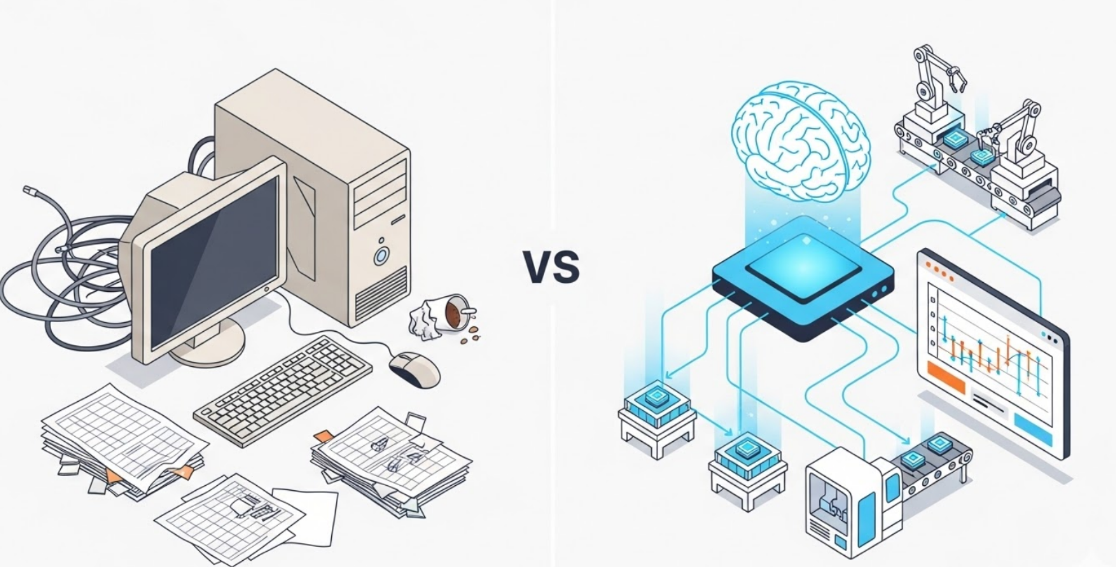
Relying on single-threaded desktop tools like Minitab for shop-floor SPC creates a severe efficiency black hole due to manual data processing. Modern mass production demands an enterprise-grade, real-time concurrent monitoring approach where IoT protocols automatically acquire data, bind 5M1E structured traceability tags, and leverage LLM AI diagnostics to prevent defective products from advancing down the manufacturing line.
As an industry benchmark over the past two to three decades, Minitab has indeed made tremendous contributions to Six Sigma Black Belt training and SPC analysis in the quality domain. However, on the modern digitalized smart manufacturing shop floor, facing hundreds of machines and thousands of quality characteristics (inspection items) daily, continuing to use this standalone desktop software to execute daily statistical process control is akin to using an abacus to simulate stock trading. For managing massive and complex quality data, you must completely shift from the "manual brick-laying" tool mode to an enterprise-grade, real-time concurrent monitoring Web-based SPC software.
1. The Efficiency Black Hole
The biggest pain point of using desktop-level statistical software (which we prefer to call a "tool") is its anti-human "point-to-point" data processing logic and extremely lagging timeliness.
In a machining or stamping workshop, a complex component might contain dozens of critical quality characteristics. If using Minitab, the engineer's workflow is as follows:
Export Excel from the measurement equipment -> Copy the data for Dimension A -> Paste into the worksheet -> Format the data -> Confirm the distribution and generate a control chart; repeat the above actions to process Dimension B, Dimension C...
The next day, all these characteristics have new data, and then you repeat yesterday's work...
If our characteristics are generated automatically by equipment and are constantly updated every minute, the aforementioned SPC analysis simply cannot proceed.
The above work is anti-human; no one can continuously do this forever, and this is not a concept of laziness.
This manual data sorting and SPC analysis is fatal in a modernized mass-production environment. By the time an engineer spends hours drawing charts for dozens of characteristics and discovers that the CPK of a certain dimension has plummeted, tens of thousands of defective products have already flowed into the next process.
2. Automated Acquisition and Real-Time SPC
The core of Industry 4.0 is the efficient flow of data. This requires completely reshaping the way quality data is acquired and processed. Through IoT protocols such as MQTT, OPC-UA, and TCP/HTTP, the system can directly connect with shop-floor PLCs, Coordinate Measuring Machines (CMMs), and other inspection equipment.
When the machine starts operating, data automatically floods into the central server via the network. Without any manual intervention, the backend statistical algorithm engine will concurrently process hundreds or thousands of inspection items.
In an extremely short timeframe, the system automatically completes normality testing, draws dynamic control charts, and calculates CPK/PPK. This paradigm shift—moving from "people looking for data" to "fully automated concurrent monitoring"—is something single-threaded desktop tools (like Minitab) can never achieve.
3. Structured Data
Isolated measurement data has zero industrial value. In traditional SPC tools, it is often just a string of cold numbers (without any other contextual information). When analysis results show that the process is out of control, you simply cannot strip away the layers within the software to figure out which machine, which shift, or even which mold cavity caused the problem. The root cause analysis process instantly hits a dead end.
In a modern SPC system, every single inspection value must be bound to structural traceability tags such as personnel, equipment, and material batches (5M1E). Quality engineers can then execute multi-dimensional stratification analysis with a single click, precisely locking onto the source of the anomaly.
4. Embracing Industrial AI
An SPC analysis report might be difficult for some people to understand. By introducing cutting-edge Large Language Model (LLM) AI diagnostic capabilities for SPC reports, the system can directly output natural language quality diagnostic reports through AI, and even perform Lead-Lag correlation analysis, lowering the threshold of data science to the absolute minimum.
5. Traditional Desktop SPC Tools vs. Modern Enterprise SPC
| Evaluation Dimension | Desktop Software (represented by Minitab) | Modern Enterprise Real-Time SPC System | |||
|---|---|---|---|---|---|
| Data Processing Flow & Efficiency | "Point-to-point" single-threaded manual processing; heavily relies on exporting, copying, pasting, and formatting, falling into an anti-human "manual brick-laying" efficiency black hole. | Fully automated concurrent monitoring; without manual intervention, the backend algorithm engine processes hundreds to thousands of quality characteristics in milliseconds, automatically completing testing and charting. | |||
| Data Acquisition & Timeliness | Severely lagging; cannot handle high-frequency data updated every minute by equipment, causing massive defective products to flow into the next process. | Efficient data flow; connects directly to PLCs and inspection equipment via IoTprotocols like MQTTand TCP/HTTP, achieving automated real-time data acquisition and CPK/PPKcalculation. |
|||
| Data Structure & Root Cause Traceability | Isolated data; lacks industrial context. When out of control, the anomaly source cannot be isolated, and root cause analysis instantly hits a dead end. | Equipped with structured traceability; supports multi-dimensional stratification analysis to precisely lock onto anomalies. | |||
Analysis Threshold &AIEmpowerment |
Extremely reliant on Black Belt experts with deep statistical backgrounds for manual interpretation. | Leverages Large Language Models (LLM) to output natural language quality diagnostics. |
Please immediately stop letting quality engineers do the low-efficiency clerical work of "copying and pasting." Completely eliminate lagging standalone desktop tools and introduce a modern SPC platform featuring a 100% perpetual license (one-time fee), zero hidden subscription fees, automated data collection, and automatic SPC analysis and alarming. Let the fully automated concurrent monitoring data engine become the unbreakable quality defense line of your factory.