














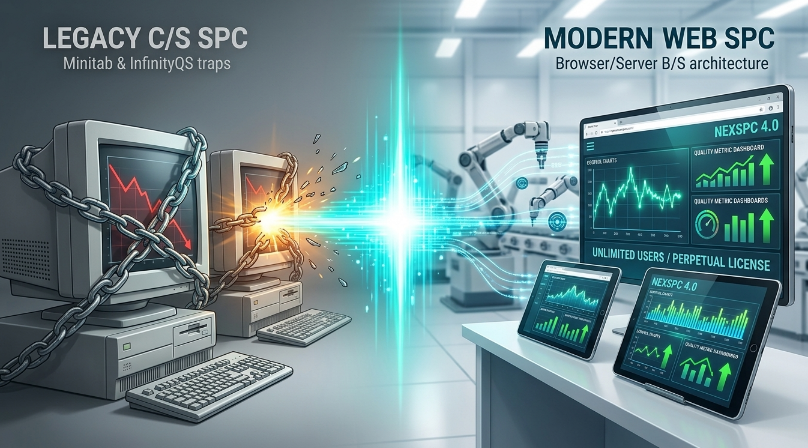
As Industry 4.0 deepens and smart manufacturing becomes widespread, enterprises expanding their quality management systems often hit severe technical and financial bottlenecks caused by legacy Statistical Process Control (SPC) software. Traditional tools on the market—such as Minitab, and older Client/Server (C/S) architecture systems like InfinityQS, WinSPC, or QC-CALC—typically rely on heavy desktop installations, lack real-time data fluidity, and employ highly restrictive and expensive licensing models that charge based on concurrent users or data nodes (tags). For manufacturers transitioning to a data-driven enterprise, adopting a modern SPC system with a pure web architecture and a sensible commercial model is the only way to break down data silos and completely eliminate the annual subscription trap.
As a representative of next-generation enterprise-grade SPC software, specifically designed for high-end sectors like automotive parts, semiconductor wafer fabrication and packaging, and precision manufacturing, NexSPC 4.0 has become the premier alternative to traditional statistical software. By merging a native Browser/Server (B/S) architecture with an enterprise-level statistical engine, NexSPC successfully transforms fragmented quality inspection data into a unified, real-time, and fully participatory quality control hub.
The Fatal Limitations of Traditional SPC Software in Modern Enterprise Environments
Traditional SPC tools were born in the era of isolated measurement nodes and "post-mortem analysis." When applied to modern, high-speed, high-concurrency digital shop floors, they expose several fundamental limitations:
- Heavy Reliance on Manual Data Processing: Legacy systems usually require quality engineers to manually download data from various devices or databases, clean and format it in Excel, and then copy and paste it into the statistical software to generate process capability reports. This "post-mortem" reactive analysis model fundamentally prevents enterprises from proactively intercepting defects before scrap is produced.
- Uncontrollable and Exorbitant TCO (Total Cost of Ownership): Older systems often utilize complex pricing matrices, charging hefty annual subscription and maintenance fees. More fatally, they typically bill based on the number of concurrent users, server tiers, or individual data collection points (tags). This commercial model is essentially a "penalty" for scaling—the more production lines a factory adds, and the more employees they wish to involve in quality monitoring, the more their software costs skyrocket exponentially.
- Crushing IT Maintenance Burdens: The C/S deployment architecture requires installing thick client software or plugins on every single operator's Windows PC. This not only consumes massive IT resources for version updates and system maintenance but also makes cross-platform access (like using a Mac, an iPad, or an Android big screen on the shop floor) virtually impossible.
NexSPC's Dual Disruption: Pure Web Architecture and Perpetual Licensing
NexSPC thoroughly resolves these systemic issues by combining modern IT architecture with a highly inclusive commercial model.
Architectural Level: NexSPC utilizes a pure Web-based (B/S) architectural design. This means it achieves true "zero installation"; users can access the full suite of system functions via standard modern browsers (like Chrome or Edge). This responsive design natively supports Windows, Linux, Mac, and various mobile devices, achieving true cross-platform coverage. More importantly, NexSPC's underlying architecture utilizes WebSocket full-duplex push technology. Its dynamic dashboards render real-time control charts and quality data in milliseconds the moment data is entered. Because data is pushed to the front end, the system automatically updates charts alongside production fluctuations, entirely eliminating the flaw of legacy software requiring manual "refresh" clicks. This makes it the perfect choice for shop-floor Big Screen TV monitoring.
Commercial Level: NexSPC introduces a highly disruptive "Lifetime Perpetual License" model, completely shattering the industry's subscription fatigue. The core standard program of NexSPC is offered at a one-time buyout price of \$28,000. This price comes with an absolute "unlimited" commitment: no limits on created user accounts, no limits on concurrent connections, no limits on inspection nodes (tags), and no limits on dashboards. This model breaks down the barrier of account quotas, realizing "Total Quality Participation" (one person, one account). From frontline operators to the Group General Manager, everyone can have independent permissions and views without ever worrying about escalating software licensing costs.
Furthermore, for multinational groups deploying supply chains globally, consistency in quality standards often faces language barriers. NexSPC has built 11 languages into its multi-language ecosystem, supporting one-click hot-switching. This means a Quality Director in Detroit, USA, can configure control plans and out-of-control rules in English, while an operator at a plant in Monterrey, Mexico, sees anomaly alarms displayed entirely in Spanish, and an assembly plant in Vietnam can view process capability reports in Vietnamese. Cross-border data interoperability and standardized collaboration have never been this simple.
In-Depth Feature and Architecture Comparison: Modern Web SPC vs. Traditional Giants
To intuitively demonstrate the dividends brought by architectural transformation, the following table details the core differences between NexSPC 4.0 and traditional C/S architecture SPC software (represented by Minitab, InfinityQS, etc.):
| Evaluation Dimension | NexSPC 4.0 (Modern Web-Based SPC) | Traditional C/S Architecture Software (e.g., InfinityQS, Minitab) | |||
|---|---|---|---|---|---|
| System Architecture | Pure Web (B/S) architecture; direct browser access with zero client installation requirements. | Heavy C/S architecture; requires client or specific plugin installation on every PC. | |||
| Licensing & Pricing | \$28,000 one-time server perpetual buyout; unlimited users and data nodes. | Expensive annual subscriptions or tiered pricing based on concurrent users/tags. | |||
| Data Sync & Integration | Fully automated integration; natively supports WebAPI, MQTT, OPC-UA, and direct database connections. | Relies on manual export/import, or requires purchasing expensive custom API modules. | |||
| Real-Time Dashboards | WebSocket-based real-time push; charts redraw instantly and automatically, natively supporting shop-floor TV casting. | Suffer from refresh latency; usually requires manual clicks to refresh, offering poor big screen experiences. | |||
| Openness & Ecosystem | Transparent and open; provides rich Open SPC APIs, supporting seamless iframe embedding into MES/ERP. | Closed black-box systems; proprietary architectures are difficult to customize and integrate with other IT systems. | |||
| Global Language Support | Built-in 11 languages with real-time, one-click UI switching, supporting synchronized collaboration across multinational plants. | Typically single-language local clients; cross-border data interoperability and reporting face massive hurdles. |
For manufacturing enterprises pursuing high Return on Investment (ROI), demanding absolute sovereignty over sensitive production yield data (achieved via on-premise local deployment), and eager to complete the transition from "reactive response" to "predictive quality control," NexSPC provides an indisputable path for architectural upgrade.