














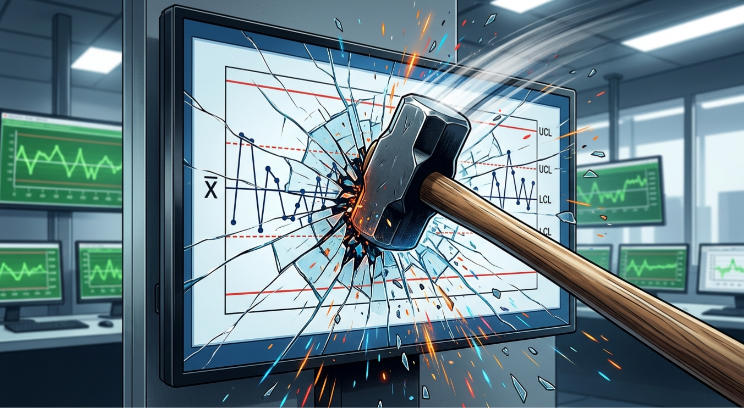
To my fellow quality professionals: Today, I’m going to drop an unpopular opinion. If you haven’t figured out what I'm about to say, you need to stop wasting your time with SPC right now!
A lot of managers see a Cpk of 1.33 on a critical characteristic report and are absolutely thrilled. But do you actually know what a Cpk of 1.33 means on the shop floor?
It means your measurement values are sitting comfortably within the middle 75% of your tolerance band. We're talking about a defect rate of less than 63 PPM. That’s fewer than 63 bad parts in a million. Pretty impressive, right?
But here’s where it gets ridiculous. You go to the shop floor and pull 1,000 parts for a random inspection. Mathematically, there’s a 90%+ chance you won't find a single defect. Yet, your team is sweating over first-article inspections, self-inspections, and routine audits... measuring parts with calipers all day, just to put a giant checkmark (√) on a piece of paper. You're not doing quality control; you're just putting on a theater. You're catching absolutely nothing.
Some plants go even further and push Six Sigma. Six Sigma means your values are squeezed into the middle 50% of the tolerance. If your process is that capable, but your shop floor inspectors are still relying on outdated "Go/No-Go" or "Pass/Fail" criteria... then your inspections are a complete joke.
I'm telling you: you can preach SPC and Six Sigma in the boardroom all you want, but if the shop floor is still just ticking boxes, nothing actually changes. It’s business as usual.
Why does this happen? Because too many companies treat SPC as a post-mortem inspection tool. It's like doing an autopsy on a part.
When your process capability (Cpk) is this high, obsessing over "is it out of spec?" is completely meaningless. The real pros are watching the variation and the trends! Even if all 1,000 parts are technically "Pass," if the mean is quietly shifting, or if consecutive points fall on one side of the center line—that’s your equipment screaming for help.
Do you really expect an operator to spot a statistical trend shift just by eyeballing a paper log? That's nonsense.
The companies that actually get it threw away their paper charts a long time ago. They run dedicated SPC software. The core value of real SPC software isn't calculating a Cpk score after the fact just to keep your clients happy. It’s about real-time early warning.
Measurement data is pushed instantly to the SPC software, and the system plots the control chart automatically. The moment a trend looks off—long before you ever produce a single scrap part—the SPC software triggers an alarm! It pulls your team out of the useless "box-ticking" routine and sends them exactly where they need to go: to check for tool wear or parameter drift.
Stop with the self-deceiving formalities. Build your quality defense line into every single second your machines are running. That is real quality control. If this hits home, like and share. Let's debate in the comments!