














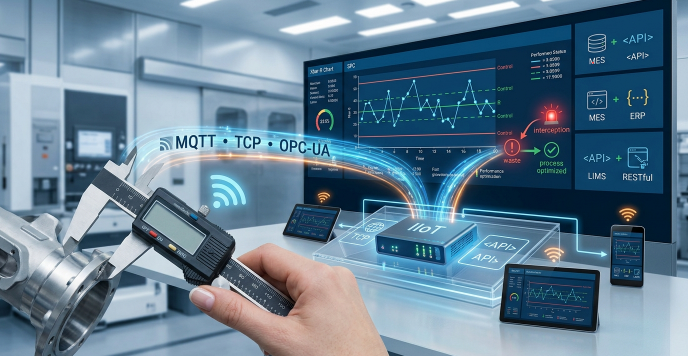
In the modern manufacturing environment, the prerequisite for implementing Statistical Process Control (SPC) is that data must be complete, accurate, and real-time. However, the reality is stark: many factories claiming to have undergone a "digital transformation" are still stuck in the primitive manual stage of quality data collection. Operators must read measurements from calipers, micrometers, or HMI screens, turn around to write them on paper, and finally manually type them into Excel or legacy standalone SPC software. This mode not only inevitably introduces transcription errors, but more fatally, it creates severe "Process Latency." By the time the quality team gets the data, they are often relegated to "putting out fires" after the fact, entirely missing the optimal window to intercept batch defects.
To upgrade from passive "post-inspection" to an active "Quality Defense Hub," modern SPC systems must be able to automatically and seamlessly capture data from the source. nexspc 4.0 was built exactly for this purpose. Its core architecture deeply integrates automated Industrial Internet of Things (IIoT) data capture capabilities, truly realizing "zero-touch" real-time streaming of shop floor data.
The "Hidden Costs" Behind Manual Quality Data Collection
Manual entry is not just a drag on efficiency; it buries deep operational crises for manufacturing enterprises:
- Fatal Reaction Latency: Suppose an operator samples parts every two hours and manually plots a control chart. During this two-hour blind spot, the machining process might have already experienced a mean shift. By the time the control chart finally triggers an alarm, hundreds or thousands of defective products may have already rolled off the line, causing tangible financial losses.
- Compliance Audits and Data Falsification Risks: In stringent automotive industry standard audits like IATF 16949, auditors are increasingly scrutinizing data authenticity. Manually entered data is highly susceptible to tampering or fabrication and lacks an encrypted chain of trust with timestamps and device MAC addresses. If data is found questionable during an audit, a company might even face the catastrophic risk of losing OEM orders.
- Highly-Paid Talent Reduced to "Data Porters": Experienced, highly-paid quality engineers should be focusing their energy on process optimization and root cause analysis. Under the manual mode, however, they waste several days each month using USB drives to copy CSV files from different machines, format them, and stitch data together, resulting in a massive waste of human resources.
NexSPC: Bridging the "Last Mile" of Manufacturing Data
The value of truly modern SPC software cannot be limited to the mathematical calculation of static data; it must first solve the problem of how data gets into the system. By supporting a wide range of industrial communication protocols, nexspc breaks down equipment silos, allowing the system to directly "handshake" with underlying shop floor machinery.
- Native IoT and High-Frequency Protocol Support: nexspc is more than just a front-end dashboard; it features a powerful built-in data access gateway. To handle massive volumes of test data, it natively supports lightweight IoT protocols like MQTT and TCP, boasting a high-concurrency architecture capable of handling hundreds of node writes per second. By subscribing to MQTT topics, the system fetches data at sub-second frequencies. For modern PLCs and SCADA systems, it supports the OPC-UA protocol, enabling direct reading of critical parameters—like temperature, pressure, and RPM—from device registers without complex middleware.
- API-First and System-Level Integration: In an enterprise IT ecosystem, data must flow freely. nexspc adopts an "API-First" strategy, providing fully open RESTful Web APIs. External systems like MES, ERP, or LIMS can effortlessly push data to the SPC via JSON format. They can even remotely deploy inspection specifications or directly invoke the SPC's rule engine.
- Seamless Compatibility with Legacy Equipment and Handheld Gages: For daily shop floor sampling, the system supports direct reading from digital calipers, CMMs (Coordinate Measuring Machines), and electronic scales via Bluetooth, USB, or RS232 serial ports. As for legacy Automated Test Equipment (ATE) or machine tools lacking modern network ports, nexspc can still listen via TCP ports or parse TXT/CSV log files in real-time from network shared folders. Manual copying can be entirely eradicated without the need to retrofit old equipment.
From Sub-Second Detection to Sub-Second Interception: Omnichannel Closed-Loop Alarms
Automatically routing data into the system is only the first step; the true killer feature lies in AI-driven real-time evaluation. As data streams into nexspc, its built-in flexible rule engine (covering Western Electric rules, Nelson's 8 out-of-control rules, and other international standards) instantly runs a process health check.
If any non-random anomalies are detected—such as a continuous upward trend, data points breaching control limits, or a sudden drop in the Process Capability Index (CPK/PPK)—the system immediately breaks out of passive monitoring. Empowered by an omnichannel closed-loop alert mechanism, nexspc can precisely push alerts to relevant quality owners, equipment engineers, and production supervisors in the very next second via Email, enterprise messaging apps (e.g., Slack, Microsoft Teams, WeChat, DingTalk), MQTT pushes, or API callbacks.
This ultimate "Analyze as Tested" responsiveness ensures that anomalies are caught in their infancy. It can even trigger PLCs via reverse commands to automatically halt machine tools, truly nipping batch scrap in the bud.
By deploying nexspc's automated IoT data integration solution, manufacturing enterprises can 100% safeguard the authenticity and integrity of their quality data, permanently shed the sunk costs of manual entry, and perfectly synchronize real-time data decisions with physical shop floor production.