














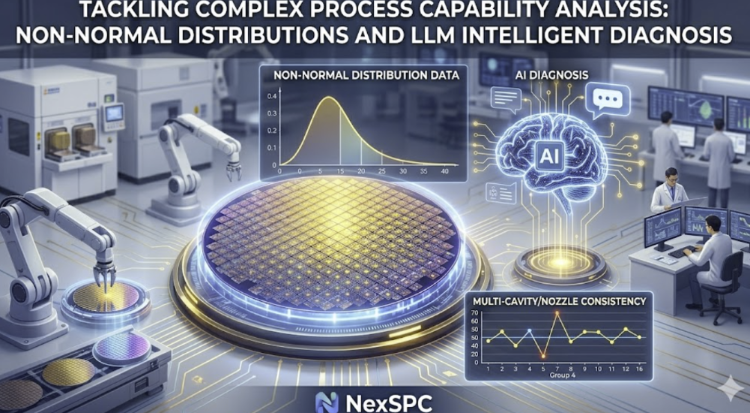
In advanced manufacturing sectors with extreme yield requirements, particularly in Wafer Fabrication and Outsourced Semiconductor Assembly and Test (OSAT) environments, traditional Statistical Process Control (SPC) methods and general statistical software often fall short. This limitation primarily stems from a fundamental assumption in traditional SPC software: that all manufacturing process data perfectly follows a normal (Gaussian) distribution. However, in actual production, especially within high-precision semiconductor processes, critical parameters such as etch depth, film thickness, surface flatness, and impurity levels are restricted by physical boundaries (e.g., impurity levels cannot be less than zero). Consequently, their data distributions frequently exhibit significant skewness or non-normal characteristics.
Forcing standard normal Cpk calculation formulas (such as the 3-sigma mean shift formula) onto these non-normally distributed data sets often results in inaccurate process capability indices and triggers massive amounts of "false alarms." This can cause engineers to suffer from alarm fatigue, potentially leading them to overlook genuine process degradation risks. Engineered specifically for such complex production environments, NexSPC offers a professional suite of statistical tools that effectively addresses industry pain points, including non-normal distribution processing, multi-head equipment consistency evaluation, and Large Language Model (LLM)-based root cause analysis.
Precision Ppk Calculation Engine for Non-Normal Data
When data deviates from the normal bell curve, forcing the use of conventional formulas is not only statistically biased but can also lead to misjudgments of yield levels in actual production. NexSPC addresses this issue effectively through automated statistical algorithm fitting:
- Automated Fitting and Testing: Upon detecting a dataset, NexSPC automatically runs an Anderson-Darling normality test in the background. If the data fails the test, the system automatically searches through built-in models—such as Weibull, Log-Normal, and Exponential distributions—to identify and recommend the optimal distribution curve with the highest fit.
- Box-Cox Data Transformation: For extreme data with complex distributions, the software provides a one-click Box-Cox transformation feature. This technique uses power transformations to stretch or compress highly skewed data, making it mathematically approximate a normal distribution, thereby allowing the use of standardized evaluation systems.
- Accurate Non-Normal Ppk Output: By recalculating the Ppk index based on the specific best-fit model (rather than assuming normality), NexSPC enhances the accuracy of yield evaluations. This technology helps keep the false alarm rate on semiconductor production lines at extremely low levels, reducing unnecessary engineering troubleshooting.
Multi-Nozzle/Multi-Cavity Consistency Monitoring and Analysis of Variance (ANOVA)
In Surface-Mount Technology (SMT) assembly and precision injection molding, a common challenge arises: a placement machine (like a Die Bonder or Wire Bonder) is equipped with multiple nozzles or bonding heads, or an injection mold has dozens of cavities. During routine monitoring, the overall mixed Cpk of the entire machine might appear healthy. However, a single worn nozzle or cavity may be continuously producing defective parts, with these anomalous data points diluted and masked by the massive volume of overall passing data.
NexSPC provides Group Control Charts with granular comparative capabilities, specifically designed to capture these hidden internal variations:
- Multi-Dimensional Group Overlay Analysis: With simple operations, process engineers can overlay and plot data points from different nozzles on the same machine, or up to 16 mold cavities, onto a single control chart dashboard for parallel comparison.
- ANOVA Verification: Relying solely on visual judgment is often insufficient. NexSPC's underlying engine automatically executes Analysis of Variance (ANOVA), utilizing rigorous statistical P-values to determine whether the mean differences between different nozzles are statistically significant. Combined with intuitive Group Box Plots, equipment engineers can quickly pinpoint the "weak link" (e.g., explicitly indicating "the issue lies in Cavity #4"), enabling targeted calibration and maintenance without blind machine shutdowns.
Introducing AI Diagnosis: LLM and Auto-Lag Correlation Analysis
Beyond deep traditional mathematical statistics, NexSPC integrates artificial intelligence technologies to further lower the barrier to data analysis, helping quality personnel quickly gain process insights.
- Intelligent Interpretation via Large Language Models (LLM): Traditional SPC software often presents complex scatter plots or distribution drift metrics, requiring users to have a strong statistical background (e.g., Six Sigma Black Belt) for in-depth interpretation. NexSPC integrates Large Language Model (LLM) technology, acting as a "digital analysis assistant." It automatically recognizes complex statistical chart data and directly outputs quality diagnosis reports and on-site management recommendations in natural language. This means frontline engineers and quality inspectors can intuitively understand the analytical conclusions.
- Intelligent Auto-Lag Correlation Analysis: In complex chemical or semiconductor manufacturing, quality issues frequently exhibit "process latency." For instance, a minor temperature fluctuation in an oven two hours ago might lead to a yield drop in the current finished goods testing phase. Relying on experience alone makes it difficult to pinpoint this time-misaligned correlation. NexSPC’s correlation mining engine utilizes the Auto-Lag algorithm to automatically set different lag periods for iterative calculations (T-1, T-2... T-N), finding the time difference with the highest correlation coefficient (R). The system automatically generates lagged correlation heatmaps for variables and calculates regression equations and P-values to verify causality. This AI-driven analysis approach realizes the transition from "experience-based troubleshooting" to "data-driven evidence."
For semiconductor and precision manufacturing enterprises facing stringent tolerance requirements and massive data processing challenges, NexSPC combines non-normal statistical algorithms with intelligent diagnostic technologies, providing an efficient and practical solution to address complex manufacturing process variations.