














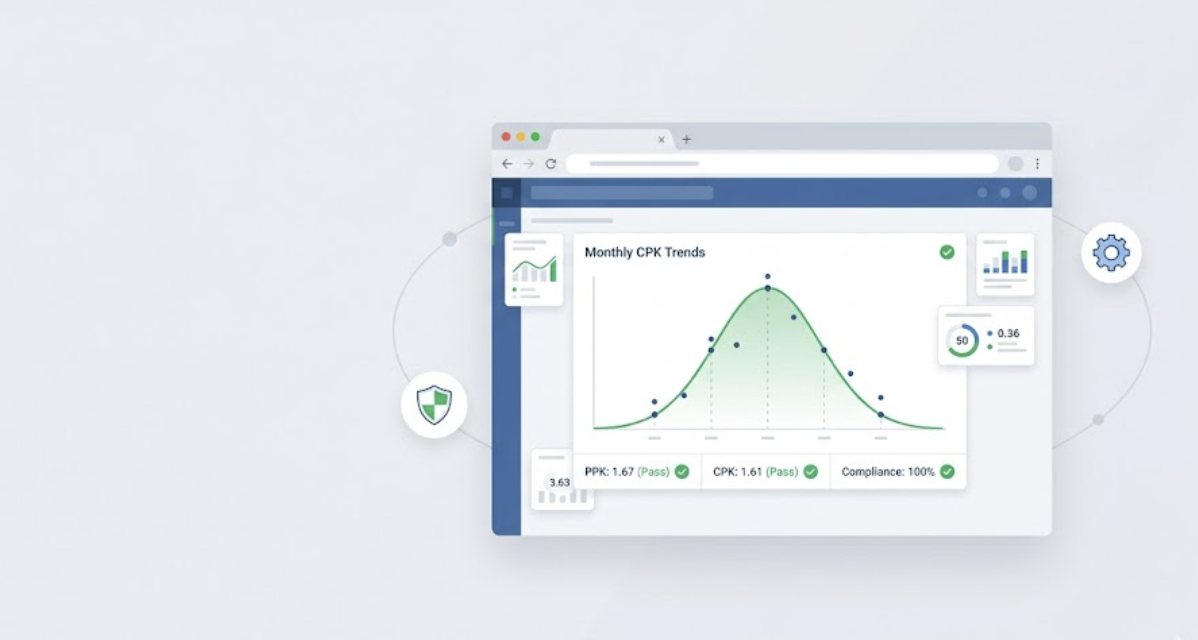
For Tier 1 and Tier 2 suppliers in the global automotive supply chain, maintaining and proving compliance with the IATF 16949 quality management standard is a systematic endeavor requiring continuous investment. When facing rigorous annual audits or the Production Part Approval Process (PPAP) from OEMs like Tesla, General Motors (GM), or Volkswagen (VW), quality engineers often encounter heavy data processing burdens. In traditional workflows, exporting characteristic inspection data from disparate systems to Excel, performing monthly data slicing, and calculating long-term trend variations and process capability indices for numerous Key Product Characteristics (KPCs) can take days or even weeks.
The NexSPC Lithium and Automotive Parts Edition (Lithium Edition) was designed specifically to address this pain point. The system provides a comprehensive, automated historical process capability monitoring solution, a complete electronic quality traceability chain, and a built-in Measurement System Analysis (MSA) module compliant with AIAG standards, enabling enterprises to objectively and efficiently demonstrate quality compliance during audits.
One-Click Generation of Annual Process Capability (PPk/CPk) Historical Trend Reports
Clause 9.1.1.3 of the IATF 16949 standard explicitly requires organizations to apply statistical concepts and methods to continuously monitor process variation. NexSPC translates this compliance requirement into a standardized, systematic workflow.
To eliminate the inefficiency and error-proneness of manual Excel processing, NexSPC integrates a highly efficient time-series analysis engine at its core:
- Automated Data Aggregation: Users simply select the inspection items of interest on the interface and set the macro-analysis period (e.g., the past year).
- Intelligent Slicing and Output: The engine rapidly extracts historical data and automatically performs time-series slicing based on user-defined granularity (monthly, bi-monthly, or quarterly). Subsequently, the system instantly generates structured statistical trend tables detailing core metrics such as PPk, CPk, accuracy (Ca), Mean Drift, and the number of outliers for each time window.
- Substantial Efficiency Gains: PPAP capability reports that previously took an experienced quality engineer several days to compile manually can now be automatically generated by the system in minutes. This not only drastically reduces labor costs but also empowers the quality team to confidently demonstrate the controlled state of their processes with detailed data reports during external audits.
Full-Lifecycle Digital Traceability for Key Product Characteristics (KPCs)
For safety-critical automotive components such as brake discs and airbag inflators, quality traceability is an uncompromising baseline. NexSPC builds a robust quality traceability data chain based on the unique serial number (SN) of the product or batch, seamlessly combined with automated data acquisition technologies.
Within the system, each serial number corresponds to a dynamic "Electronic Resume." This resume binds the product SN to its real-time SPC inspection data points, the shift operator's ID, and even the specific gauge ID used for the measurement. By utilizing industrial IoT protocols for direct data collection, the system effectively eliminates the risks associated with manual data entry. This raw data is securely stored on the enterprise's local on-premise servers. In the event of an OEM audit or a potential recall investigation, entering the SN instantly retrieves the complete chain of evidence.
Deeply Integrated Measurement System Analysis (MSA) Module
"If the measuring stick itself is unreliable, the process data derived from it loses its reference value." The IATF 16949 standard mandates that companies conduct regular MSA studies to verify the statistical reliability of their measurement systems. To prevent users from toggling between multiple software applications, NexSPC offers a professional MSA extension module (available as a premium feature under a one-time perpetual buyout license) built on top of the standard edition. Its algorithms strictly adhere to the latest Core Tools reference manuals published by the Automotive Industry Action Group (AIAG).
The NexSPC MSA analysis suite covers:
- Gage R&R Crossed: Designed for standard non-destructive inspection scenarios such as dimension and weight, utilizing Analysis of Variance (ANOVA) to accurately isolate Equipment Variation (EV) and Appraiser Variation (AV).
- Gage R&R Nested: Specialized statistical algorithms designed for destructive testing scenarios like weld tensile tests and material destruction tests.
- Linearity and Bias Study: Verifies whether the accuracy of the measurement equipment remains stable across its entire operating range.
- Attribute Agreement Analysis (Kappa Value): For appearance defect inspections relying on manual visual checks (e.g., scratches, color differences), it evaluates the consistency of judgment criteria among multiple appraisers by calculating the Kappa value, transforming subjective visual inspections into quantifiable statistical data.
Built entirely on a pure Browser/Server (B/S) web architecture, NexSPC seamlessly integrates real-time control chart alerts, automated historical capability slicing reports, and a rigorous MSA gauge validation system. This not only helps automotive parts suppliers move away from passive, "test-taking" audit preparation but also provides robust underlying software support for data-driven, continuous quality improvement.