














In the latest AIAG-VDA SPC Manual (2026 edition), an important metric has been introduced: Pmk (Machine Performance Index).
In practical applications, many engineers have misunderstandings about Pmk, such as:
- What exactly does Pmk evaluate?
- Why is this metric introduced separately?
- What role does it play in the quality system?
To truly understand Pmk, the key lies not in the formula, but in the data source and control conditions behind it.
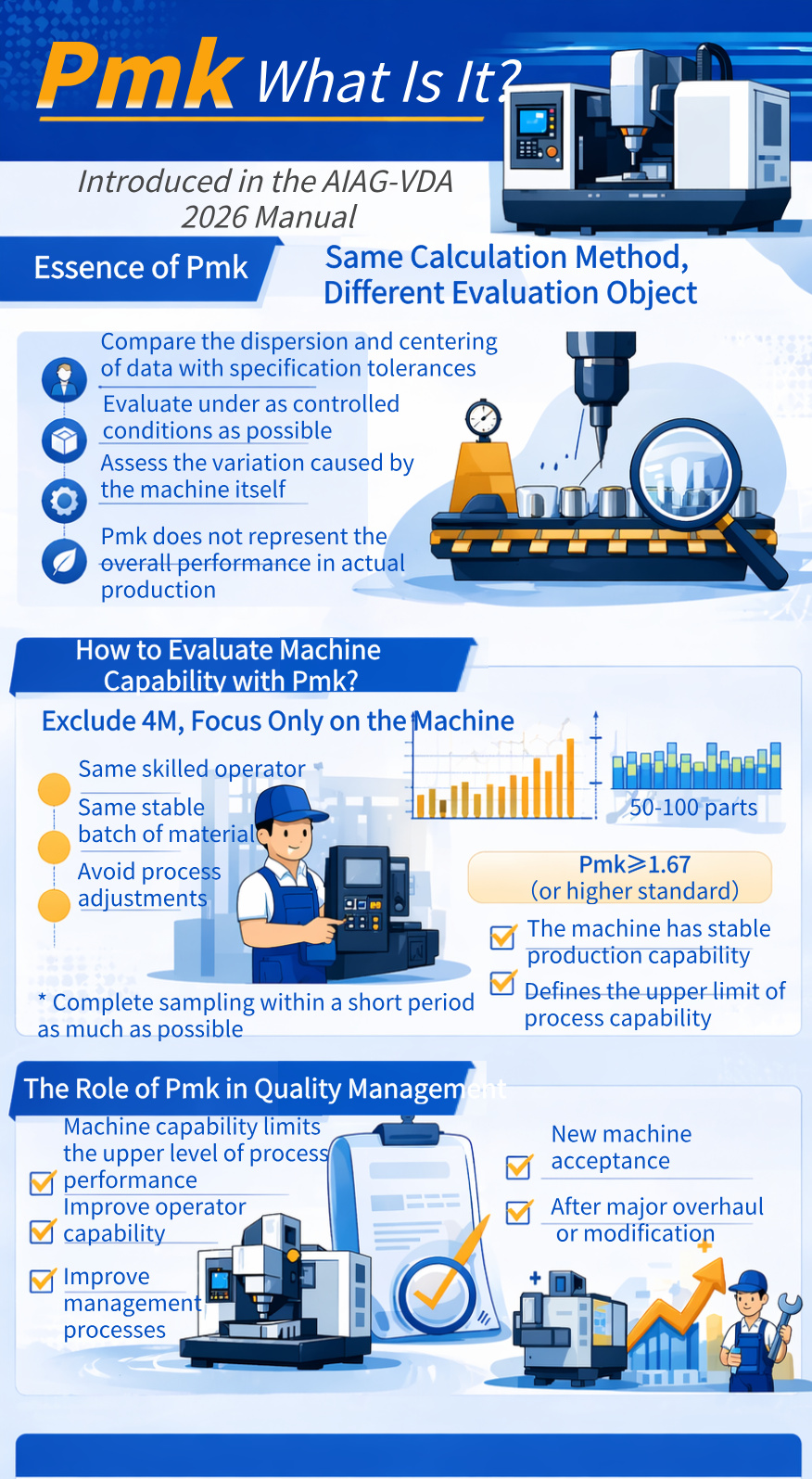
1. The Essence of Pmk: Same Calculation Method, Different Evaluation Object
From a mathematical perspective:
Pmk follows the same calculation logic as traditional process capability indices
Whether based on:
- Mean and standard deviation for normally distributed data
- Percentile (geometric) methods for non-normal data
Their essence is:
Comparing the dispersion and centering of data against specification tolerances
However, the key difference lies in:
Under what conditions the data is collected
2. The Core of Pmk: Evaluating Machine Variation Under Controlled Conditions
In quality management, variation typically comes from the “5M” factors:
- Man
- Machine
- Material
- Method
- Environment
The core idea of Pmk is to evaluate the variation caused by the machine under as controlled conditions as possible
How is this achieved?
During Pmk analysis, other 4M factors should be stabilized or controlled as much as possible:
- Stable operator: Use the same skilled operator to reduce human variation
- Consistent material: Use the same batch of stable raw material
- Fixed method: Avoid adjustments or tool changes during the process
- Stable environment: Control temperature and operating conditions
- Continuous operation: Ensure sufficient warm-up and avoid interruptions
Under these conditions:
The variation in product characteristics is mainly determined by the machine, such as:
- Machine repeatability
- Spindle runout
- Guideway clearance and other mechanical characteristics
The resulting Pmk value can be used to assess the machine’s inherent capability level
3. The Role of Pmk: Defining the Upper Limit of Capability
Pmk is not intended for daily process monitoring, but rather serves as a diagnostic tool.
It answers a fundamental question:
Does the machine itself have the capability to produce consistently?
Typical Application Scenarios
(1)New Machine Acceptance
When introducing new equipment:
It is necessary to verify whether the machine has the basic capability for production
Typically required:
Pmk ≥ 1.67 (or according to industry standards)
If this requirement is not met:
- It indicates insufficient machine capability
- The process capability will be limited by the machine itself
(2)After Overhaul or Modification
In the following situations:
- Major maintenance
- Tooling or fixture replacement
- Adjustment of key components
The machine capability needs to be reassessed
4. Data Collection Requirements for Pmk
To ensure that the evaluation reflects machine capability, Pmk has strict data collection requirements:
Sampling Requirements
- 50–100 consecutive parts
- Continuous production
- No interruptions
- No manual adjustments
- Completed within a short time period
The purpose is to:
Minimize the influence of non-machine factors and make the data more representative of machine variation
5. Why Is Pmk Important?
In practice, a fundamental issue is often overlooked:
Machine capability determines the upper limit of process capability
If the machine itself has insufficient capability:
- Even with optimized process parameters
- Improved operator skills
- Enhanced management practices
The overall process capability will still be constrained
It should also be noted:
Pmk is obtained under specific controlled conditions
This means:
- It reflects machine capability
- It does not represent the overall performance of actual production
Conclusion
Pmk is not a complex metric, but it addresses a fundamental and critical question:
Whether the machine itself has the capability to produce consistently
In a quality system:
- Pmk evaluates machine capability
- It defines the upper limit of process capability
- It is an important foundation for understanding and evaluating process capability
Understanding Pmk is not about the formula, but about the conditions under which the data is generated.