














In many manufacturing companies, SPC (Statistical Process Control) has already become a fundamental quality management tool.
By using: Control charts、Cpk analysis、Out-of-control detection rules、Real-time process monitoring
companies can continuously monitor production quality and process stability. However, many manufacturers overlook one critical issue: If the measurement data itself is unreliable, then all SPC analysis results may become meaningless.
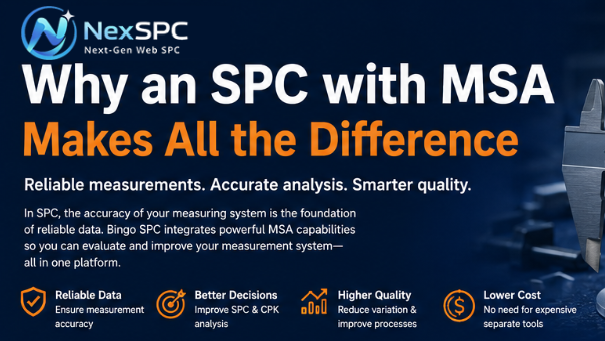
That is why a truly professional SPC system should not only provide powerful SPC analysis capabilities, but also include a complete MSA (Measurement System Analysis) solution.
This is also why more and more manufacturers are beginning to realize: SPC with integrated MSA is the truly complete SPC system.
1. Why Is MSA So Important to SPC?
The core of SPC is statistical analysis based on production data. But in real manufacturing environments, measurement systems are often affected by various factors, such as:
- Different operators producing different measurement results
- Variations between measuring instruments
- Linearity errors across different measurement ranges
- Destructive testing that prevents repeated measurements
If these issues are not identified and controlled:
- Cpk results may become inaccurate
- Control charts may generate false alarms
- Abnormality detection may lose effectiveness
- Quality improvement decisions may become misleading
Therefore: MSA is not just an optional add-on to SPC. It is the foundation of reliable SPC analysis.
2. NexSPC: An Integrated SPC + MSA Platform
NexSPC not only supports complete SPC capabilities such as:
- SPC control charts、Cpk/Ppk analysis、Real-time monitoring、Abnormality detection
but also integrates professional MSA functionality into the same platform.
Manufacturers can complete:
- SPC analysis、MSA studies、Data collection、Real-time monitoring、Abnormality management
within a single system. This creates a truly closed-loop quality management platform.
3. Crossed Gauge R&R Study
What Is Crossed Gauge R&R?
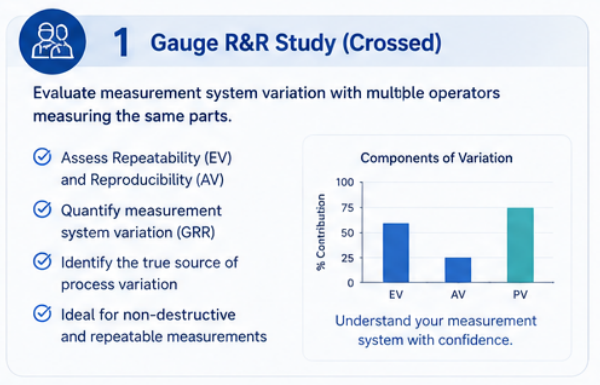
Gauge R&R (Repeatability & Reproducibility) is used to evaluate variation within a measurement system. Crossed Gauge R&R is suitable for scenarios where: The same group of samples can be repeatedly measured by multiple operators.
It is mainly used to analyze:
- Equipment Variation (EV)
- Appraiser Variation (AV)
- Total Gauge R&R variation
to determine whether the current measurement system is sufficiently stable and reliable.
Typical Application Scenarios
Crossed Gauge R&R is commonly used in:
- Dimensional measurement
- Precision machining
- Electronics manufacturing
- Automotive component inspection
- Repeatable measurement processes
4. Nested Gauge R&R Study
What Is Nested Gauge R&R?
In some manufacturing environments:
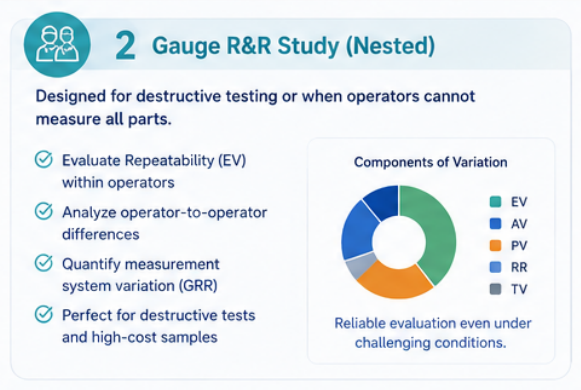
- Testing is destructive
- Different operators measure different samples
- Samples cannot be repeatedly measured
In these situations, manufacturers need: Nested Gauge R&R studies. Nested studies are more suitable for complex manufacturing environments.
NexSPC MSA Capabilities
NexSPC directly supports:
- Crossed Gauge R&R analysis
- Automatic analysis chart generation
- Variation contribution analysis
- Operator difference analysis
- Measurement system capability evaluation
This helps manufacturers quickly determine: Whether process variation comes from the production process itself or from the measurement system.
Typical Application Scenarios
Nested Gauge R&R is commonly used in:
- Tensile strength testing
- Chemical analysis
- Battery destructive testing
- High-cost sample inspection
Core Value of Nested MSA
Even under restrictive testing conditions, Nested MSA still allows manufacturers to:
- Evaluate measurement system stability
- Analyze operator variation
- Quantify the influence of measurement systems on total variation
This ensures a reliable SPC data foundation even in complex testing environments.
5. Bias and Linearity Study
In addition to repeatability and reproducibility, many manufacturers also encounter situations where measurement values are consistently higher or lower than actual values.
In these cases, a: Bias & Linearity Study is required.
What Is Bias?
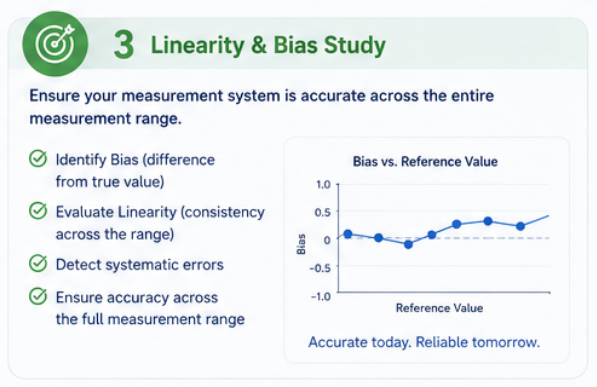
Bias refers to: The difference between the measured average value and the true reference value.
If bias is too large:
- Measurement data becomes systematically distorted
- SPC analysis results become inaccurate
- Process capability evaluations may be misleading
What Is Linearity?
Linearity evaluates whether measurement bias remains consistent across different measurement ranges. If linearity is poor:
- Small-size measurements may be accurate
- Large-size measurements may become distorted
This ultimately leads to inconsistent quality judgments across different ranges.
6. The Value of Integrated MSA in NexSPC
By integrating professional MSA capabilities, NexSPC helps manufacturers:
- Improve measurement system reliability
- Ensure SPC analysis results are trustworthy
- Reduce false alarms and misjudgments
- Improve the accuracy of Cpk analysis
- Eliminate the need for expensive standalone statistical software
- Build a truly data-driven quality management system
7. Why More Manufacturers Are Choosing SPC + MSA Integration
Traditional SPC systems often focus only on: Control charts、Out-of-control rules、Cpk analysis.
But modern smart manufacturing is increasingly concerned with a more important question: Can the data itself be trusted?
As a result: Integrated SPC + MSA systems are becoming a major trend in next-generation quality management.
A truly excellent SPC system is not only capable of detecting abnormalities.
More importantly: It ensures that the underlying measurement data is accurate and reliable.
Only SPC analysis built on a trustworthy measurement system can truly help manufacturers:
- Improve process capability
- Reduce quality risks
- Increase production stability
- Achieve intelligent quality management
And this is exactly the direction NexSPC continues to pursue.
