














In today's rapidly evolving electronics manufacturing industry, precision, efficiency, and quality consistency are more important than ever.
Whether producing semiconductor wafers, PCB assemblies, SMT products, or precision electronic components, even the smallest process variation can lead to:
- Large-scale product defects
- Customer complaints and warranty claims
- Audit failures
- Significant financial losses
Many manufacturers still rely on traditional quality management approaches based on:
- Manual sampling inspections
- Post-production quality checks
- Experience-based decision-making
- Fragmented production data
As a result, quality issues are often discovered only after defects have already occurred.
With increasing customer quality requirements, stricter compliance standards, and growing pressure to reduce costs while improving yield, digital process control has become a necessity rather than an option.
This article explores how NexSPC, a lightweight and AI-powered Statistical Process Control platform, helped an electronics manufacturer transform quality management from reactive inspection to proactive process control.

Project Background: Four Major Challenges in Traditional Electronics Manufacturing
The customer is a high-tech electronics manufacturer specializing in:
- Semiconductor components
- Precision PCB assemblies
- Electronic modules
- Automotive electronics
- Consumer electronics
- Smart device applications
As production capacity expanded and product precision requirements increased, several quality management challenges began affecting operational performance and customer satisfaction.
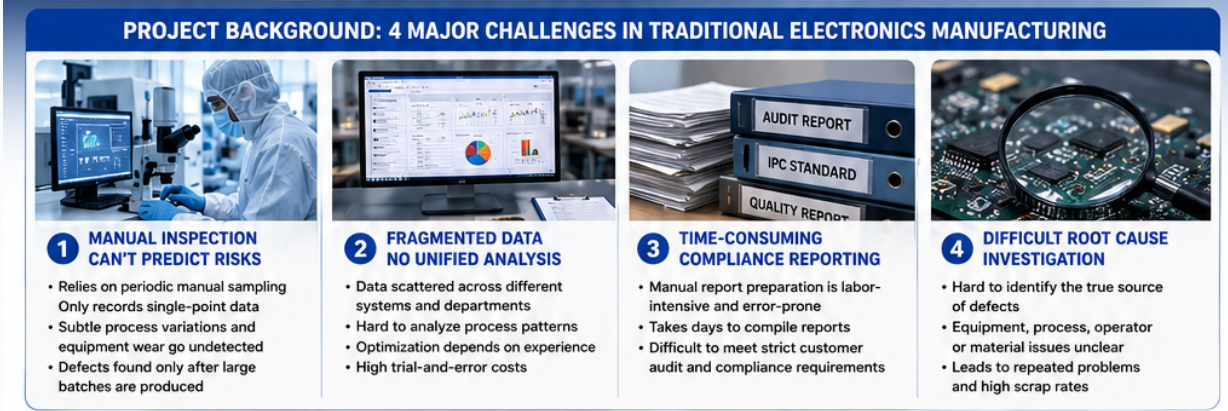
Challenge 1: Manual Inspection Could Not Predict Process Risks
The production line relied heavily on periodic manual sampling.
Critical process characteristics such as:
- PCB trace width
- Copper thickness
- Reflow soldering temperature
- Photolithography parameters
were recorded only as individual measurements.
This made it difficult to identify subtle process trends, equipment wear, and parameter drift before defects occurred.
As a result, corrective actions were often taken only after large batches of defective products had already been produced.
Challenge 2: Fragmented Data with No Unified Analysis Platform
Production data, inspection data, and equipment data existed in separate systems across different workshops and departments.
Without centralized analysis:
- Process optimization relied on operator experience
- Root causes were difficult to identify
- Continuous improvement initiatives lacked data support
- Trial-and-error costs remained high
The company had data, but lacked actionable insights.
Challenge 3: Time-Consuming Compliance Reporting
To satisfy customer audits, IPC standards, and quality management certifications, the quality team spent considerable time manually preparing:
- Process capability reports
- Quality summaries
- Compliance documentation
- Audit records
The process was labor-intensive, inefficient, and prone to human error.
Challenge 4: Difficult Root Cause Investigation
When defects occurred, the company struggled to determine whether the source was:
- Equipment instability
- Process parameter variation
- Operator error
- Material inconsistency
- Environmental influences
Without effective root cause analysis, corrective actions were often based on assumptions rather than evidence.
This resulted in ongoing quality losses and rising manufacturing costs.
Solution: End-to-End Digital Process Control with NexSPC
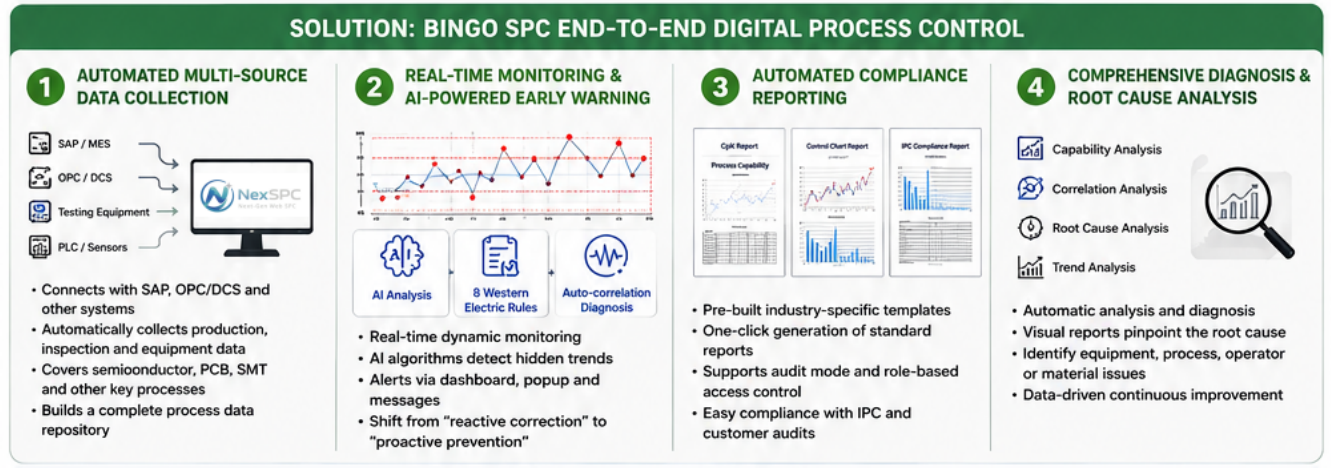
To address these challenges, NexSPC delivered a lightweight, AI-enhanced SPC solution tailored specifically for electronics manufacturing.
The platform was deployed rapidly without complex implementation requirements and provided unlimited user access across the entire factory.
1. Automated Multi-Source Data Collection
NexSPC integrated directly with:
- SAP systems
- OPC devices
- DCS systems
- Production databases
- Inspection systems
This enabled automatic synchronization of:
- Production data
- Inspection data
- Process parameters
without manual data entry.
Critical manufacturing data such as:
Semiconductor Processes
- Photolithography
- Etching
- Thin-film deposition
PCB Manufacturing
- Trace width
- Copper thickness
SMT Production
- Placement accuracy
- Reflow soldering temperature
could now be collected and analyzed within a single platform.
The result was a complete digital process database connecting production, quality, and equipment information.
2. Real-Time Monitoring and AI-Powered Early Warning
NexSPC combines:
- Standard SPC control rules
- Advanced AI analytics
- Autocorrelation diagnostics
- Trend detection algorithms
Unlike traditional SPC systems that focus only on isolated out-of-control points, NexSPC identifies hidden process trends and emerging risks before they become quality issues.
When abnormal behavior is detected, alerts are immediately delivered through:
- Dashboard notifications
- Real-time messages
- Factory display screens
This transforms quality management from reactive correction to proactive prevention.
3. Automated Compliance Reporting
To meet the strict requirements of electronics manufacturing audits, NexSPC includes industry-specific reporting templates.
The system automatically generates:
- Cpk reports
- Defect rate analysis
- Process capability studies
- Process variation reports
- IPC compliance documentation
- Customer audit reports
With a single click.
Additional features include:
- Customer audit mode
- Role-based access control
- Data security management
allowing manufacturers to demonstrate compliance while protecting sensitive production data.
4. Comprehensive Process Diagnosis and Root Cause Analysis
NexSPC automatically performs:
- Process capability analysis
- Correlation analysis
- Root cause investigation
- Trend analysis
The platform generates visual reports that clearly identify whether quality issues are caused by:
- Equipment wear
- Process parameter drift
- Environmental changes
- Human factors
This enables targeted corrective actions and data-driven continuous improvement.
Results After Six Months of Implementation
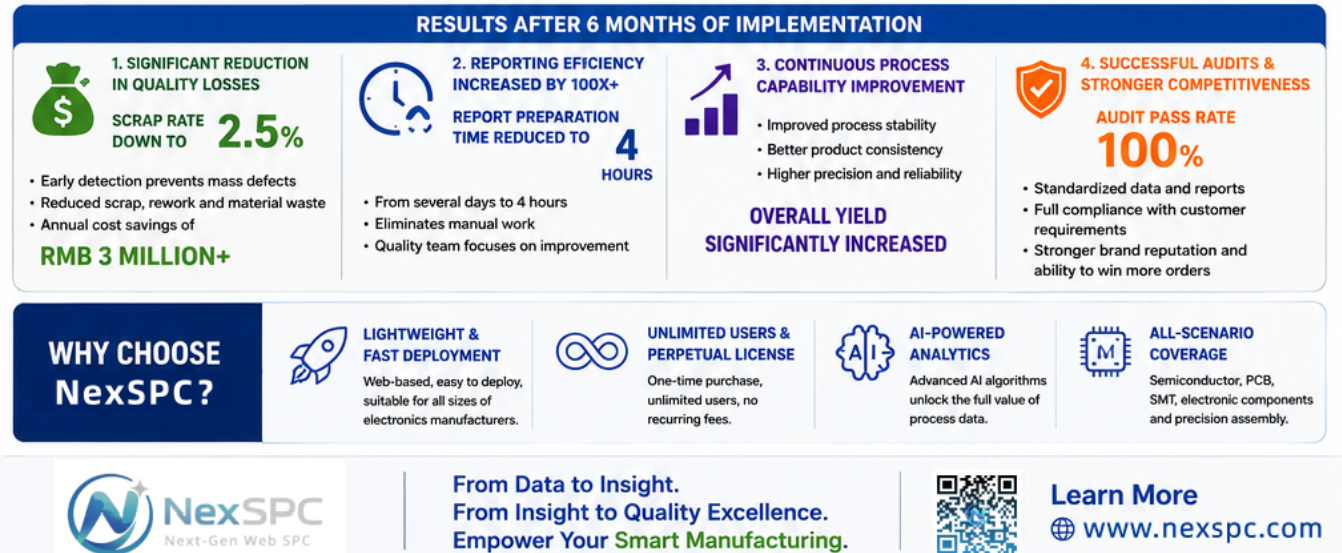
After six months of operation, the company achieved significant improvements across quality, cost, and operational efficiency.
1. Significant Reduction in Quality Losses
Through continuous monitoring and early warning capabilities, the manufacturer dramatically reduced large-scale defect incidents.
Key results included:
- Scrap rates reduced to 2.5%
- Earlier abnormality detection
- Lower rework costs
- Reduced material waste
The company achieved direct annual savings exceeding RMB 3 million through reduced production losses and quality-related expenses.
2. Reporting Efficiency Increased by More Than 100×
Manual report preparation was virtually eliminated.
Tasks that previously required several days of manual work could now be completed automatically.
Report preparation time was reduced to approximately four hours, allowing quality engineers to focus on process improvement rather than administrative tasks.
3. Continuous Process Capability Improvement
Using AI-driven analytics and trend monitoring, the company continuously optimized key manufacturing processes including:
- SMT assembly
- Semiconductor processing
- PCB production
Benefits included:
- Higher process stability
- Improved product consistency
- Better precision control
- Increased overall yield
The long-standing challenge of inconsistent product quality was effectively eliminated.
4. Faster and More Successful Customer Audits
The company established a fully digital quality management framework featuring:
- Standardized process records
- Automated compliance reports
- Visualized process monitoring
As a result:
- Customer audit pass rate reached 100%
- Supply chain credibility improved significantly
- The company became more competitive for high-value projects and premium customers
Why Electronics Manufacturers Choose NexSPC
Compared with traditional SPC systems that are expensive, complex, and difficult to deploy, NexSPC is designed specifically for modern manufacturing environments.
Rapid and Lightweight Deployment
- Web-based architecture
- No client installation required
- On-premises deployment support
- Fast implementation
Suitable for electronics manufacturers of all sizes.
Perpetual Licensing with Unlimited Users
- One-time purchase
- Lifetime usage rights
- Unlimited users
- No recurring license fees
Delivering exceptional long-term value.
AI-Powered Advanced Analytics
By integrating large language models and advanced statistical analysis, NexSPC helps manufacturers:
- Understand process behavior
- Detect hidden risks
- Simplify complex SPC analysis
- Turn data into actionable improvements
Comprehensive Electronics Industry Coverage
NexSPC supports a wide range of electronics manufacturing applications, including:
- Semiconductor manufacturing
- PCB production
- SMT assembly
- Electronic component manufacturing
- Precision electronic assembly
making it a versatile platform for the entire electronics industry.
Conclusion
Competition in electronics manufacturing ultimately comes down to two factors:
Quality and Cost.
Traditional quality management methods based on manual inspection, experience, and post-production correction are no longer sufficient for today's highly precise manufacturing environment.
NexSPC combines:
- Real-time process monitoring
- AI-powered analytics
- Automated data collection
- Intelligent early warning
- Digital quality management
to help manufacturers achieve:
√ Stable processes
√ Predictable quality
√ Lower production costs
√ Higher yields
√ Stronger customer confidence
By transforming quality data into actionable intelligence, NexSPC enables electronics manufacturers to move from reactive quality control to proactive process excellence.