














For manufacturers pursuing digital transformation, selecting the right SPC software is often the first major challenge.
The market offers a wide variety of SPC solutions, with prices ranging from a few thousand dollars to enterprise-level investments costing hundreds of thousands.
Common questions include:
- What types of SPC software are available today?
- How is the SPC market evolving?
- Which architecture is best suited for modern manufacturing environments?
- Why are more companies moving toward Web-based SPC platforms?
This article provides a comprehensive overview of the SPC software landscape and explains why Web-based SPC has become the preferred choice for modern manufacturers.
Understanding the Three Generations of SPC Software
SPC software should not be viewed as a single category.
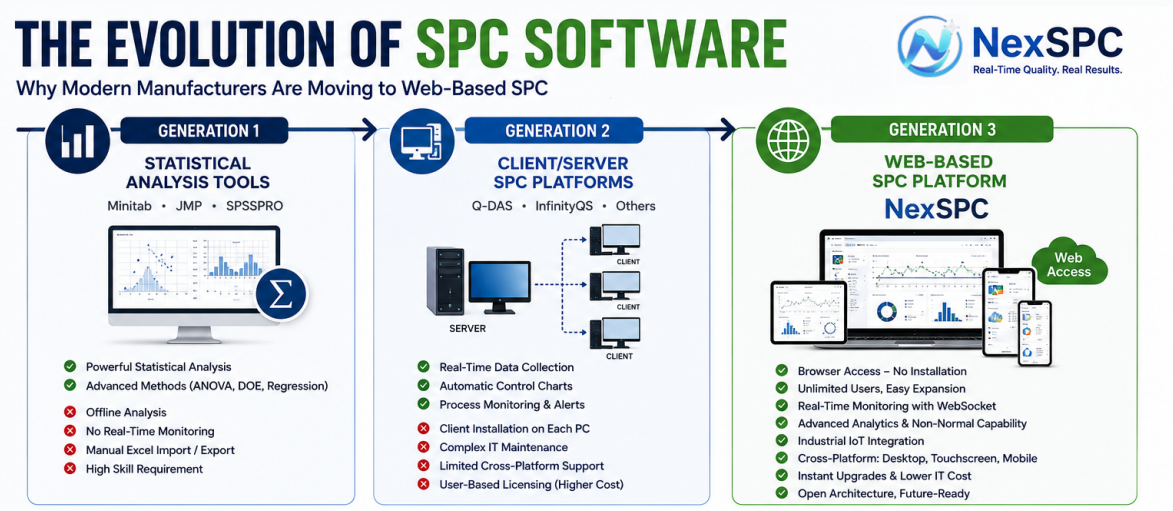
Based on system architecture, application scenarios, and data processing capabilities, today's SPC solutions can generally be divided into three generations.
Generation 1: Standalone Statistical Analysis Tools
Representative Solutions
- Minitab
- JMP
- SPSSPRO
Typical Use Cases
- Research & Development
- Quality Engineering
- Laboratory Analysis
- Root Cause Analysis (RCA)
Key Characteristics
These tools excel at advanced statistical analysis and provide capabilities such as:
- ANOVA
- DOE (Design of Experiments)
- Regression Analysis
- Multivariate Statistics
However, they are primarily designed for offline analysis.
Quality engineers must manually:
- Export production data
- Import spreadsheets
- Build reports
As a result, these tools cannot support:
- Automated shop-floor data collection
- Real-time process monitoring
- Second-level abnormality alerts
They are powerful statistical calculators, but not real-time manufacturing platforms.
Generation 2: Traditional Client-Server (C/S) SPC Platforms
Representative Solutions
- Q-DAS
- InfinityQS
- Other traditional SPC monitoring systems
Typical Use Cases
- Manufacturing workshops
- Real-time data collection
- Process monitoring
Advantages
Compared with standalone tools, these systems introduced:
- Direct gauge connectivity
- Automatic control chart generation
- Online process monitoring
for the first time.
Limitations
Most of these platforms were designed years ago using a traditional Client/Server architecture.
Common challenges include:
- Software installation required on every workstation
- Complex deployment and upgrades
- High IT maintenance workload
- Limited support for mobile devices
- Poor compatibility with modern web environments
Adding a new workstation often requires:
- Software installation
- Local configuration
- User setup
- Ongoing maintenance
Many systems also charge based on:
- Number of users
- Number of clients
- Subscription licenses
As factories expand, software costs increase accordingly.
These legacy architecture limitations are becoming increasingly apparent in modern manufacturing environments.
Generation 3: Native Web-Based Distributed SPC Platforms
Representative Solution
NexSPC
Typical Use Cases
- Multi-site manufacturing groups
- Semiconductor production
- Battery manufacturing
- Precision machining
- High-frequency data collection environments
Key Characteristics
NexSPC is built on a true Browser/Server (B/S) architecture.
This means:
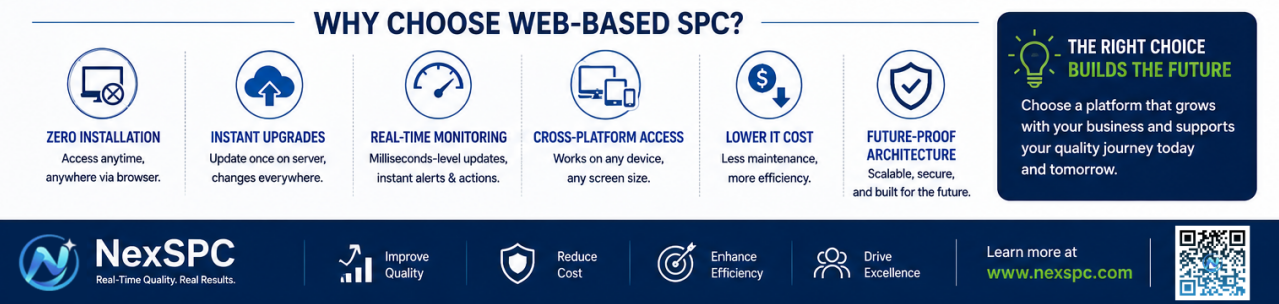
Deploy once on the server and access from anywhere through a web browser.
No client installation is required.
Users can access the platform through:
- Desktop PCs
- Industrial workstations
- Large production dashboards
- Tablets
- Smartphones
At the same time, NexSPC combines:
- Advanced SPC analytics
- Non-normal distribution capability analysis
- Industrial IoT connectivity
- Modern user experience
within a lightweight and scalable platform.
What About SPC Modules Built into MES or ERP Systems?
Many MES and ERP platforms include basic SPC functionality.
These modules usually provide:
- Simple Cpk calculations
- Basic Xbar-R charts
- Basic Xbar-S charts
While useful for basic monitoring, they often lack advanced capabilities such as:
- Real-time data cleansing
- Flexible SPC rule configuration
- Advanced abnormality detection
- Closed-loop corrective action management
- Deep statistical analysis
For manufacturers requiring rigorous process control, dedicated SPC platforms remain the preferred solution.
How Is the SPC Market Evolving?
The SPC software market is currently undergoing significant transformation.
Three major trends are shaping the future.
Trend 1: From Offline Analysis to Real-Time Manufacturing Platforms
Manufacturers can no longer afford to spend hours exporting spreadsheets and generating reports manually.
Organizations increasingly expect:
- Automated data acquisition
- Real-time monitoring
- Instant abnormality alerts
- Factory-wide visibility
Investment is rapidly shifting toward real-time SPC platforms.
Trend 2: Advanced Capability Analysis for Non-Normal Data
In industries such as:
- Semiconductors
- Solar manufacturing
- Battery production
- Precision machining
many critical measurements do not follow a perfect normal distribution.
Examples include:
- Roundness
- Surface roughness
- Flatness
- Cylindricity
Traditional SPC systems often assume normality and produce misleading capability results.
Modern SPC platforms must support advanced statistical methods such as:
- Box-Cox Transformation
- Johnson Transformation
- Non-Normal Capability Analysis
Statistical rigor is becoming a key differentiator.
Trend 3: Open Architecture and Technology Independence
Manufacturers increasingly seek software platforms that offer:
- Flexible deployment
- Database independence
- Open integration standards
- Long-term technology sustainability
Modern Web-based platforms provide significantly greater flexibility than traditional desktop architectures.
Why Are More Companies Choosing Web-Based SPC?
After understanding the market evolution, the next question becomes obvious:
Why are so many manufacturers insisting on a native Web architecture?
The answer lies in three major advantages.
1. Zero-Client Deployment Reduces IT Workload
Traditional SPC systems can create significant maintenance overhead.
Every workstation requires:
- Installation
- Configuration
- Upgrades
- Troubleshooting
With a Web-based platform such as NexSPC:
System Upgrades
Administrators update only the server.
Users simply refresh their browser and immediately access the latest version.
Production Expansion
Adding a new workstation is as simple as:
- Opening a browser
- Entering the system URL
- Logging in
Implementation time can be reduced dramatically.
2. Real-Time Monitoring Through WebSocket Technology
Many people assume web applications are slower than desktop software.
Modern Web technology has eliminated this limitation.
NexSPC utilizes WebSocket technology to provide real-time bidirectional communication.
When data arrives from:
- PLCs
- Measurement devices
- MES systems
control charts update instantly without requiring page refreshes.
When an abnormality is detected, the system can:
- Display visual alerts
- Trigger warning sounds
- Send notifications through Email, Teams, DingTalk, or Lark
- Initiate corrective action workflows
all in real time.
3. Seamless Cross-Platform Experience
Modern Web technologies such as:
- HTML5
- Canvas
- WebGL
allow a single application to adapt automatically across devices.
Large Shop-Floor Displays
Optimized for:
- Large fonts
- Dashboard layouts
- Real-time monitoring centers
Industrial Workstations
Optimized for:
- Touch screens
- Operator interaction
- Production environments
Mobile Devices
Optimized for:
- Smartphones
- Tablets
- Remote management
Executives can review key quality metrics and Cpk trends from anywhere.
Choosing an SPC System Is Choosing Your Future Technology Platform
Selecting industrial software is not simply purchasing a tool.
It is choosing a technology platform that may remain in operation for the next 5 to 10 years.
Organizations that continue investing in outdated Client/Server systems often inherit:
- Higher maintenance costs
- Upgrade difficulties
- Scalability limitations
- Technology debt
The future of SPC belongs to platforms that combine:
- Advanced statistical analytics
- Real-time monitoring
- Open integration
- Modern Web architecture
Conclusion
Understanding the current SPC landscape makes one thing clear:
The industry is moving toward Web-based, real-time, intelligent SPC platforms.
For manufacturers operating in:
- Semiconductor manufacturing
- Battery production
- Electronics assembly
- Precision machining
- Smart factories
modern Web-native platforms such as NexSPC provide the scalability, flexibility, and analytical power required for next-generation quality management.
Understand the categories. Choose the right architecture. Build a future-ready quality system.