














As Industrial IoT becomes increasingly widespread, manufacturing equipment now generates massive amounts of inspection data every second.
However, when traditional SPC analysis methods are directly applied to high-frequency production data, they often create large numbers of unnecessary “false alarms.”
This article introduces a dynamic monitoring method based on Sliding Window Extremes, and explains how this approach helps manufacturers filter out process noise while accurately identifying real process abnormalities.
1. The SPC Alarm Storm Caused by High-Frequency Data
During factory digital transformation projects, many companies encounter the same frustrating situation.
The IT department invests significant effort connecting equipment parameters such as:
- Temperature
- Pressure
- Torque
- Machine status data
to the network infrastructure, enabling:
- Real-time second-level data acquisition
- Real-time SPC monitoring
At first, everyone believes this will finally provide complete visibility into the manufacturing process.
But shortly after the SPC system goes live:
Email inboxes and enterprise messaging systems become flooded with SPC alarms.
Why Traditional SPC Struggles with High-Frequency Data
Traditional SPC monitoring typically relies on:
- Long-term historical data
- Fixed upper and lower control limits
This model is based on an important assumption:
Process data is statistically independent and stable.
However, in real second-level production environments:
- Equipment parameters are highly continuous
- Small natural oscillations constantly occur
- Signals contain short-term noise and vibration
If extremely strict fixed control limits are directly applied to second-level data:
The system may trigger alarms every time the machine simply “takes a breath.”
The Result: Alarm Fatigue
Engineers go to the production floor to investigate alarm after alarm — only to discover:
Nothing is actually wrong.
Over time, this “alarm storm” creates a classic:“Boy Who Cried Wolf” effect.
As a result:
- Operators begin ignoring alarms
- Quality teams lose trust in notifications
- Real process risks may eventually be overlooked
2. What Is “Sliding Window Extremes” Monitoring?
To solve the false alarm problem, SPC systems must begin to:
“Think more like experienced operators.”
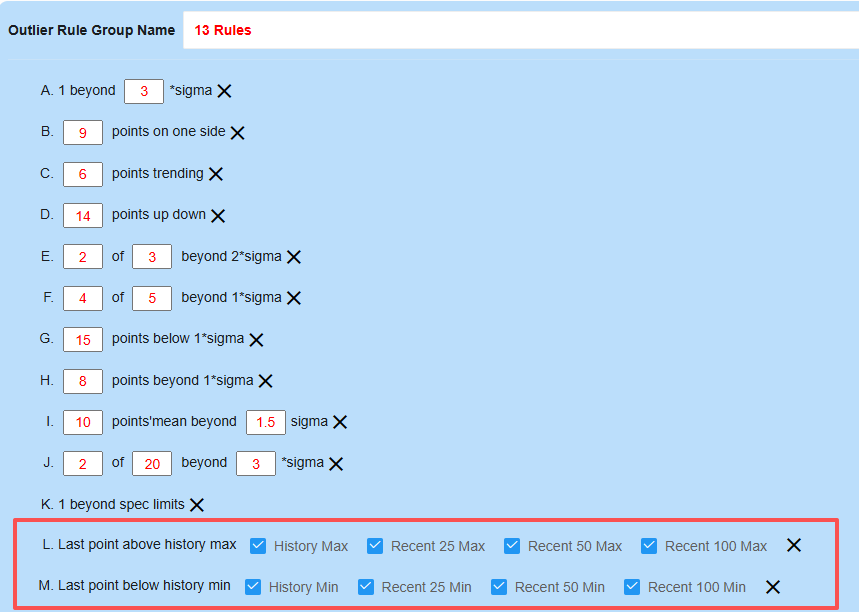
In the latest version of NEXSPC, we introduced the: Sliding Window Extremes Rule.
This gives the SPC system a form of:“Short-term memory.”
How the Sliding Window Extremes Rule Works
The logic is simple, but highly practical.
When a new inspection result enters the SPC system, the software automatically reviews:
- The previous 25 products
- The previous 50 products
- Or the previous 100 products
The system then identifies:
- The maximum value
- The minimum value
within that recent production window.
The newly incoming data point is evaluated against these recent local extremes.
Instead of relying only on fixed historical control limits, the system creates:
A dynamic “exclusive warning boundary” based on recent process behavior.
3. The Business Value of Sliding Window Extremes
This feature was specifically designed for high-frequency manufacturing environments and delivers significant operational benefits.
1. Filtering Equipment Noise and Eliminating Invalid Alarms
Instantaneous spikes on production lines are extremely common.
For example:
- Temporary sensor fluctuations
- One-second signal disturbances
- Short communication interruptions
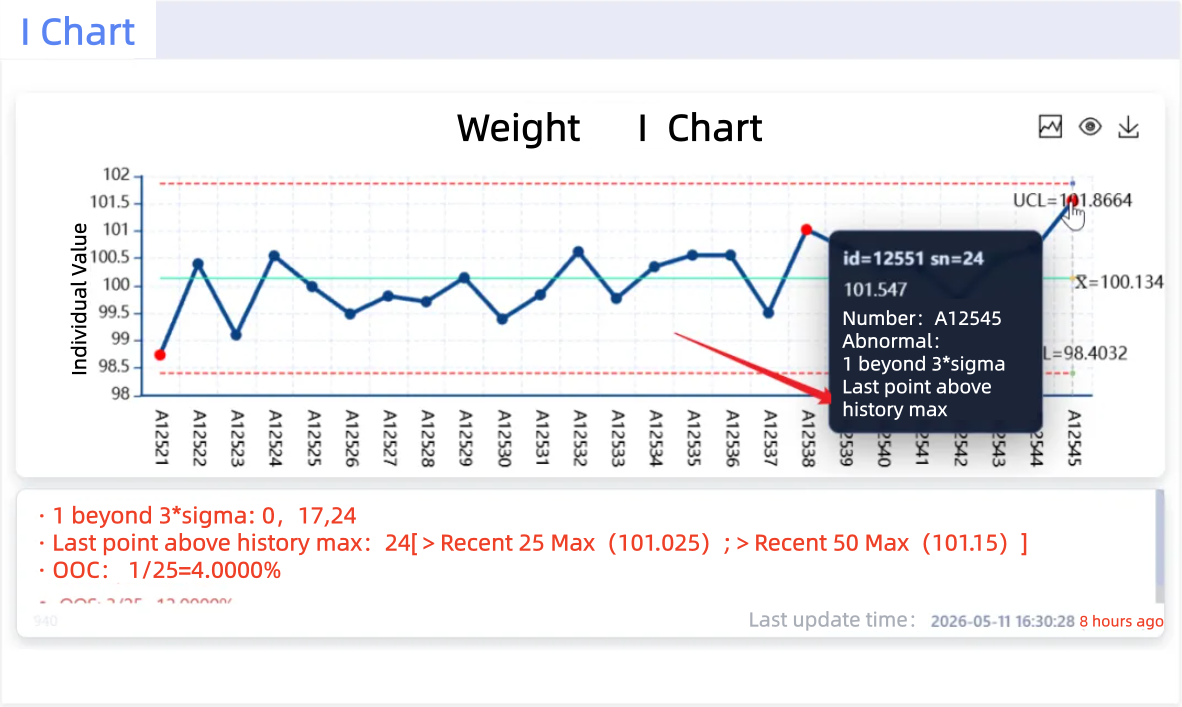
Under the Sliding Window Extremes mechanism, the system focuses on only one critical question:
Has the current point truly broken through the recent real process ceiling or floor?
If the abnormality is merely a short-lived noise spike:
- It quickly exits the sliding window memory
- It no longer continuously interferes with SPC analysis
This allows quality engineers to focus only on:
Meaningful process abnormalities.
In many high-frequency applications, this mechanism can dramatically reduce invalid alarms.
2. Detecting Process Drift Early
Gradual process issues such as:
- Tool wear
- Filter blockage
- Thermal drift
- Equipment aging
often evolve slowly over time.
Traditional fixed SPC limits may not trigger warnings until:
- The parameter fully exceeds specifications
- Scrap products have already been produced
However, Sliding Window Extremes continuously follows the real-time process trend.
Once a parameter suddenly breaks:“Its own recently established record,”
the system immediately generates an early warning.
This enables manufacturers to:
- Detect abnormalities earlier
- Prevent defects before they occur
- Improve predictive quality management
4. Best Practice Recommendations
Technology is only a tool — effective management remains the foundation.
To fully leverage massive Industrial IoT data for quality improvement, manufacturers should consider the following practices.
Reduce Noise Through Smart Downsampling
For data that changes every second, companies may choose to:
- Calculate 5-minute averages first
- Then send the aggregated data into SPC charts
This allows engineers to observe: Real production trends,
instead of: Every minor machine fluctuation.
Apply Layered Monitoring Strategies
Different parameters require different SPC strategies. For example:
Use Traditional Strict SPC Rules For:
- Final product dimensions
- Critical concentrations
- Key customer characteristics
Use Sliding Window Extremes For:
- Equipment auxiliary parameters
- High-frequency sensor signals
- Machine operating conditions
This creates a balanced approach between:
- Monitoring sensitivity
- Operational efficiency
Smarter SPC for the Industrial IoT Era
True industrial digitalization is not simply about collecting more data.
It is about:
Transforming data into actionable manufacturing intelligence through smarter algorithms.
The introduction of the Sliding Window Extremes Rule represents another important step toward:
Adaptive dynamic quality management in modern SPC systems.
With NEXSPC:
- Manufacturers can reduce alarm storms
- Improve alarm credibility
- Enhance process monitoring efficiency
- Ensure every alarm deserves attention
Conclusion
As manufacturing enters the Industrial IoT and Industry 4.0 era, traditional fixed SPC logic is no longer sufficient for massive high-frequency production data.
The Sliding Window Extremes approach helps manufacturers:
- Filter meaningless process noise
- Capture true process drift
- Reduce false alarms
- Build more intelligent SPC monitoring systems
NEXSPC continues to focus on practical, manufacturing-oriented SPC innovation — helping enterprises move from passive alarm response toward smarter predictive quality control.