













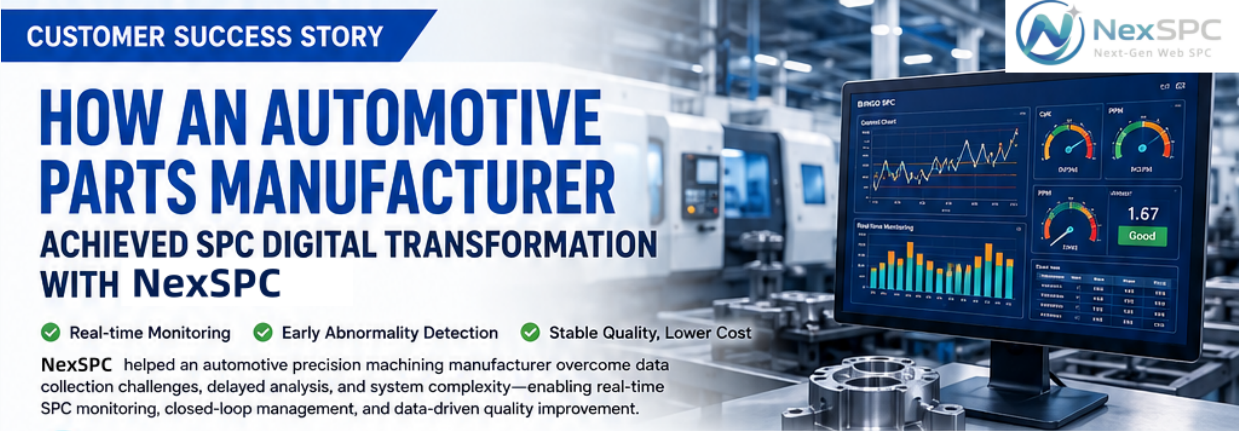
In the automotive parts industry, quality stability is not something that simply happens during production—it is achieved through continuous process monitoring.
Particularly in precision machining environments, issues such as dimensional drift, tool wear, thermal deformation, and operator variation often do not immediately create out-of-specification products. Instead, these small variations accumulate over time and eventually impact the quality of entire production batches.
For many manufacturers, the challenge is not a lack of SPC knowledge. The real problems are:
- SPC systems are too complex for shop-floor adoption
- Data collection relies heavily on Excel spreadsheets
- Abnormalities are discovered too late
- Software implementation is costly and time-consuming
- Operators find the system difficult to use
- SPC becomes a reporting tool rather than a process control tool
One automotive precision machining company faced exactly these challenges before implementing NexSPC.
Customer Background
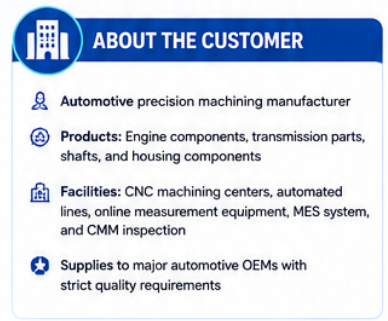
The customer is a precision automotive machining manufacturer producing:
- Engine components
- Transmission precision parts
- Critical shafts and housing components
Their production facility includes:
- CNC machining centers
- Automated production lines
- Online measurement equipment
- MES systems
- Coordinate Measuring Machine (CMM) inspection stations
As a long-term supplier to major automotive OEMs, the company operates under strict process quality requirements.
In recent years, customer audits have increasingly focused on:
- Critical dimension monitoring
- SPC control charts
- Cpk and Ppk capability analysis
- Closed-loop abnormality management
- Full process traceability
Their existing quality control approach relied primarily on:
- Manual SPC analysis in Excel
- Periodic inspection sampling
- Manual abnormality tracking
- Weekly and monthly quality reports
As production volume increased and manufacturing capacity expanded, this approach became increasingly difficult to sustain.
Key Challenges
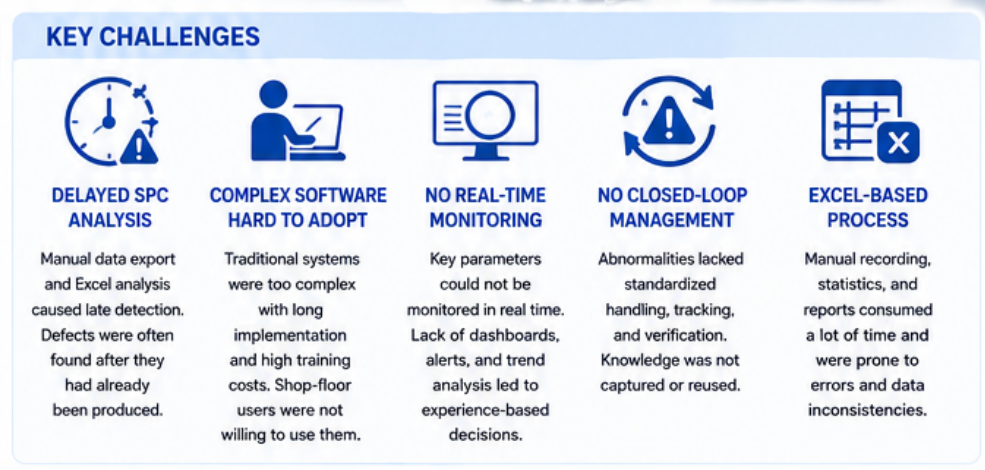
1. SPC Analysis Was Too Late
Production data had to be manually exported and analyzed.
By the time abnormalities were discovered:
- Cutting tools had already worn out
- Machines had already drifted
- Defective products had already been produced
SPC functioned as a retrospective analysis tool rather than a real-time process control system.
2. Shop-Floor Personnel Could Not Use Complex SPC Software
The company had evaluated several large-scale quality management systems.
Although powerful, these systems suffered from:
- Complex interfaces
- Long implementation cycles
- High training requirements
- Poor usability
The result was a common problem:
Quality engineers used the software, but production personnel did not.
3. No Real-Time Monitoring of Critical Processes
Critical quality characteristics such as:
- Bore diameter
- Outer diameter
- Concentricity
- Press-fit force
- Torque
could not be monitored dynamically in real time.
The factory lacked:
- SPC dashboards
- Real-time alerts
- Trend analysis tools
Many decisions still depended on operator experience rather than objective data.
4. No Closed-Loop Abnormality Management
Even when SPC abnormalities were detected, there was no standardized process for managing them.
Questions such as:
- Who handled the issue?
- Was corrective action completed?
- Was process stability restored?
- Did the issue recur?
often remained unanswered.
As a result, valuable quality knowledge was not accumulated or reused.
Why the Customer Chose NexSPC
The customer ultimately selected Bingo SPC not because it offered the largest number of features, but because:
It was designed for practical shop-floor implementation.
Compared with traditional SPC systems, Bingo SPC emphasizes:
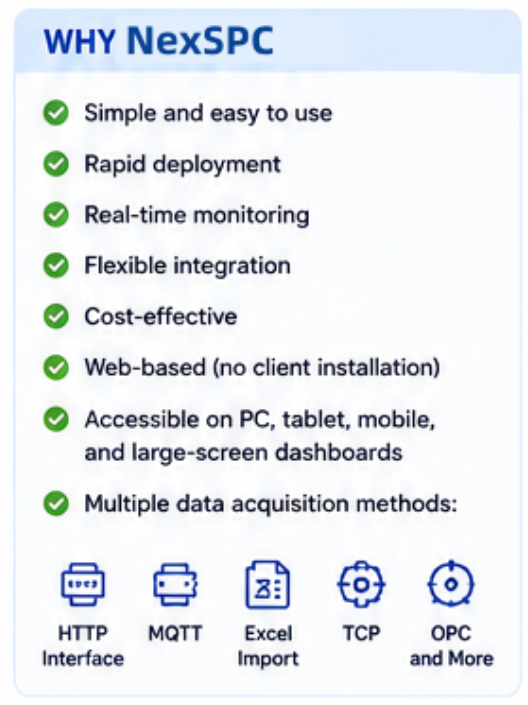
- Simplicity
- Rapid deployment
- Real-time monitoring
- Flexible integration
- Cost-effective implementation
The platform uses a web-based architecture that requires no client installation.
Users can access SPC data from:
- Desktop computers
- Laptops
- Tablets
- Smartphones
- Large-screen production dashboards
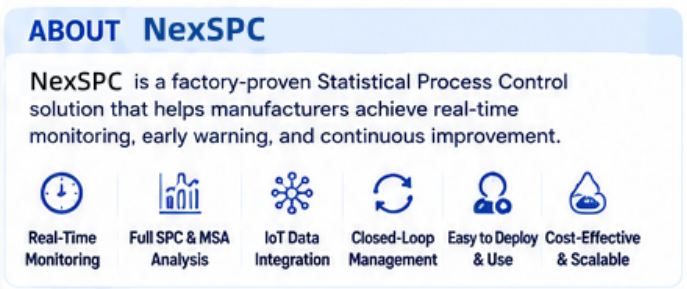
NexSPC also supports multiple data acquisition methods, making deployment in manufacturing environments significantly easier.
Supported integration methods include:
- HTTP APIs
- MQTT
- Excel import
- TCP communication
- OPC connectivity
Project Implementation
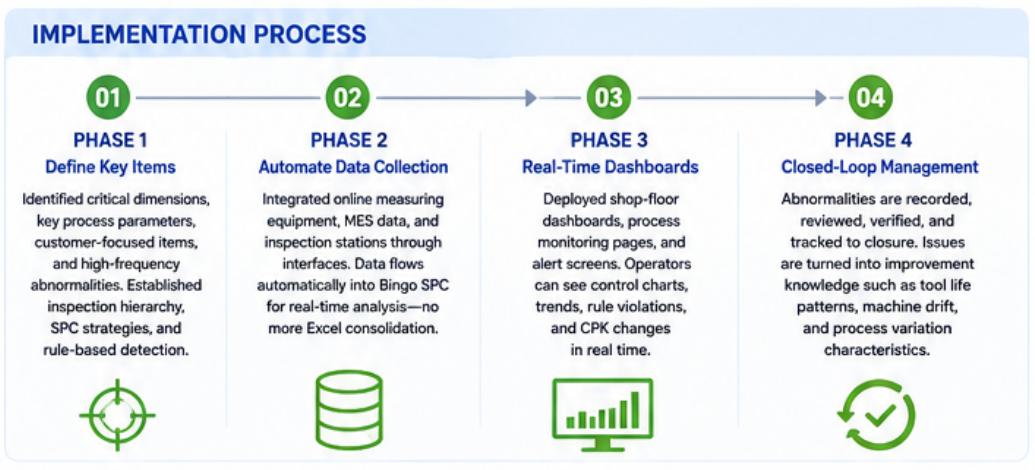
Phase 1: Defining Critical Inspection Characteristics
The company first identified:
- Critical dimensions
- Key process parameters
- Customer-focused quality characteristics
- High-frequency abnormality categories
Based on this information, they established:
- Inspection classification structures
- SPC monitoring strategies
- Rule-based abnormality detection groups
Phase 2: Automated Data Collection
The following data sources were integrated directly into NexSPC:
- Online measuring equipment
- MES systems
- Inspection workstations
This created a fully automated workflow:
Inspection Completed → Data Sent to SPC → Real-Time Analysis
No Excel processing or manual data consolidation was required.
Phase 3: Real-Time SPC Dashboards
The company deployed:
- Shop-floor SPC dashboards
- Process monitoring screens
- Real-time alert pages
Operators and engineers could immediately see:
- Control chart updates
- Process trends
- SPC rule violations
- Cpk changes
This enabled teams to identify issues while they were still developing.
As the customer described:
"Problems are now detected when they first begin to emerge, rather than after they have already caused defects."
Phase 4: Closed-Loop Exception Management
For every SPC abnormality detected:
- Operators recorded the cause
- Process engineers reviewed corrective actions
- The system tracked closure status
Abnormal conditions were no longer simply red warning points on a chart.
Each event became part of a documented improvement process.
Over time, the company accumulated valuable process knowledge regarding:
- Tool life patterns
- Machine drift behavior
- Process variation characteristics
SPC evolved from a reporting tool into a continuous improvement platform.
Results After Implementation
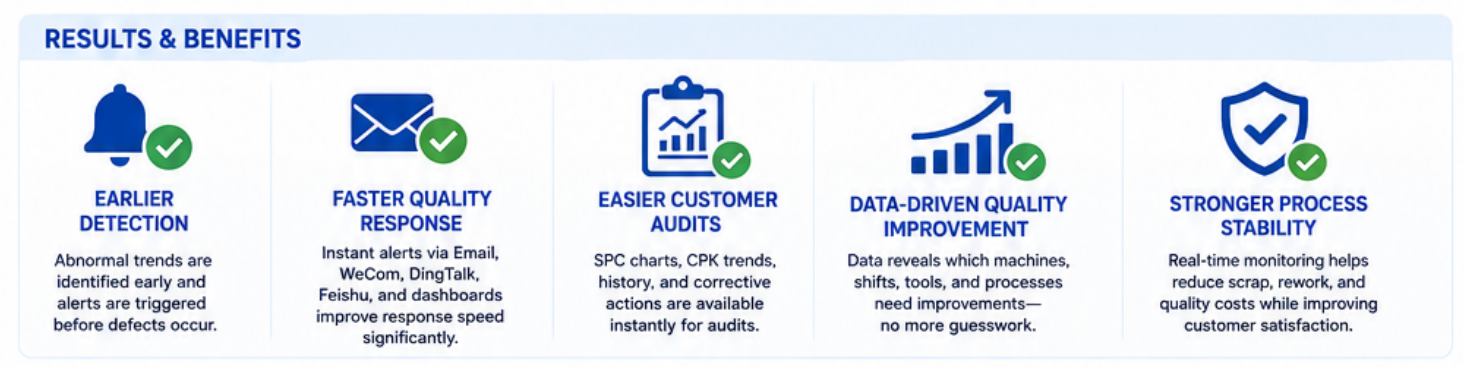
Earlier Detection of Quality Risks
Before implementation:
Defects were often discovered after production issues had already occurred.
After implementation:
The system identifies process drift at an early stage and generates alerts before specifications are violated.
Many potential problems are now resolved before producing defective parts.
Faster Quality Response
NexSPC automatically distributes alerts through:
- WeCom
- DingTalk
- Feishu (Lark)
- Large-screen dashboards
Relevant personnel receive notifications immediately, significantly improving response speed.
Easier Customer Audits
Previously, preparing for customer audits involved:
- Organizing historical records
- Exporting Excel files
- Collecting screenshots manually
Now auditors can access information directly from the system, including:
- SPC control charts
- Cpk trend analysis
- Historical abnormalities
- Corrective action records
According to customer feedback:
"Our process control is now much more transparent and professional."
Data-Driven Quality Improvement
Many quality decisions were previously based on experience and intuition.
Today, SPC data helps the company quickly identify:
- Which machine has the greatest variation
- Which shift performs least consistently
- Which cutting tools have abnormal wear patterns
- Which processes exhibit long-term drift
Continuous improvement has become measurable and data-driven.
The Most Valuable Benefit: Real Shop-Floor Adoption
Many manufacturers already understand SPC theory.
What they truly need is:
An SPC system that people actually use every day.
During the project review, the customer summarized:
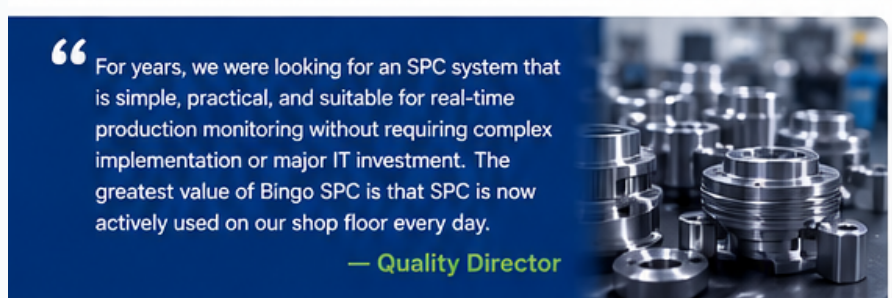
"For years, we were looking for an SPC system that was simple, practical, and suitable for real-time production monitoring without requiring complex implementation or major IT investment. The greatest value of Bingo SPC is not its feature list—it is the fact that SPC is now actively used on our shop floor every day."
Conclusion: SPC Is About More Than Detecting Abnormalities
An effective SPC system does not simply analyze problems after they occur.
It enables manufacturers to:
- Detect trends earlier
- Identify risks sooner
- Intervene before defects occur
In automotive manufacturing, major quality issues rarely happen overnight.
Most begin as small process variations that go unnoticed for too long.
The earlier a manufacturer can detect process drift, the better it can protect product quality and process stability.
That is the true value of SPC.
NexSPC is helping manufacturers transform SPC from a spreadsheet-based reporting tool into a real-time process control platform that drives continuous quality improvement.