













As global supply chains continue to evolve, opportunities for automotive, aerospace, battery, and industrial component manufacturers are growing rapidly.
For suppliers targeting international markets, securing large orders from global OEMs and Tier 1 manufacturers often requires more than competitive pricing and production capacity.
Today, quality capability has become one of the most important differentiators.
Many manufacturers discover that before winning a major contract, they must first pass rigorous supplier audits conducted by international customers.
And during these audits, customers are no longer asking:
"How many defective parts did you catch?"
Instead, they are asking:
"How stable is your manufacturing process?"
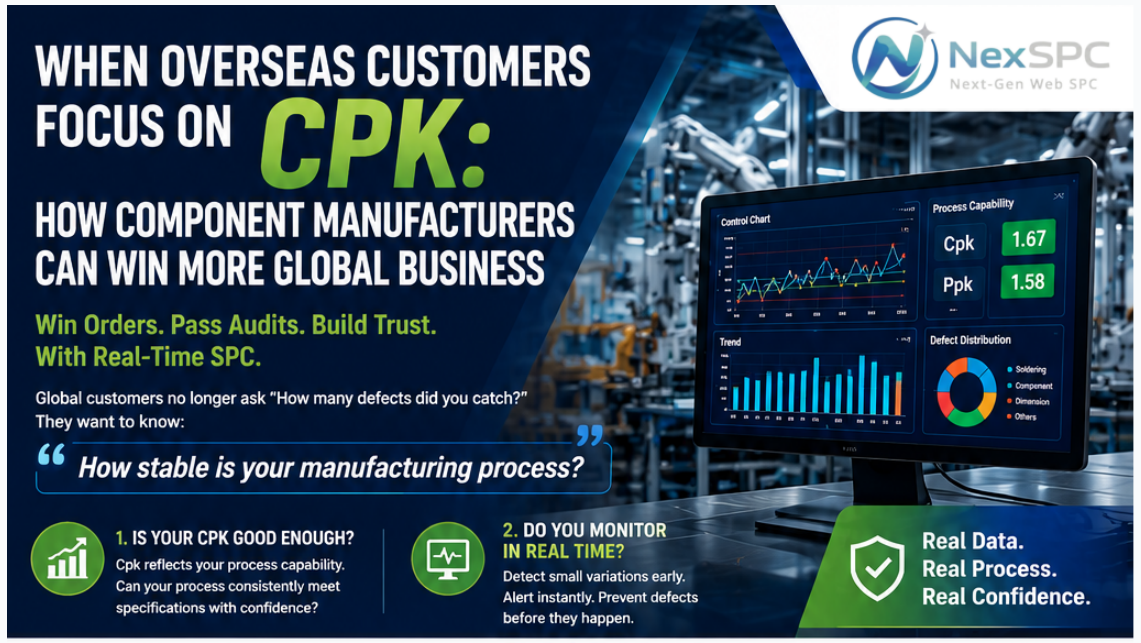
Global Customers Care About Process Capability, Not Just Product Quality
When purchasing teams from leading manufacturers evaluate suppliers, they typically focus on two key questions:
1. Is Your Cpk Good Enough?
Process Capability Index (Cpk) has become one of the most important indicators used to evaluate manufacturing quality.
Customers want to know:
- Can the process consistently meet specifications?
- Is process variation under control?
- Can quality remain stable during high-volume production?
A strong Cpk demonstrates that quality is built into the process rather than relying on final inspection.
2. Do You Monitor the Process in Real Time?
Modern manufacturers expect suppliers to identify quality risks before defects occur.
When process variation appears, can your organization:
- Detect abnormalities immediately?
- Generate automatic alerts?
- Prevent nonconforming products from reaching downstream operations?
Or does the company still rely on manual inspections and post-production sorting?
Increasingly, global customers expect suppliers to operate a real-time, data-driven quality management system.
Why Traditional SPC Approaches Are No Longer Enough
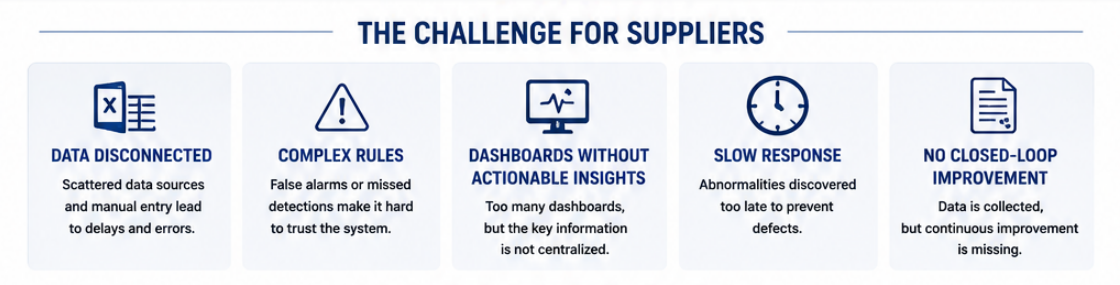
Many manufacturers implemented SPC years ago, but the reality often looks very different from what auditors expect.
Common situations include:
- Control charts updated only at the end of the month
- Data entered manually into spreadsheets
- Reports generated solely for audit purposes
- No real-time process visibility
- No automated abnormality alerts
In today's competitive global supply chain environment, this approach is becoming increasingly difficult to justify.
International customers want to see:
- Live production data
- Real-time SPC charts
- Process capability trends
- Corrective action records
- Evidence of continuous improvement
Static reports and manually maintained spreadsheets rarely provide the level of transparency required by modern supplier audits.
The Hidden Cost of Traditional SPC Software
For many companies, selecting an SPC system introduces another challenge.
Traditional client-server (C/S) software often requires:
- Software installation on every workstation
- Manual operator interaction
- Extensive IT maintenance
- Complex upgrade procedures
More importantly, many systems charge based on:
- Number of users
- Number of workstations
- Number of licenses
As factories expand production capacity, software costs often increase dramatically.
For manufacturers planning new production lines or facility expansions, these hidden costs can quickly become a significant burden.
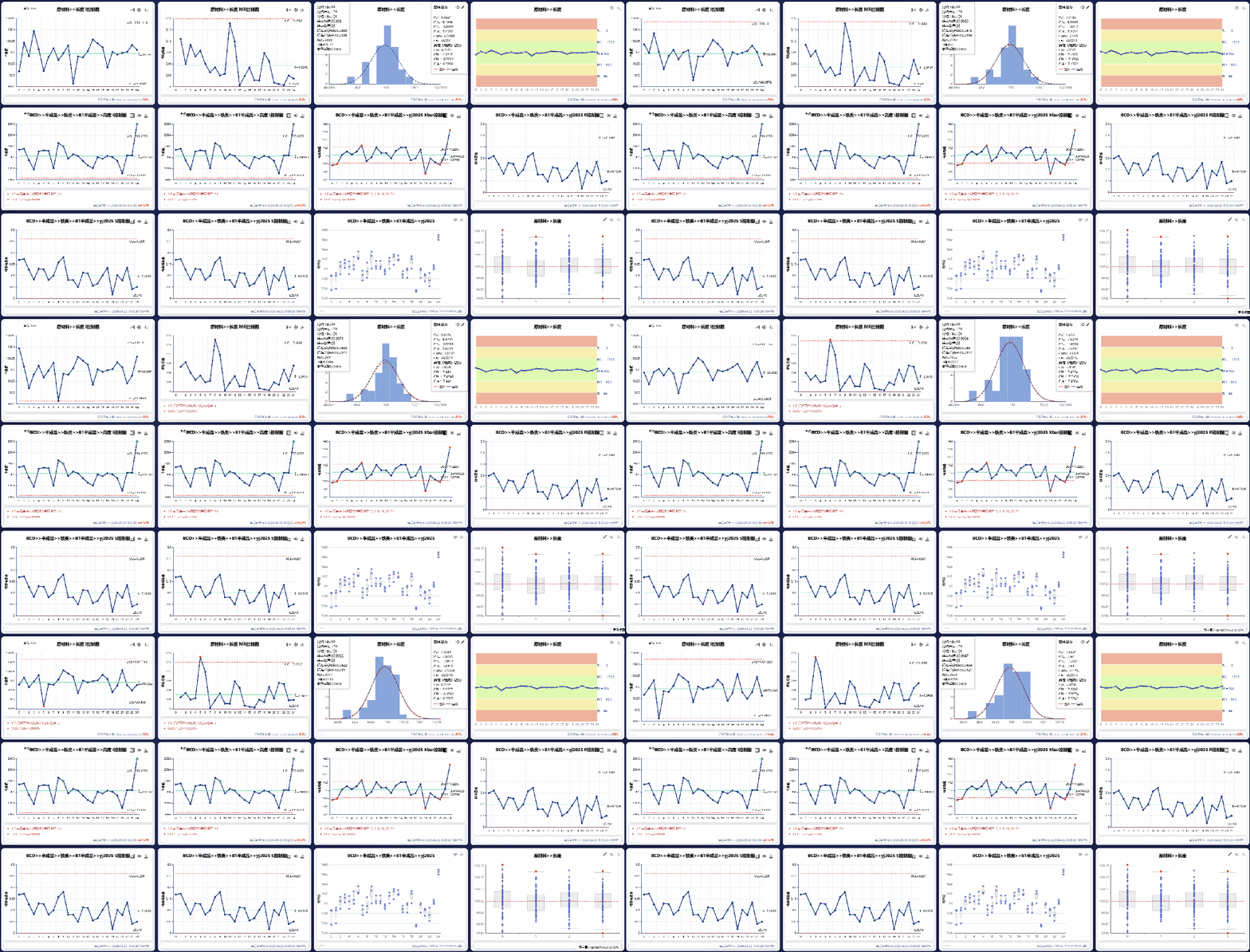
How Manufacturers Are Preparing for Global Quality Audits with NexSPC
Recently, many manufacturers preparing for international expansion have chosen NexSPC after evaluating multiple SPC solutions.
Their decision is typically driven by several key advantages.
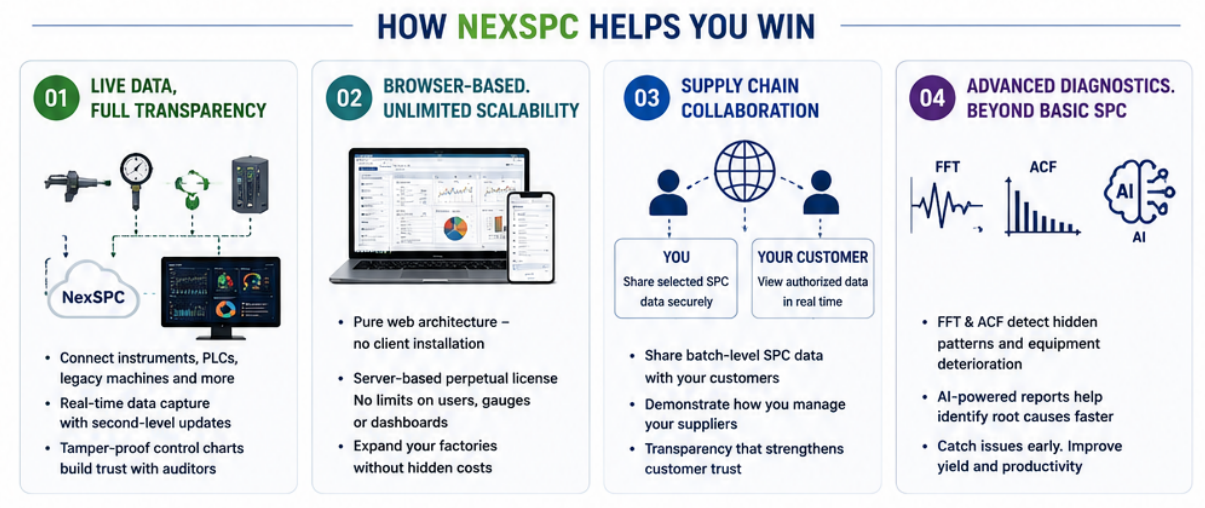
1. Replace Manual Data Entry with Live Production Data
The strongest evidence during a customer audit is real, traceable production data.
NexSPC supports direct connectivity with:
- Digital measuring instruments
- Thickness gauges
- PLC systems
- Inspection equipment
- Legacy machines through shared files
- Industrial IoT devices
Production data can be collected automatically and displayed in real time.
The result is:
- Reduced manual input
- Improved data accuracy
- Better traceability
- Greater customer confidence
Auditors can immediately see real-time process performance rather than static reports.
2. Browser-Based Architecture with Unlimited Scalability
Unlike traditional SPC systems, NexSPC is built on a pure web-based architecture.
Benefits include:
- No client installation required
- Accessible through standard web browsers
- Simplified deployment
- Easier maintenance
Most importantly, NexSPC uses a server-based perpetual licensing model.
Manufacturers receive:
- Unlimited users
- Unlimited inspection characteristics
- Unlimited dashboards
As production grows, software costs remain predictable.
New production lines and additional facilities can be integrated without worrying about workstation-based licensing fees.
3. Greater Supply Chain Transparency
Transparency has become a powerful competitive advantage.
NexSPC includes a unique Supply Chain Collaboration capability that allows manufacturers to securely share selected SPC information with customers.
Through controlled authorization, customers can view:
- Specific production batches
- Process capability performance
- Real-time SPC monitoring results
without exposing sensitive manufacturing know-how.
Manufacturers can also demonstrate how they monitor and manage their own suppliers.
This level of visibility helps strengthen customer trust and supports long-term business relationships.
4. Advanced Analytics Beyond Traditional SPC Rules
For highly demanding industries such as:
- Aerospace manufacturing
- Precision machining
- Battery production
- Semiconductor manufacturing
traditional SPC rules alone may not be sufficient.
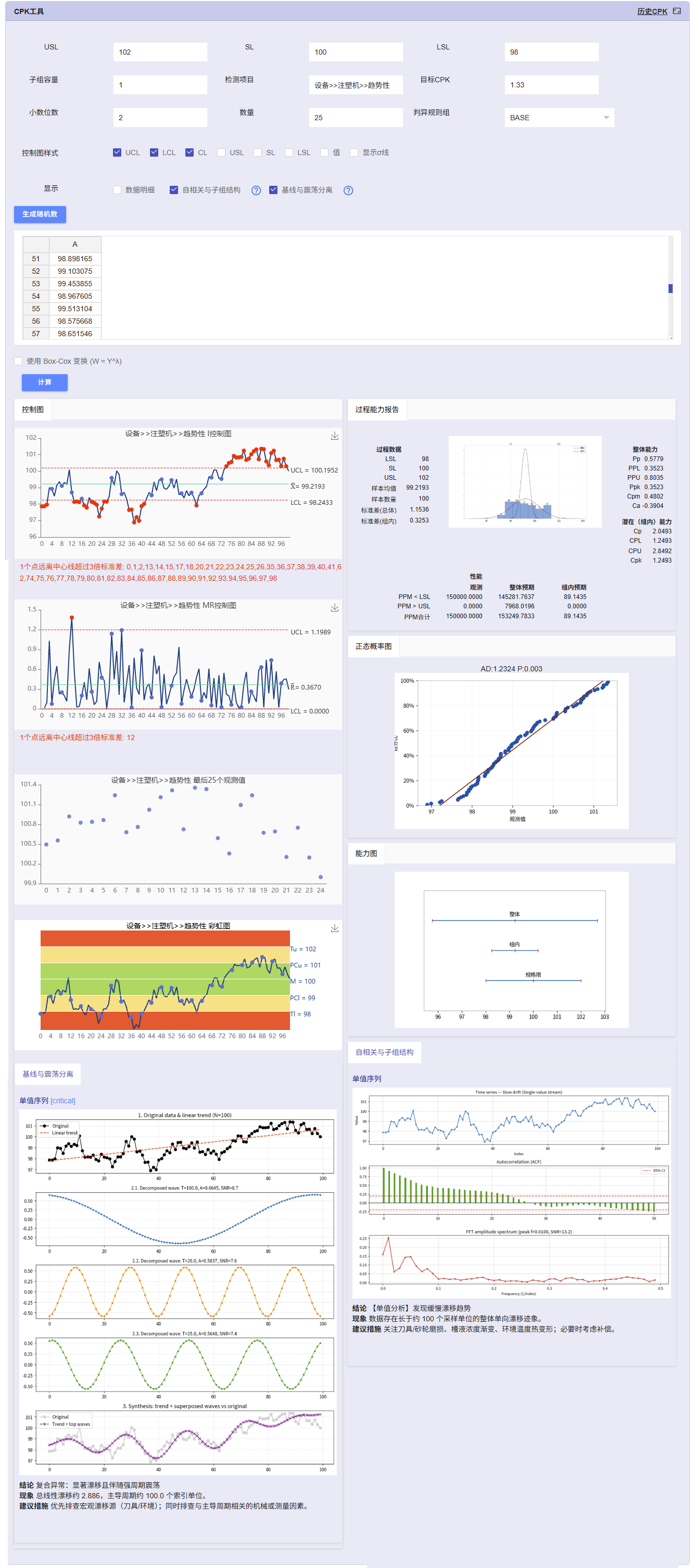
NexSPC provides advanced diagnostic technologies including:
- FFT (Fast Fourier Transform) Analysis
- ACF (Autocorrelation Function) Analysis
- AI-Assisted Process Diagnostics
These tools help identify:
- Equipment deterioration
- Hidden process oscillations
- Long-term process drift
- Early-stage abnormalities
before they impact product quality.
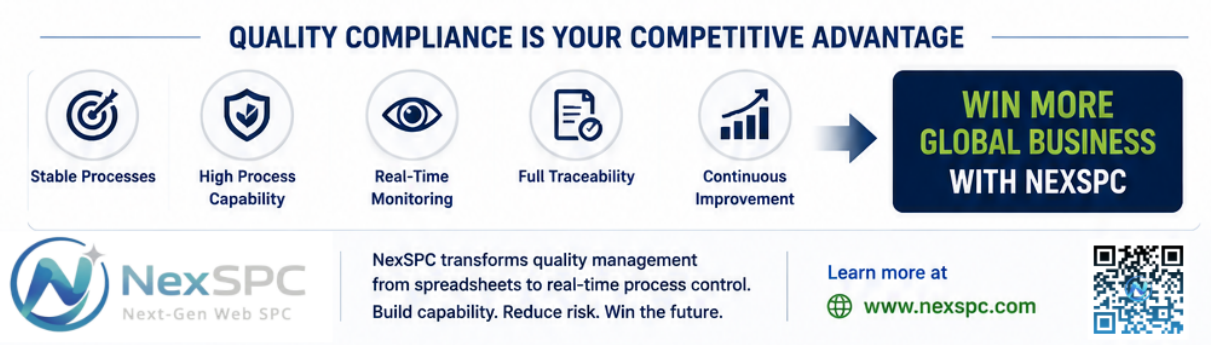
Quality Compliance Is Becoming a Competitive Advantage
The manufacturers that win future global opportunities will not necessarily be those with the lowest prices.
Increasingly, they will be the companies that can demonstrate:
- Stable manufacturing processes
- High process capability
- Real-time quality monitoring
- Transparent quality management
- Strong continuous improvement practices
In global supply chains, quality compliance is no longer just a requirement.
It is becoming a strategic advantage.
Conclusion
When international customers evaluate suppliers, they are looking beyond final inspection results.
They want confidence that your manufacturing process is:
- Stable
- Predictable
- Traceable
- Continuously improving
Modern SPC systems such as NexSPC help manufacturers move beyond spreadsheets and manual reporting toward real-time process control and digital quality management.
For companies preparing for customer audits, expanding production capacity, or competing for global business, investing in process capability and real-time SPC monitoring may be one of the most valuable decisions they can make.
The companies that control process variation first will be the companies that win the next generation of global manufacturing opportunities.