














Why the Best SPC Systems Don't Generate More Alarms—They Generate More Meaningful Ones
Walk into almost any manufacturing plant that has recently implemented an SPC system, and you'll hear the same complaint.
"The dashboard is full of alarms."
Operators begin to ignore them.
Quality engineers spend more time explaining the alarms than investigating them.
Eventually, the SPC system becomes little more than a charting tool used for customer audits instead of a real-time quality management system.
The problem is rarely the control chart itself.
More often, it is the alarm strategy behind it.
Traditional SPC rules were designed decades ago and remain an essential foundation of statistical process control. However, modern manufacturing environments have become far more complex than the production processes those rules were originally created to monitor.
High-speed automated lines, multi-cavity molds, precision machining, semiconductor manufacturing, and intelligent production systems generate process behaviors that cannot always be interpreted using a fixed set of statistical rules.
Modern SPC should not force every production process to follow the same alarm logic.
Instead, alarm strategies should adapt to the characteristics of the process being monitored.
Why Traditional SPC Rules Are No Longer Enough
Most quality engineers are familiar with the Western Electric Rules, which remain the most widely used SPC abnormality detection rules.
These rules are highly effective for identifying process shifts, trends, and unusual variation under stable statistical conditions.
But real manufacturing rarely follows textbook assumptions.
Today's production lines experience:
- Continuous tool wear
- Short-term process disturbances
- High-frequency automated sampling
- Multiple production stations
- Different process capabilities across products
Applying exactly the same alarm rules to every production scenario often produces two undesirable results.
The first is false alarms.
Operators are interrupted even though the process remains under control.
The second is missed opportunities.
Some process abnormalities develop too quickly or behave too differently to trigger traditional SPC rules until quality has already begun to deteriorate.
A smarter SPC system should do more than apply fixed statistical rules.
It should provide flexible alarm strategies that match the behavior of the manufacturing process.
Four Capabilities Every Modern SPC System Should Provide
Instead of relying on one fixed alarm strategy, modern SPC software should allow manufacturers to combine different monitoring methods according to their products, equipment, and quality objectives.
1. Flexible Rule Libraries
The classic SPC rules remain the foundation of statistical process control.
However, they should not be the only available option.
Different industries require different monitoring strategies.
For example, a semiconductor production line collecting thousands of measurements every hour demands much higher sensitivity than a conventional machining process with manual inspection.
A modern SPC platform should therefore provide both internationally recognized SPC rules and extended rule libraries that allow manufacturers to select the most appropriate monitoring strategy for each application.
The goal is not to replace traditional SPC rules.
It is to make them more practical for modern manufacturing.
2. Dynamic Threshold Monitoring
One of the biggest limitations of traditional SPC is its reliance on statistical assumptions.
Some abnormal process events do not gradually shift the process average.
Instead, they appear suddenly.
Examples include:
- Broken cutting tools
- Sudden air pressure loss
- Material batch abnormalities
- Sensor failures
Waiting for standard SPC calculations to identify these events may delay corrective action.
A more responsive approach is Dynamic Threshold Monitoring.
Instead of comparing new measurements only with calculated control limits, the system continuously compares incoming data against recent historical performance.
Using configurable sliding windows—such as the most recent 25, 50, or 100 measurements—the system automatically establishes a dynamic operating envelope.
Whenever a new measurement exceeds the highest or lowest value observed within the selected historical window, an alarm can be generated immediately.
Unlike conventional SPC rules, this approach does not depend on normal distribution assumptions.
It simply asks a practical manufacturing question:
"Has the process just done something it has never done recently?"
For many production environments, this provides much earlier detection of sudden process changes.
3. Detecting Local Outliers Instead of Global Abnormalities
Not every abnormal point breaks a control limit.
Some of the most valuable process signals are small local disturbances hidden inside otherwise stable trends.
Imagine a process slowly drifting upward because of normal thermal expansion.
One measurement suddenly deviates significantly from the surrounding data before immediately returning to the previous trend.
Traditional SPC may consider the process perfectly acceptable.
Engineers, however, recognize that this isolated spike often indicates an early warning of mechanical disturbance or measurement instability.
To detect these events, advanced SPC systems can apply local outlier detection based on robust statistical methods such as the Hampel Filter.
Rather than comparing each point with the entire dataset, the algorithm evaluates each measurement against its local neighborhood using the median rather than the average, making the analysis far less sensitive to extreme values.
The result is earlier identification of localized abnormalities that conventional SPC rules may completely overlook.
4. Configurable Alarm Strategies for Different Processes
Not every quality characteristic should be monitored in the same way.
Some dimensions have both upper and lower specification limits.
Others have only a single critical limit.
Some processes require highly sensitive monitoring during pilot production, while mature production lines benefit from more stable alarm strategies that minimize unnecessary interruptions.
A modern SPC system should allow engineers to configure alarm behavior according to the manufacturing process—not according to software limitations.
Examples include:
- Enabling or disabling specific SPC rules
- Combining multiple rules into customized rule groups
- Applying different rules to different products or production lines
- Supporting one-sided or two-sided monitoring
- Adjusting alarm sensitivity for different production stages
This flexibility helps manufacturers balance early detection with practical shop-floor operation.
After all, an alarm is only valuable if people trust it.
A Real Manufacturing Example
An automotive parts manufacturer was monitoring several critical machining dimensions using conventional SPC rules.
Although the production process remained stable most of the time, operators received frequent alarms throughout each shift.
After several weeks, alarm fatigue became a serious problem.
Operators gradually stopped responding because many alarms did not require corrective action.
The quality team reviewed the monitoring strategy and found that identical SPC rules had been applied across all product families, regardless of their process characteristics.
After implementing NexSPC, the manufacturer redesigned its alarm strategy.
Traditional SPC rules remained active for long-term process monitoring, while Dynamic Threshold Monitoring was introduced for sudden abnormalities.
One-sided rules were applied to characteristics with only an upper control requirement, and customized rule groups were configured for different machining processes.
Within a short period, unnecessary alarms were significantly reduced.
More importantly, when an alarm appeared, engineers knew it represented a meaningful process change rather than routine statistical fluctuation.
The result was faster response, greater confidence in SPC, and more efficient quality management.
Smarter Alarms Lead to Better Decisions
The purpose of SPC is not to produce more warnings.
Its purpose is to help engineers identify situations that genuinely require attention.
As manufacturing systems become increasingly automated and data volumes continue to grow, alarm quality becomes just as important as data quality.
An effective SPC platform should help manufacturers answer questions such as:
- Is this alarm statistically meaningful?
- Does it indicate a real process change?
- Should operators intervene immediately?
- Or should the process continue running while engineers collect additional evidence?
These are engineering decisions—not simply statistical calculations.
The right alarm strategy transforms SPC from a reporting system into a practical decision-support tool.
Why NexSPC Takes a Different Approach
NexSPC is designed for real manufacturing environments where every production process behaves differently.
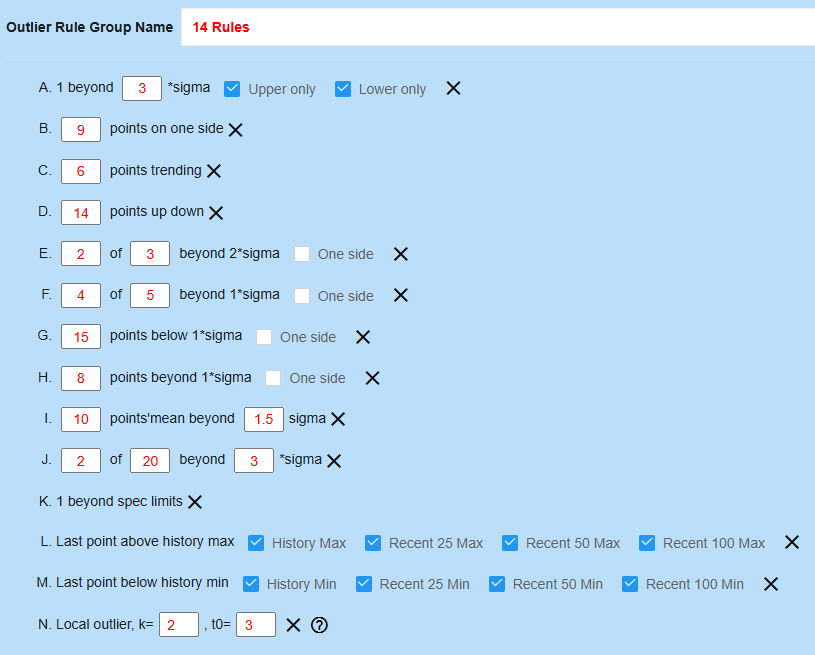
Instead of limiting manufacturers to a fixed set of statistical rules, NexSPC provides a flexible abnormality detection framework that combines traditional SPC methods with modern analytical capabilities.
Manufacturers can configure monitoring strategies using features such as:
- 14 configurable SPC abnormality detection rules
- Dynamic Threshold Monitoring
- Sliding Window Maximum & Minimum Detection
- Hampel Filter Local Outlier Detection
- One-Sided and Two-Sided Monitoring
- Custom Rule Groups
- Real-Time Alarm Management
Rather than generating more notifications, NexSPC helps quality teams focus on the alarms that truly matter.
Conclusion
Traditional SPC rules remain one of the most valuable tools in statistical quality control.
However, modern manufacturing requires alarm strategies that are as flexible as the production processes they monitor.
By combining classical SPC rules with dynamic monitoring, local outlier detection, and configurable alarm strategies, manufacturers can significantly reduce false alarms while improving their ability to detect meaningful process changes.
Because the goal of SPC is not to generate more alarms.
It's to ensure every alarm deserves your attention.