













When manufacturers begin discussing digital transformation, the first suggestion is often:
"Let's implement a QMS."
There's nothing wrong with that.
A comprehensive Quality Management System (QMS) is essential for companies that want to standardize operations and scale their business.
However, reality is often more complicated.
A QMS is a large-scale management project involving document control, workflows, approvals, audits, corrective actions, supplier management, and much more.
From initial consulting to full deployment, implementation typically takes six months to a year—or even longer.
For manufacturers facing immediate customer audits, that's simply too slow.
As the saying goes:
A distant solution won't solve today's urgent problem.

What Are Automotive Customers Really Looking For?
If you're supplying automotive OEMs or Tier-1 manufacturers, you've probably experienced the increasing pressure of IATF 16949 requirements.
Customer audits today are more demanding than ever.
Auditors may arrive with very little notice.
But when they visit your factory, what do they really want to see?
Is it beautifully designed approval workflows inside your QMS?
Not really.
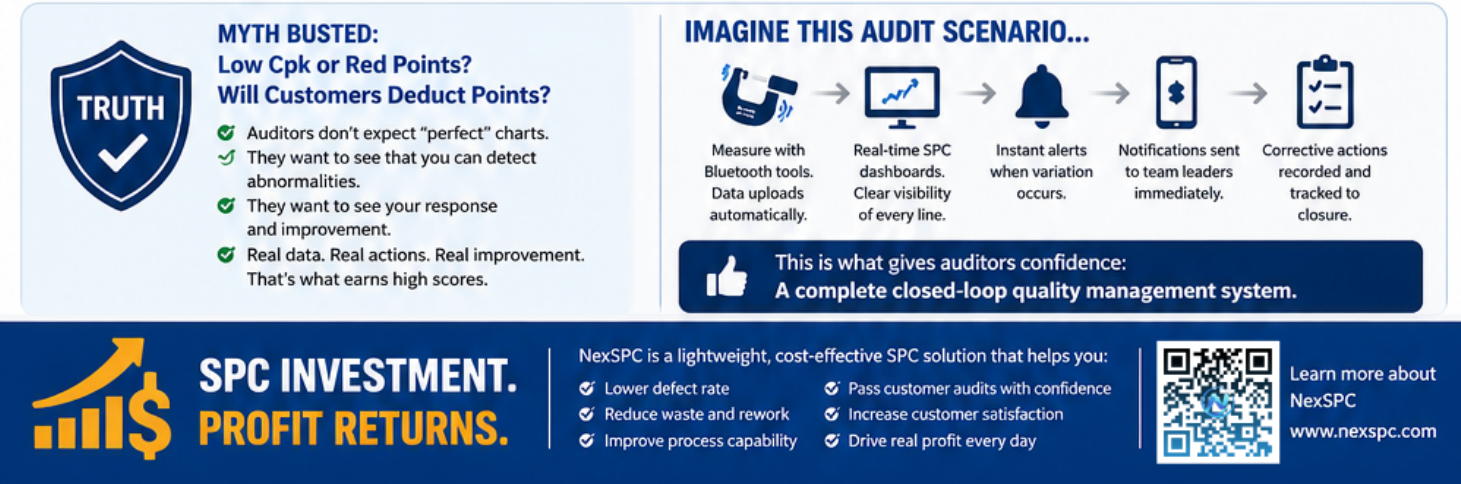
What they care about most is whether your manufacturing process is truly under control.
Questions such as:
- Are critical dimensions monitored in real time?
- Can you immediately generate a professional, production-based Cpk report?
- Is abnormal process variation detected before defective products are produced?
These are the questions that determine confidence in your manufacturing capability.
If you're still waiting for your QMS implementation to finish, you may spend months without an effective way to demonstrate real-time process control.
When a customer requests production data next month—not next year—you need answers immediately.
Why Is QMS Like an Accountant, While SPC Is Like Radar?
Let's look at a typical machining or stamping production line.
Every day:
- Cutting tools wear gradually.
- Dies slowly deteriorate.
- Raw material batches vary.
- Process conditions continuously change.
These are normal characteristics of manufacturing.
A traditional QMS primarily records what has already happened.
By the time an inspector discovers a defect, completes the nonconformance workflow, and notifies the production team, hundreds—or even thousands—of defective parts may already have been produced.
In some cases, valuable tooling may already have been damaged.
A professional Statistical Process Control (SPC) system works very differently.
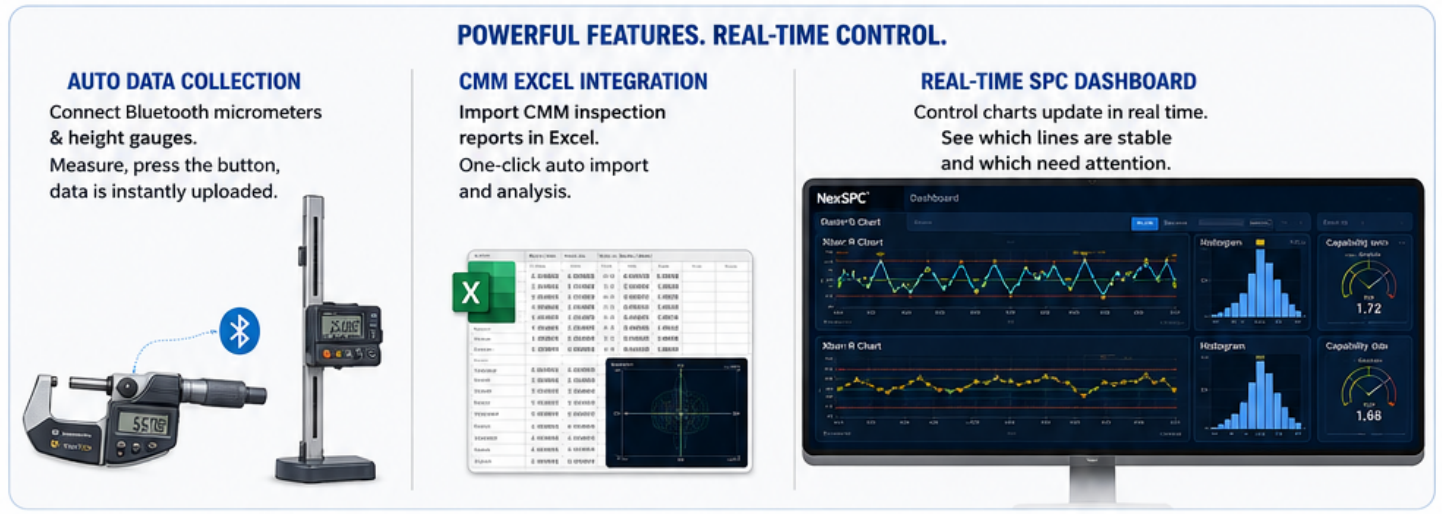
Instead of documenting quality problems after they occur, SPC continuously monitors the manufacturing process.
The moment a critical dimension begins drifting toward an abnormal condition, the control chart immediately detects the trend and triggers an alert.

Operators can adjust the machine, replace tooling, or correct the process before defective products are produced.
Rather than reacting to quality problems,
SPC helps prevent them.
Every defect avoided represents:
- Lower material waste
- Reduced rework costs
- Longer tooling life
- Higher production efficiency
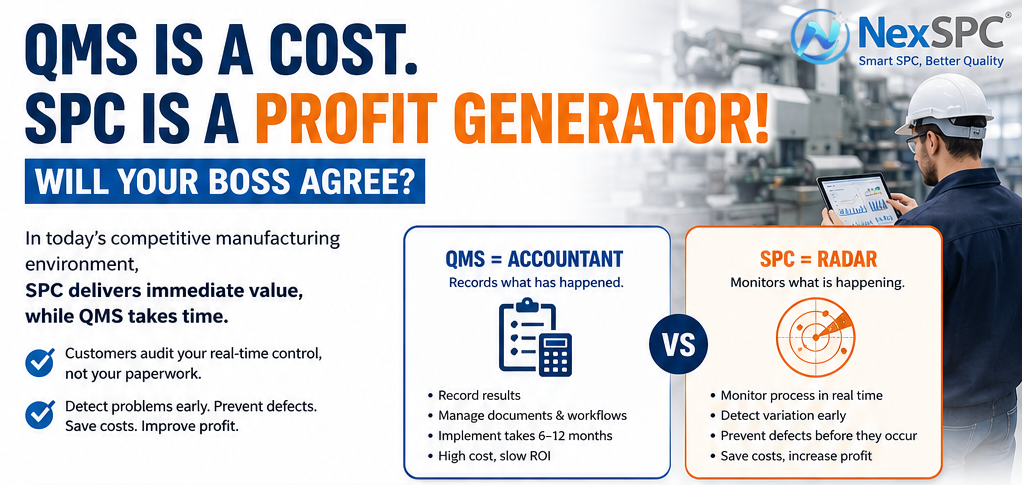
In other words,QMS records results.
SPC improves the process that creates those results.
That is why many manufacturers see QMS as an operational investment—
while SPC often delivers measurable financial returns through continuous process improvement.