













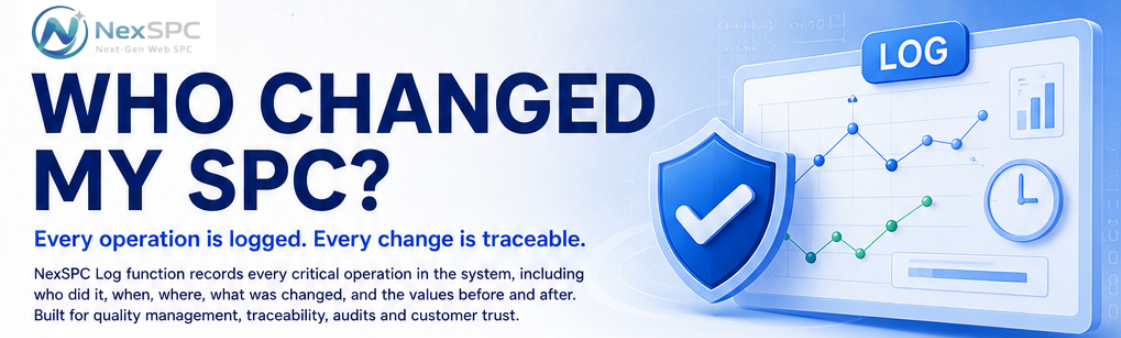
Why More and More Factories Are Paying Attention to Audit Trail Functions
When companies first implement an SPC system, they usually focus on:
- Whether control charts are updated in real time
- Whether out-of-control alarms are triggered promptly
- Whether data collection is automated
But after the system has been running for a while, another type of problem often appears on the shop floor.
One day, the quality manager notices something strange: A control chart that used to trigger frequent alarms has suddenly become “quiet.”
After taking a closer look: The control limits had been changed.
But then the real questions begin:
- Who changed them?
- When were they changed?
- Why were they changed?
- What were the original values?
- Was it an accidental operation?
Suddenly, the factory realizes:
The issue is no longer the chart itself — it is the lack of traceability.
At that moment, companies begin to understand: What truly determines whether an SPC system is trustworthy is not just the control chart itself, but whether the system has a complete audit trail capability.
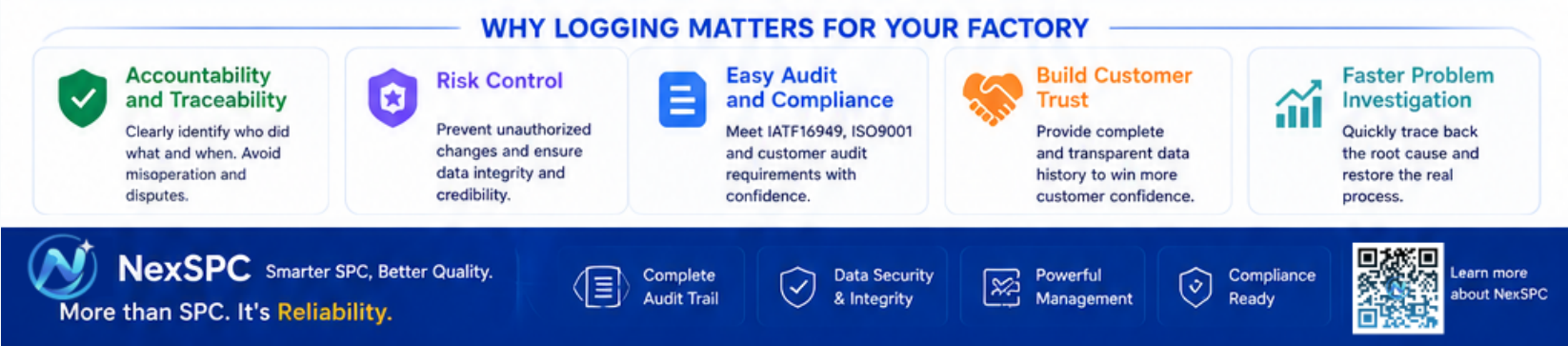
1. Why Are More Factories Paying Attention to “Logs”?
Modern factory management is no longer just about: “Do we have data?”
Instead, it has become: “Can the data be trusted?”
Especially in industries and scenarios involving:
- IATF 16949
- ISO 9001
- Medical devices
- Semiconductor manufacturing
- Automotive production
- Overseas customer audits
Customers increasingly care about one thing:
Has the data been manually modified?
2. A Real Scenario: Why Customers Care About “Who Changed the Data”
During a customer audit at an automotive parts factory, the auditor asked:
“Why didn’t this control chart trigger any alarms last month?”
The on-site team answered: “The process may have been relatively stable.”
But the customer continued: “Then why are the control limits different from before?”
At that moment, nobody could explain:
- Who modified the parameters
- Why they were changed
- What the original settings were
As a result:
→The customer immediately began to question the credibility of the SPC data.
Many companies assume:
→ “As long as the SPC system can generate charts, it is good enough.”
But mature quality systems care more about: What happened behind the data.
3. It’s Not Just Parameter Changes — Even Exception Handling Must Be Traceable
One issue many factories overlook is:
→ What happens after an SPC violation has been handled?
For example: A control chart originally displayed:
※ A red out-of-control point.
Later, an engineer performed:
- Root cause analysis
- Temporary corrective actions
- Exception handling registration
After the issue was processed: The red point turned into a green point.
This is actually a very important step in SPC management.
Because auditors and customers may ask:
- Who handled the issue?
- When was it handled?
- What actions were taken?
- Why did the abnormal point later “disappear”?
Without system logs:
× There is no proof the issue was truly closed
× There is no evidence the action was genuine
× It becomes impossible to determine whether the issue was intentionally hidden
In NexSPC, all of these operations are fully recorded.
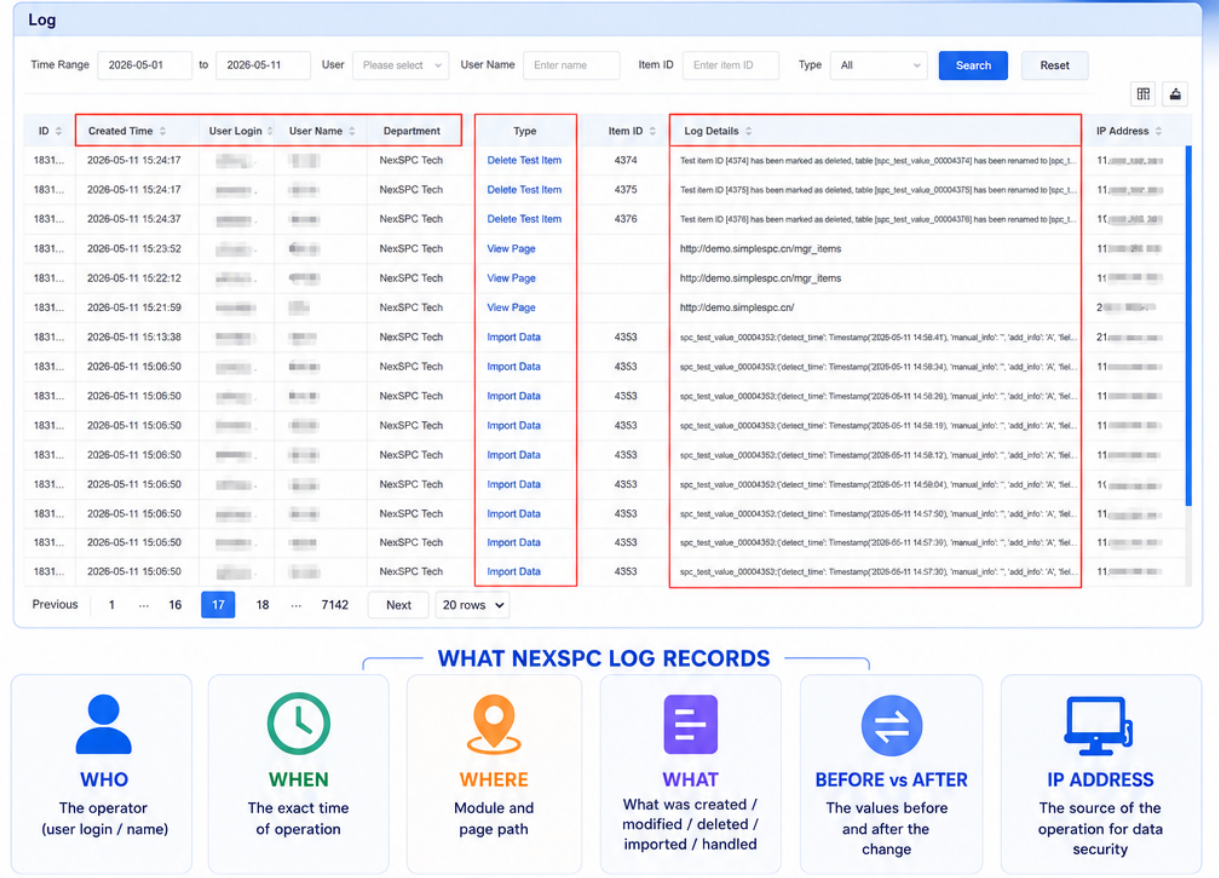
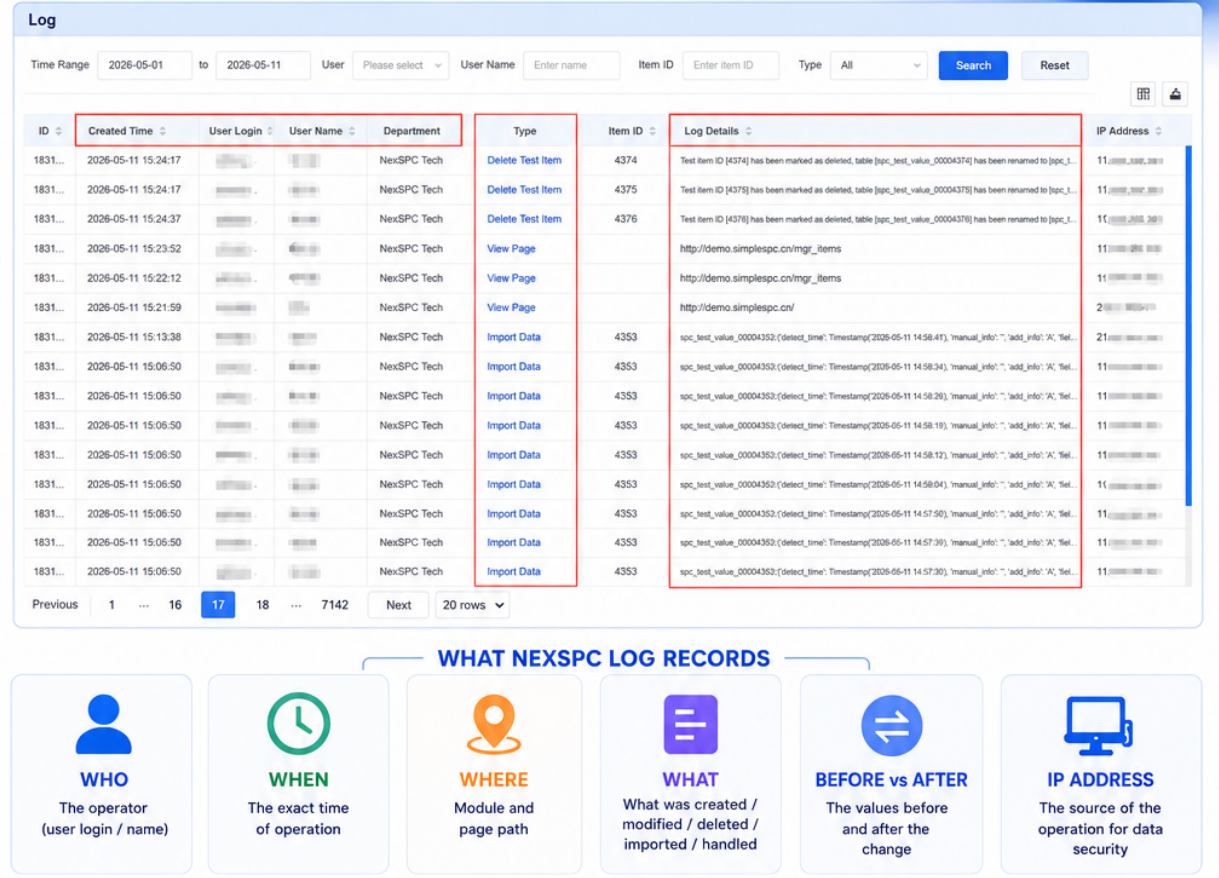
4. NexSPC Audit Trail Function: Recording Not Only Results, but the Entire Process
To achieve true quality traceability, NexSPC provides a complete: Audit Trail Function
The system automatically records:
√ Who Performed the Operation
Examples:
- Operators
- Process engineers
- Quality managers
√ Where the Operation Occurred
Including:
- Which module
- Which page
- Which functional path
√ What Was Changed
Examples:
- Control limit adjustments
- Out-of-control rule modifications
- Specification limit changes
- Deletion of inspection items
- Exception handling registration
√ What the Original Data Was
The system does not only record that something was changed.
It also records: What it was before the change.
Examples include:
- “Modified out-of-control rule group”
- “Modified monitoring configuration”
- “Modified inspection data”
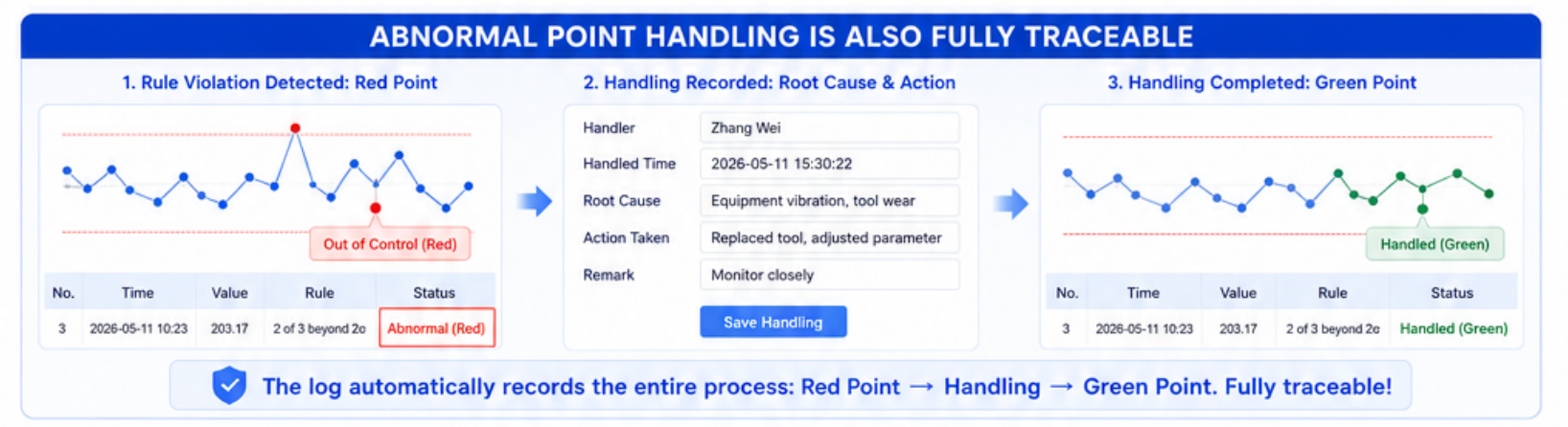
5. Why Is “Red Point to Green Point” Tracking So Important?
In many factories: The exception handling process itself is part of the audit focus.
Auditors do not only care about: Whether alarms occurred.
They care more about: Whether alarms were actually handled properly.
Therefore: “Red Point → Green Point”
is not just a color change on the interface.
It represents: A complete quality closed-loop process.
NexSPC logs fully preserve:
- Processing time
- Responsible personnel
- Handling records
- Status changes
This enables:
√ Traceable exceptions
√ Reviewable corrective actions
√ Verifiable quality closure
6. Why Is “Original Data Before Modification” So Important?
Many systems can only record: “Someone made a change.”
But what customers really care about is: What exactly was changed.
Especially during customer audits, it is not enough for a company to simply say:
→ “Yes, our system has logs.”
Customers want to see:
- Change history
- Parameter differences
- Modification records
- Historical comparisons
NexSPC directly supports: “Before vs After” comparison tracking
to achieve full-process traceability.
7. What Is the Biggest Value of Audit Trail Functions?
Many people think logs are only for “record keeping.”
But in reality, they solve much bigger management problems.
(1)Preventing Operational Mistakes
Common shop-floor problems include:
- Incorrect control limit settings
- Disabled alarm rules
- Incorrect specification changes
With logs, factories can quickly identify: Who made the change and why.
(2)Increasing Customer Trust
More and more customers now care about:
- Data authenticity
- Human intervention risks
- Audit capability
Complete logs mean: The company’s quality data is trustworthy.
(3)Supporting System Audits
In industries involving:
- IATF 16949
- ISO 9001
- Medical systems
- Semiconductor audits
Audit trail functionality is increasingly becoming: A standard requirement.
Because auditors care not only about results, but also: Whether the process is transparent.
(4)Achieving True Quality Traceability
Many times, the key issue is not: Whether a problem happened.
But rather: Whether it can still be traced afterward.
The greatest value of logs is: Making problems reconstructable.
8. NexSPC: From “Chart Visualization” to “Trusted Quality Management”
Traditional SPC systems often focus only on: Data display.
But NexSPC emphasizes:
- Data credibility
- Process transparency
- Operation traceability
The system supports:
√ Operation logs
√ Audit trails
√ Before-and-after comparisons
√ Page path tracking
√ Real-time operation recording
√ Exception handling status tracking
Helping enterprises truly achieve: “Every operation leaves a trace.”
Conclusion
In the era of industrial digitalization, an excellent SPC system should not only:
√Detect abnormalities.
It should also: Record what happened behind the abnormalities.
Because: Only trustworthy data has management value.
NexSPC’s complete audit trail capability helps enterprises:
- Pass audits more easily
- Gain greater customer trust
- Build a true quality closed-loop system
Ultimately enabling companies to move: From “data recording” to “trusted quality management.”