














Every quality professional is familiar with the five core quality tools: APQP, FMEA, MSA, SPC, and PPAP.
When a company decides to improve quality or prepare for a major customer audit, the typical reaction is often dramatic:
- Launch cross-functional meetings
- Redesign workflows
- Build management systems
- Create new procedures and documentation
Is that the right direction?
Absolutely.
But there's a problem:
It's slow, expensive, and extremely labor-intensive.
Meanwhile, the production manager is watching the scrap area fill up with defective parts, and customers are asking for immediate yield-improvement reports.
Telling them, "Give us six months to complete the process redesign and documentation rollout" does not solve today's manufacturing problems.
As we often say in production environments:
Long-term planning is important, but it cannot stop today's defects.
But there's a problem:
It's slow, expensive, and extremely labor-intensive.
Meanwhile, the production manager is watching the scrap area fill up with defective parts, and customers are asking for immediate yield-improvement reports.
Telling them, "Give us six months to complete the process redesign and documentation rollout" does not solve today's manufacturing problems.
As we often say in production environments:
Long-term planning is important, but it cannot stop today's defects.
Why APQP, FMEA, and PPAP Often Deliver Slow Results
Think about what we are actually doing when implementing APQP, FMEA, and PPAP.
The core activities are usually:
- Following procedures
- Writing documents
- Relying heavily on experience
FMEA: A Massive Experience-Driven Exercise
FMEA is valuable, but it is also one of the most mentally demanding quality activities.
Engineering, manufacturing, quality, and production teams spend hours in meeting rooms brainstorming every possible failure mode.
After dozens of meetings and thousands of rows of spreadsheets, everyone is exhausted.
And what happens next?
In many factories, the documents are archived for audit purposes while the shop floor continues operating exactly as before.
APQP and PPAP: Building an Evidence Package
APQP and PPAP require an enormous collection of supporting evidence:
- Drawings
- Material certificates
- Control plans
- Test reports
- Process records
- Validation documents
These activities have a strong administrative and procedural nature.
They depend on extensive cross-department coordination and often generate significant communication overhead.
By the end of the process, the quality department has produced a thick stack of documents—but not necessarily a faster reduction in scrap.
That is why many manufacturers eventually feel that large-scale quality-system implementation turns into a document-production campaign designed mainly for audits.
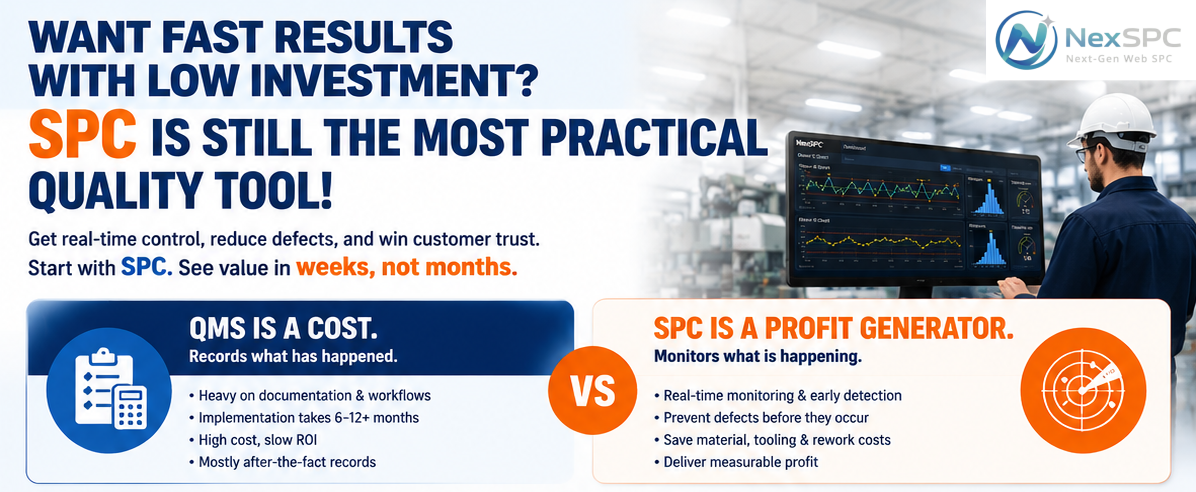
Why SPC Is the Fastest Tool to Show Real Results
SPC is fundamentally different.
It does not rely on subjective opinions or endless meetings.
It relies on three things:
- Data
- Mathematics
- Statistics
That is what makes SPC the closest thing to a special operations team among quality tools.
1. Replace Subjective Experience with Real-Time Data
When defects occur in a traditional environment, departments often argue about the cause:
- Production blames material
- Material blames process
- Process blames equipment
The discussion is driven by experience and assumptions.
Once SPC is deployed, the conversation changes completely.
Operators measure a part using a Bluetooth-connected gauge, and the actual dimension is uploaded instantly to the system.
The control chart immediately shows:
- Is the process drifting away from center?
- Is variation increasing?
- Is the trend becoming abnormal?
The data is visible to everyone.
No one needs to rely on stories or guesses.
2. Replace After-the-Fact Documentation with Statistical Prevention
A PPAP document cannot stop a machine from producing scrap right now.
An SPC system can.
The foundation of SPC is probability theory, including normal distribution analysis and the detection of statistically unlikely events.
When a dimension begins to drift—even slightly—the statistical algorithm recognizes that the variation no longer matches normal process behavior.
Before defective parts are produced, the system triggers an alert and notifies the supervisor to adjust the machine.
SPC is not guessing the problem.
It is using mathematics to identify abnormal process behavior in real time.
3. You Don't Need to Transform the Entire Factory
This is one of the biggest advantages of SPC.
You do not need to redesign the entire company before getting results.
Simply identify:
- The machine generating the most scrap
- The process consuming the most money
- The critical dimension causing customer risk
Start with one point.
Deploy a modern SPC system on that production line and connect the measurement device.
- Today: System is installed
- Tomorrow: Control charts and Cpk calculations begin automatically
- The day after: Management sees scrap reduction and process capability data on a real-time dashboard
That speed is something most other quality tools simply cannot provide.

If You Want Budget Approval, Win a Quick Battle with SPC First
Many quality directors struggle to obtain budget and cross-department support for large quality-system projects.
Why?
Because management often sees only additional paperwork and administrative workload.
They do not yet see a financial return.
That is why I strongly recommend a different strategy:
Do not start with the hardest system project. Start with the fastest measurable win.
Deploy SPC on the core production line first.
With a lightweight platform such as NexSPC, companies can typically achieve:
- Week 1: Real-time statistical monitoring is visible to management
- Week 2: Scrap reduction begins to appear in production data
- Week 3: Automatically generated professional Cpk reports can be presented to major customers
Once the company experiences a real financial benefit from data-driven process control, support for broader initiatives—such as QMS deployment and APQP process optimization—becomes dramatically easier.

The Most Pragmatic Quality Strategy
Quality management should contain less formalistic documentation and more data-driven action.
APQP, FMEA, and PPAP are important long-term system tools.
But when manufacturers need:
- Fast implementation
- Low investment
- Immediate audit readiness
- Rapid scrap reduction
- Real-time process visibility
SPC is often the highest-return starting point.
That is exactly why modern manufacturers are increasingly adopting NexSPC as a lightweight, enterprise-grade SPC platform that combines:
- Automatic data collection
- Bluetooth gauge integration
- Real-time SPC dashboards
- Cpk capability analysis
- Intelligent abnormality alerts
- Closed-loop quality improvement
Instead of waiting months for a large system rollout, manufacturers can begin controlling critical processes within days and start reducing defects immediately.
In today's competitive manufacturing environment, SPC is not just another quality tool—it is the fastest path to measurable quality improvement and operational profit.
