














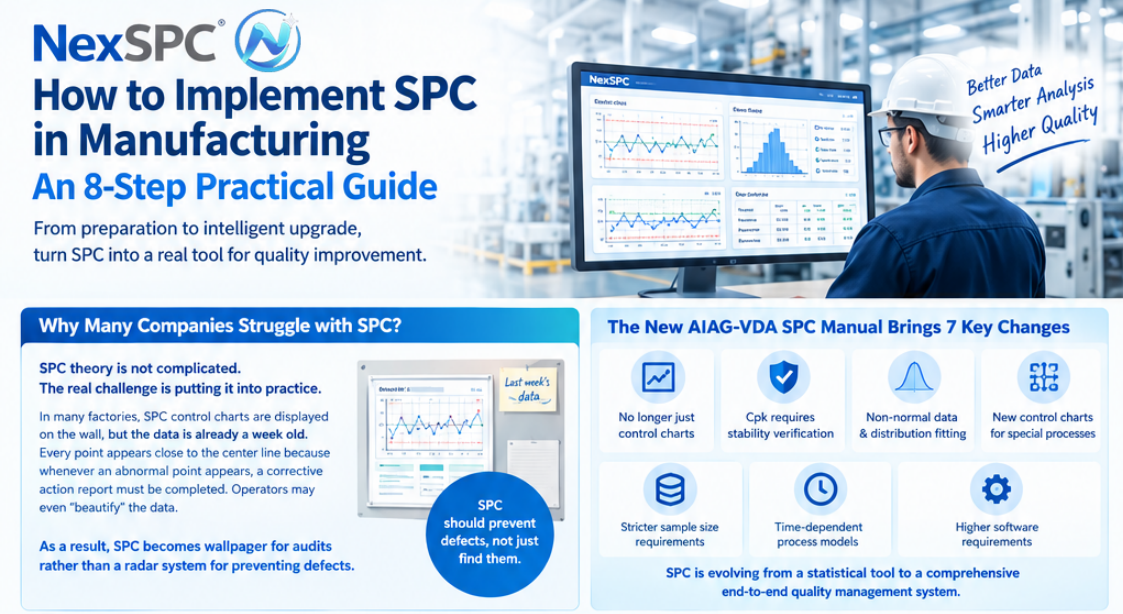
The theory behind Statistical Process Control (SPC) is not particularly complicated. The real challenge is putting it into practice.
In many factories, SPC control charts are displayed on the wall, but the data is already a week old. Every point appears close to the center line because whenever an abnormal point appears, a corrective action report must be completed. Operators may therefore be tempted to "beautify" the data.
As a result, SPC becomes wallpaper for audits rather than a radar system for preventing defects.
The following is a practical, step-by-step approach to implementing SPC, from the ground up.
1. Preparation Before Implementation: Don't Rush into Drawing Charts
Many companies start by purchasing software and creating control charts, only to discover that the system is not being used effectively.
The success of SPC implementation often depends on how much preparation is completed beforehand.
1.1 Review Your Management Foundations
SPC uses statistical methods to control processes. Before implementing it, companies should review whether their quality management systems are sufficiently established and whether employees consistently follow standardized procedures.
These are essential elements of the management environment in which SPC operates.
If basic process specifications and inspection standards are incomplete, SPC implementation will lack a solid foundation.
1.2 Secure Management Support
Successful SPC implementation requires strong management support and adequate resources.
It is not a project that the Quality Department can drive alone. Data acquisition equipment, employee training, and cross-functional coordination all require investment and organizational commitment.
Without support from senior management, progress can be extremely difficult.
1.3 Build Quality Awareness Across the Organization
Successful SPC depends not only on technology and tools but also on quality awareness and participation throughout the organization.
Training should cover more than the Quality Department. It should include production operators, engineers, and management personnel.
- Operators need to understand how to record data and read control charts.
- Engineers need to understand how to analyze results and improve processes.
- Management needs to understand how to use data to support decisions.
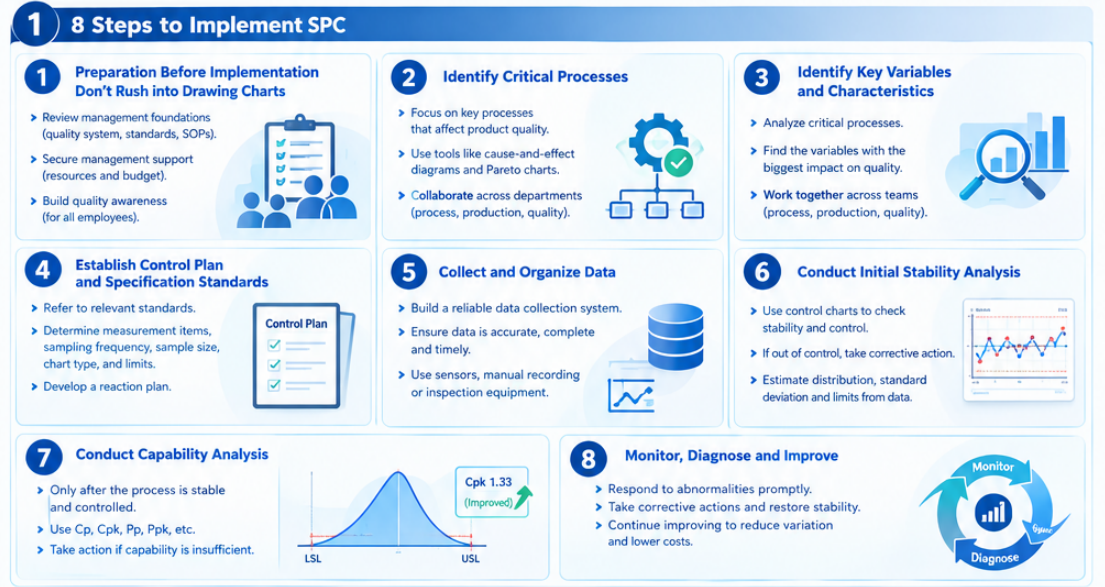
2. Eight Steps to Implement SPC
The following eight-step approach provides a practical framework for implementing SPC. Each step plays an important role.
Step 1: Identify Critical Processes
Product quality is formed through multiple manufacturing operations, some of which have a particularly significant impact on the final product. These are known as critical processes.
SPC control charts should be introduced to critical processes first, rather than indiscriminately applied to every operation.
One reason many implementations fail is that companies try to monitor everything. As a result, the most important processes may not receive sufficient attention, while resources are wasted on less critical activities.
Step 2: Identify Critical Process Variables and Characteristics
Analyze critical processes and use tools such as cause-and-effect diagrams and Pareto charts to identify the variables or characteristics that have the greatest impact on product quality.
This step often requires cross-functional collaboration. Process engineering, production, and quality teams should work together rather than leaving the entire task to the Quality Department.
Step 3: Establish the Process Control Plan and Specification Standards
This is often one of the most difficult and time-consuming steps. Relevant standards should be consulted, and experiments may be necessary when appropriate.
A complete SPC plan should include:
- Measurement characteristics
- Sampling frequency
- Sample size
- Control chart type
- Specification limits
- Reaction plan
Step 4: Collect and Organize Process Data
Data is the foundation of SPC.
Companies need a reliable data collection system to ensure that data is accurate, complete, and timely.
Data can be collected through automated sensors, manual recording, and quality inspection equipment.
One point deserves particular emphasis: data quality directly affects the success of SPC. Poor-quality data leads to poor-quality analysis.
Step 5: Conduct an Initial Assessment of Process Stability
Use control charts for process analysis to determine whether the process is stable and statistically controlled.
If the process is out of control or special causes of variation are identified, appropriate corrective actions should be taken.
At this stage, the process distribution, standard deviation, and control limits may still be unknown. They should be estimated from the collected data rather than determined through guesswork.
Step 6: Conduct Process Capability Analysis
Process capability analysis should be conducted only after the process has been shown to be stable and statistically controlled.
If the process capability is insufficient, improvement measures should be implemented.
Common process capability indices include Cp, Cpk, Pp, and Ppk.
For example, one automotive component manufacturer increased the Cpk of a critical process from 1.12 to 1.52 through SPC implementation, representing an improvement of approximately 36%.
Step 7: Establish Control Chart Monitoring
Only after the process is stable, statistically controlled, and sufficiently capable should control charts be used for ongoing process monitoring.
This marks the beginning of routine SPC operation. The preceding six steps establish the foundation for effective monitoring.
Step 8: Monitor, Diagnose, and Improve
When abnormalities are detected during monitoring, their causes should be investigated promptly and appropriate actions taken to restore normal process operation.
Even when a process is stable and under control, continuous improvement remains important. Reducing common-cause variation helps improve quality and lower costs.
SPC is not a one-time project. It is a continuous improvement cycle.
3. Embed SPC into Production Instead of Leaving It on the Wall
The eight steps above explain what to do. How SPC is integrated into daily production determines whether it becomes a living management tool or merely a chart displayed for audits.
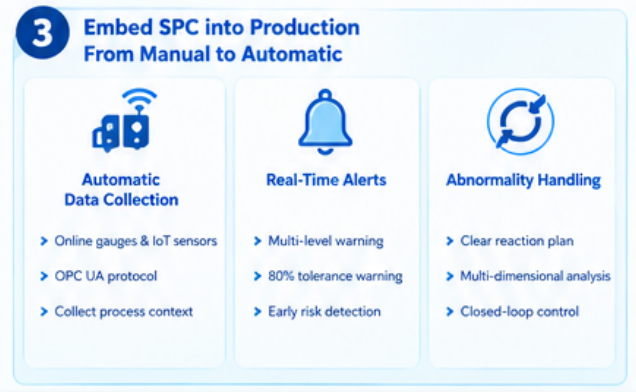
3.1 Data Collection: From Manual Entry to Automatic Acquisition
One of the biggest problems with traditional SPC is delayed data entry. By the time a control chart shows a point beyond the control limits, hundreds of defective parts may already have been produced.
The key is to embed SPC into the production process itself.
Practical approaches include:
- Automatically collecting data through online measuring instruments and IoT sensors.
- Extracting measurement data directly from equipment at individual workstations through the OPC UA protocol, without manual intervention.
- Collecting not only measurement values but also relevant process context, such as machine numbers, ambient temperature, and tool identification numbers.
One manufacturer connected 47 CNC machines to its shop-floor data collection system and achieved a 100% integration rate for measurement data from those machines.
3.2 Real-Time Alerts: Don't Wait Until Measurements Exceed Specifications
Traditional SPC management often focuses on out-of-specification measurements. However, by the time a specification limit is exceeded, the resulting losses may already have occurred.
A better approach is to introduce a multi-level warning mechanism.
- Yellow warning: A data point exceeds the 2σ control limit, prompting the process engineer to investigate.
- Orange warning: Seven consecutive points show a trend on one side, escalating the notification to the quality supervisor.
- Red warning: Three consecutive points exceed the 3σ control limit, triggering automatic equipment locking and notifying the production manager.
This proactive warning mechanism moves quality control earlier in the production process.
Some companies also introduce an 80% tolerance utilization warning. Instead of waiting until a specification limit is reached, the system issues a warning when tolerance utilization reaches 80%.
3.3 Abnormality Handling: A Reaction Plan Is Essential for Closing the Loop
When a control chart signals an abnormal condition, the company needs a clear reaction plan defining when action is required, who is responsible, and what measures must be taken.
SPC without a reaction plan is like installing a smoke detector without having a fire extinguisher. The alarm may sound, but nothing is done to resolve the problem.
A reaction plan should include:
- How the problem is identified
- Required response times
- Specific corrective action steps
- Assignment of responsibilities
Once a warning is triggered, relevant data should be brought together for analysis, including equipment status, material batches, environmental conditions, and process parameters.
One manufacturer reduced its quality problem traceability time from four hours to five minutes by using a system that automatically retained the complete measurement data trail.
4. Common Implementation Pitfalls and How to Avoid Them
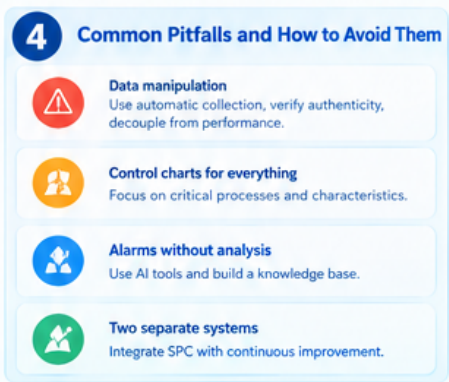
Pitfall 1: Data Manipulation
To save time or satisfy audit requirements, operators may alter or "beautify" data.
How to avoid it:
- Implement automatic data collection to reduce manual intervention.
- Establish mechanisms for verifying data authenticity.
- Decouple SPC data from performance evaluations, or at least avoid linking them too simplistically.
Pitfall 2: Creating Control Charts for Everything
Companies may spend excessive time and resources monitoring processes that do not require SPC.
How to avoid it:
Follow Step 1 strictly: identify critical processes first, and implement SPC for critical processes and characteristics.
Pitfall 3: Generating Alarms Without Understanding the Cause
The system tells the team that something has gone wrong, but nobody knows why.
How to avoid it:
Introduce AI-assisted SPC tools that can provide root-cause analysis suggestions in addition to issuing alarms. Establish an internal quality knowledge base to retain solutions to historical problems.
Pitfall 4: Separating SPC from Quality Improvement
SPC data is collected but then left unused, with little impact on actual improvement activities.
How to avoid it:
Integrate SPC data into the continuous improvement process. Abnormalities identified by control charts should enter the corrective action workflow, while process capability analysis should drive process optimization.
5. From Basic Implementation to Intelligent SPC
Once the basic SPC process is running effectively, companies can consider upgrading to more intelligent capabilities.
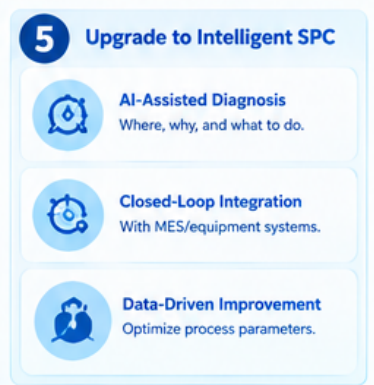
AI-Assisted Diagnosis
AI-powered SPC goes beyond simply telling the Quality Department that something has gone wrong. It aims to help explain where the problem occurred, why it may have occurred, and what actions could be taken.
When an abnormal point is detected, the system can use its built-in expert knowledge base and AI reasoning models to suggest the most likely causes.
An investigation that previously required two weeks of manual troubleshooting may be shortened to near-immediate problem localization.
Closed-Loop Integration with Other Systems
By integrating with an enterprise MES or equipment control system, SPC can automatically issue warnings when abnormal trends are detected. In some applications, it can even adjust equipment parameters directly, enabling closed-loop quality control.
Data-Driven Process Improvement
Analysis of accumulated quality data can reveal deeper relationships between process parameters and product quality characteristics.
These insights can then be used to optimize process parameters.
For example, one manufacturer improved its machining parameters based on SPC data analysis and increased Cpk to 1.67.
Conclusion
Implementing SPC is not simply a matter of purchasing software and drawing a few control charts.
It is a systematic process that begins with identifying critical processes and extends through automatic data collection, real-time monitoring and warnings, closed-loop abnormality handling, and continuous improvement.
Successful SPC is not something that is simply created and completed. It is something that grows within the organization.
It becomes part of daily production management, influencing every operator's actions and every engineer's decisions.
For companies still wondering whether they should implement SPC, the question is no longer whether to do it, but how to do it well.
The core value of SPC lies in shifting quality management away from inspection after production and toward control during the process.
For modern manufacturing, this is no longer a choice between alternatives. It is a fundamental requirement for long-term competitiveness.
NexSPC — Make SPC Part of Your Daily Production Process
NexSPC helps manufacturers integrate statistical process control into daily operations through process monitoring, capability analysis, data integration, and intelligent analysis—supporting a more proactive and data-driven approach to quality management.
