














“A few days ago, an OEM came to audit our factory. The auditor looked at the Cpk values in our report, put the data down on the table, and asked:
‘This dataset is clearly skewed. Why are you still using the conventional formula to calculate Cpk? What is your justification for choosing this model?’
The engineer was at a loss for words and could only awkwardly explain that the formula had been generated by Excel's default settings. The auditor immediately raised a nonconformity and required corrective action within a specified deadline.
To be honest, this kind of situation is all too common in today's factories. We are used to taking data and applying formulas directly, but often overlook a fundamental question:
What distribution does your process data actually follow?”
1. Stop Asking Your Engineers to Guess the Distribution Model
Many people may not yet realize that the 2026 edition of the SPC manual represents a fundamental shift in the approach to process analysis.
In the past, Cpk calculations often relied on experience or guesswork. If the data looked approximately normal, engineers would simply apply the conventional formula.
However, the updated manual and the international standard ISO 2514-2 specify eight distribution models for processes that change over time, including gradual trends, periodic oscillations, and skewed distributions.
Model selection is no longer just a matter of an engineer's intuition or experience. It has become a rigorous process of statistical algorithm evaluation.
If the data is clearly non-normal or exhibits time-series drift, applying a conventional normal-distribution formula may produce an impressive-looking Cpk value. However, the result may not be statistically justified and could raise serious concerns during an audit.
The challenge is that advanced mathematical methods—such as Johnson transformations, Pearson distribution fitting, and regression-coefficient-based classification—are not easy to implement manually.
Can we realistically expect frontline engineers to perform all these calculations in Excel?
In practice, some of these complex statistical procedures are simply too demanding to carry out manually and reliably.
2. Digital SPC Is No Longer a Luxury. It Is a Necessity.
In the past, many manufacturers believed:
“Our factory can already create control charts in Excel. Why should we spend money on an SPC system?”
But anyone who has tried to implement the updated requirements knows that Excel alone can make the process extremely difficult.
1. Compliance risks are too high.
When auditors ask about the calculation logic and distribution-fitting process, Excel-based workflows may struggle to provide a systematic, reproducible explanation of how the results were derived.
2. Efficiency is too low.
Engineers spend hours capturing screenshots, copying data, configuring formulas, and assembling reports. That leaves less time for what really matters: improving manufacturing processes on the production floor.
According to feedback from some early-adopting factories, implementing digital tools has reduced quality control costs by 45% and freed up 75% of engineers' time previously spent on administrative spreadsheet work.
The real value of quality digitalization is to transform engineers from spreadsheet operators into process improvement specialists.
3. How Should You Choose an SPC Software Solution?
Recently, many industry professionals have been asking:
With the requirements of the 2026 SPC update, is there a tool on the market that combines advanced compliance-related statistical algorithms with a straightforward user experience?
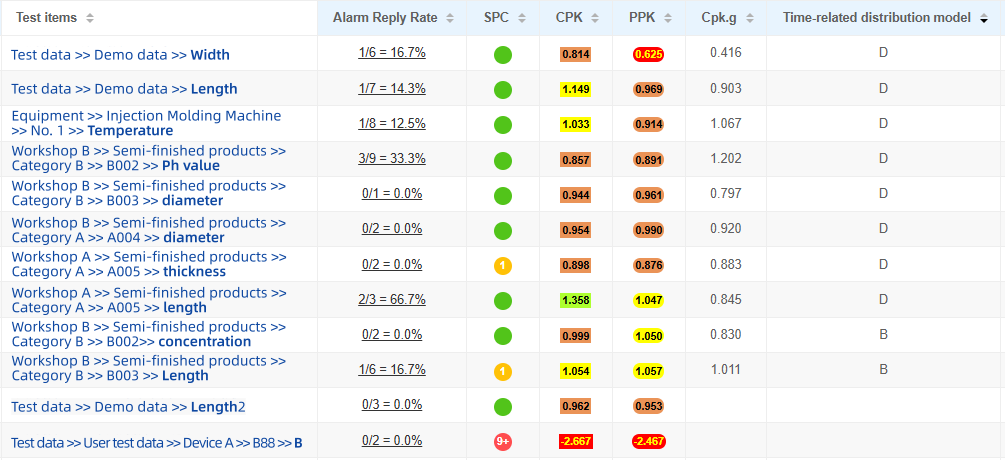
NexSPC has responded quickly. It now supports Cpk.g calculations and time-dependent distribution model classification designed to address the requirements discussed in the 2026 SPC update.
Here are three features that are particularly relevant to real-world manufacturing.

Advanced Algorithms: Automated Distribution Fitting and Model Selection
NexSPC incorporates a statistical algorithm engine designed around the relevant ISO 2514-2 requirements.
Once data is collected, the system automatically performs distribution fitting and evaluates competing models in the background to identify the most suitable time-dependent distribution model, then calculates Cpk.g.
The process is designed to deliver results within milliseconds, depending on the analysis involved.
Engineers no longer need to manually debate which model to choose or struggle to explain an ad hoc selection during an audit.
Statistical Analysis Meets AI: Generate Reports More Easily
Preparing quality analysis reports before weekly or monthly meetings is often one of the most time-consuming tasks for engineers.
NexSPC not only calculates control charts and capability indices, but also integrates large language model (LLM) capabilities, including support for locally deployed DeepSeek models.
After the statistical analysis is complete, AI can generate diagnostic text to help engineers interpret the results.
For example:
“An abnormal Ca offset index has been detected. Consider investigating cutting tool wear or the machine's zero-point setting.”
This kind of guidance can be particularly helpful for less-experienced engineers, giving them a starting point for further investigation.
AI-generated recommendations should still be verified against actual process conditions before corrective action is taken.
Practical Deployment and Pricing: Designed for Factory-Wide Use
Many industrial software products charge recurring annual fees based on the number of inspection points or users. Even adding a few workstations can require a new budget request.
NexSPC takes a different approach.
It uses a pure browser/server (B/S) architecture and supports private deployment on the factory's local network. Its licensing model is based on a one-time purchase, without limits on the number of users or inspection points.
Quality inspectors, engineers, and management can access the system through a web browser across the factory, making broader adoption easier to plan and budget for.
From Reactive Quality Control to Proactive Prevention
In the era of Industry 4.0, quality management is moving beyond reacting to problems after they occur toward preventing them before they happen.
As international standards and customer expectations become increasingly demanding, relying solely on Excel and manual calculations can create both efficiency bottlenecks and compliance risks.
A digital SPC system with built-in statistical algorithms and automated model selection offers a more practical path toward implementing SPC consistently and effectively.
If your factory is concerned about audit compliance or wants to understand how to upgrade its SPC practices in line with the 2026 requirements, NexSPC offers a demo account for you to explore the system.
When it comes to keeping up with evolving standards, choosing the right tool can save a great deal of time and unnecessary effort.